Artificial Intelligence Auditing: What It Costs in 2026
Artificial intelligence auditing means 2 things. Governance auditing certifies AI you already run and costs $15,000 to $90,000 over months. Opportunity auditing finds where AI should go and costs a fraction of that in days. Who provides each, what they charge in 2026, and how to pick.
On this page
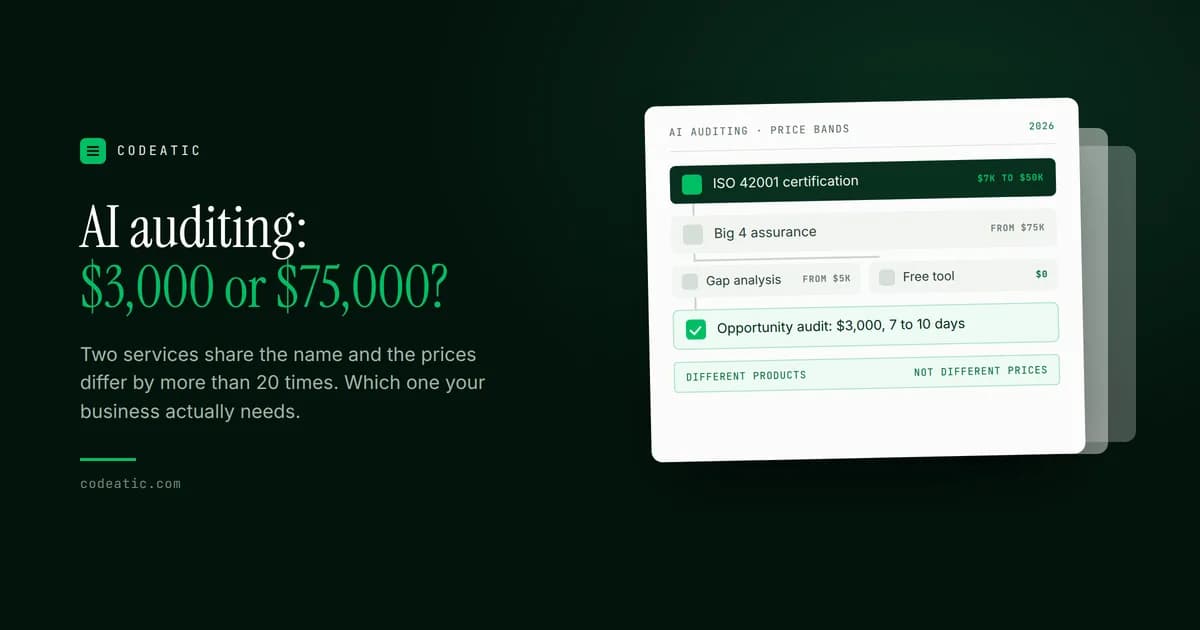
Artificial intelligence auditing covers 2 services that share a name and differ in price by more than 20 times: governance auditing, which certifies AI you already run and costs $15,000 to $90,000 over 4 to 12 months, and opportunity auditing, which finds where AI should go in your business and costs from nothing up to a few thousand dollars in days.
Which one you need comes down to a single question: do you already have AI making decisions in production? If not, the expensive one has nothing to examine. This guide covers who sells what, what each actually costs in 2026, and how to pick without overpaying for the wrong service.
What is artificial intelligence auditing?
In the compliance profession it means examining AI systems you already operate. IBM defines that work as a structured, evidence based examination of how AI systems are designed, trained and deployed, covering data quality, bias, security and compliance with frameworks like the EU AI Act.
In the operations world it means the opposite direction of travel: examining a business to find where AI and automation belong. Same 2 words, entirely different engagement, and the price difference is what catches people out. Our guide to an AI audit for business covers that distinction in detail.
Who provides artificial intelligence auditing and what does it cost?
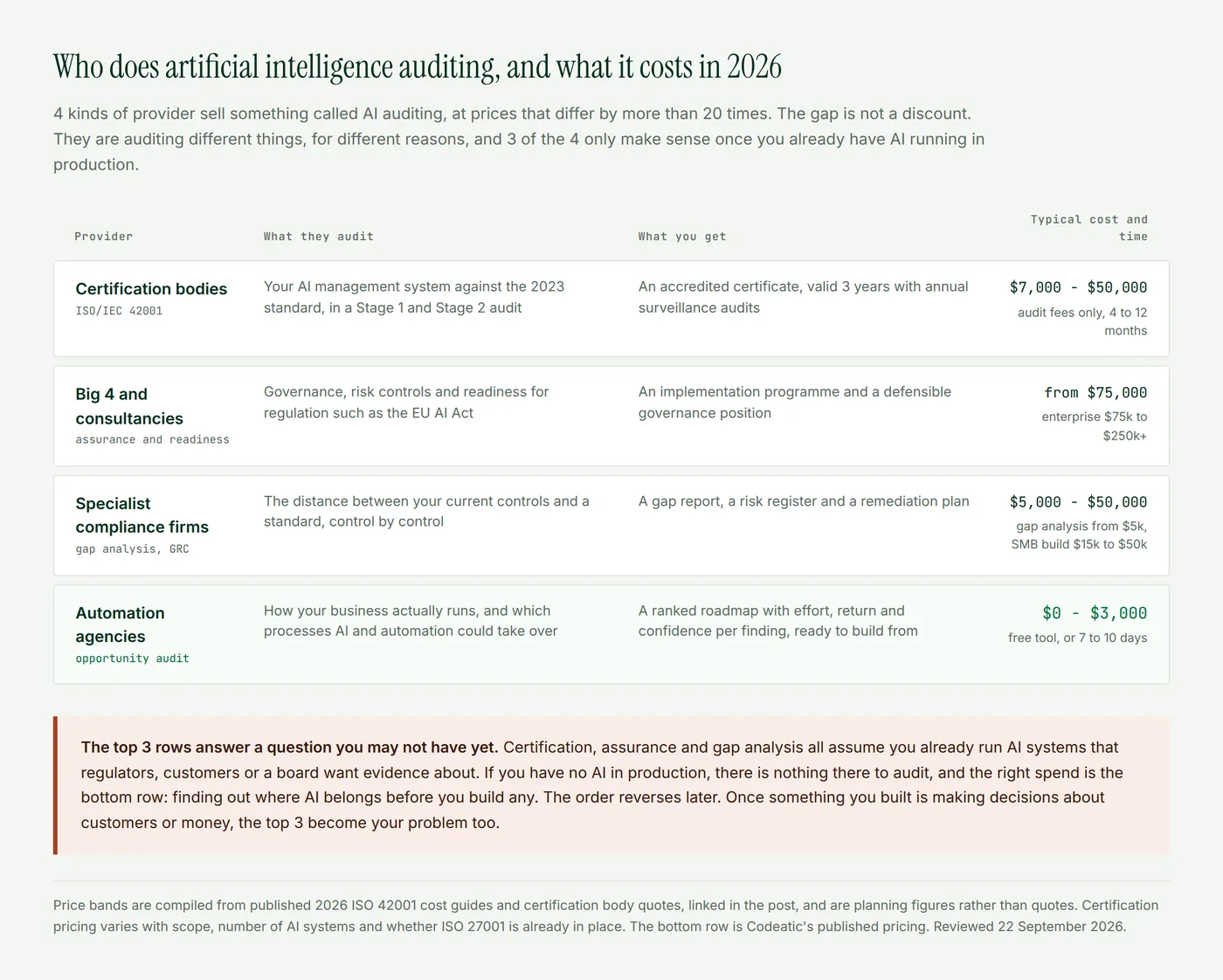
Those bands are real and they are worth unpacking, because the governance side is where budgets disappear.
Certification. ISO/IEC 42001, published in December 2023, is the first certifiable AI management system standard. Certification runs a Stage 1 and Stage 2 audit, lasts 3 years and carries annual surveillance audits. Schellman, the first ANAB accredited certification body for the standard, quotes $20,000 to $40,000 for year one, with BSI and DNV in a similar range. Other 2026 guides put the accredited audit fee alone at roughly $7,000 to $25,000 for a first cycle, with most organizations spending 2 to 3 times the audit fee again on implementation.
The all in number. Published guides put a small company at $15,000 to $40,000 and enterprises in the hundreds of thousands, with timelines of 4 to 12 months and annual surveillance audits of $3,500 to $9,000. Big 4 consultancies typically start at $75,000 for implementation work, with enterprise engagements quoted at $75,000 to $250,000 and above.
Why it is expensive. The standard is new, the pool of accredited bodies is small, and auditors charge by the day. One 2026 cost tool puts accredited bodies at $2,500 to $4,500 per audit day, and notes that ISO 42001 is expected to become a harmonized standard under EU AI Act Article 40, which would give certified organizations a presumption of conformity. That process is underway but not complete.
None of this is wasted money for a company that needs it. It is entirely wasted for a company that has no AI in production, which is most small and mid sized businesses reading this.
Which one does your business need?
3 questions settle it.
Do you have AI making decisions in production today? If no, you need an opportunity audit. There is nothing yet for a governance audit to examine.
Has a customer, investor or regulator asked for evidence of AI governance? If yes, you need certification or assurance, and the price bands above are your reality.
Are you trying to work out where AI could save money? That is an opportunity audit, and it should cost a fraction of the other kind because it takes days rather than months.
The order reverses over time. Buy the opportunity audit, build something, and once that something is deciding things about customers or money, the governance questions become yours too.
What a $3,000 opportunity audit produces
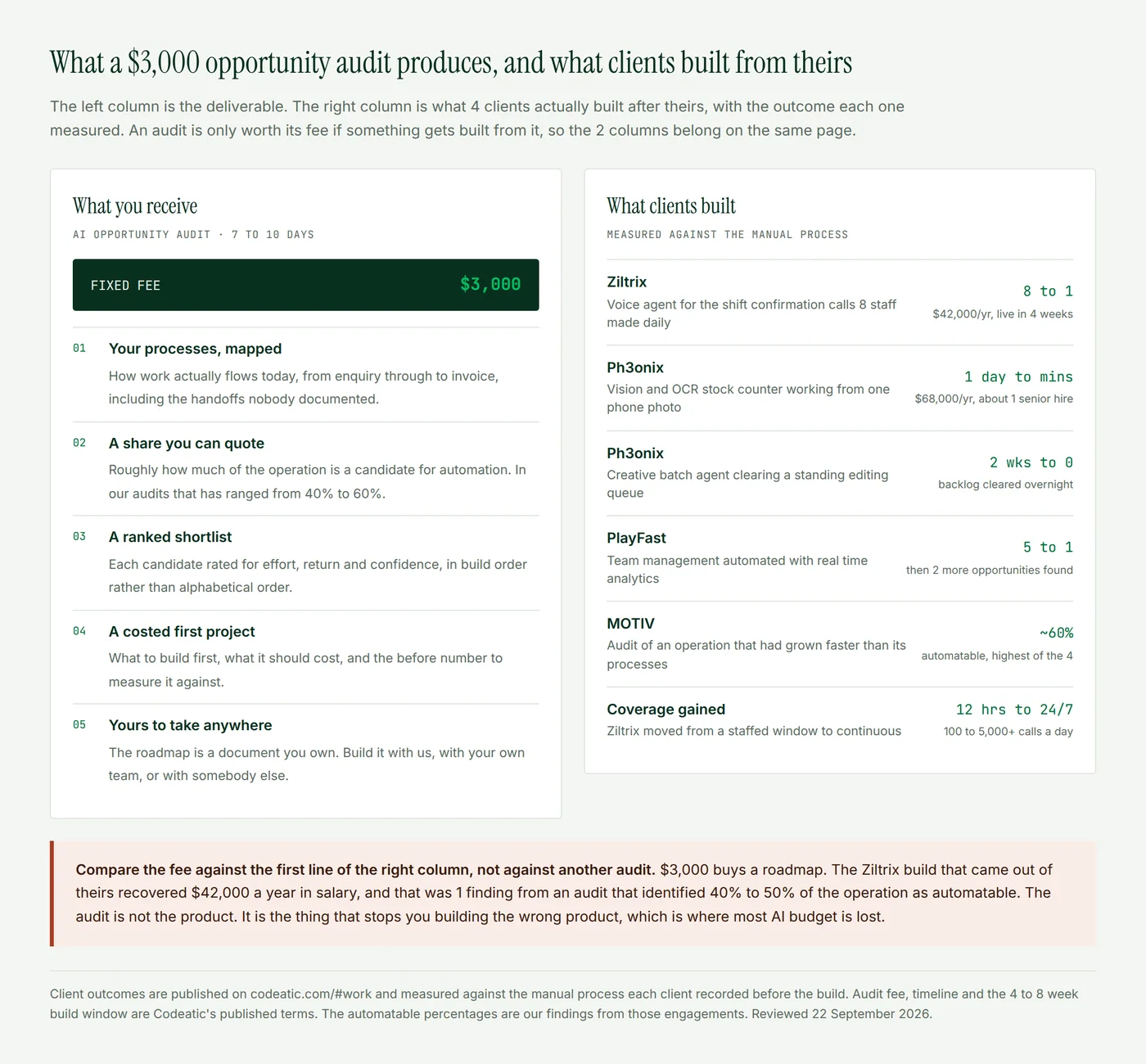
The comparison that matters is not our fee against another audit fee. It is the fee against what gets built. The Ziltrix build recovered $42,000 a year in salary, and it was 1 finding from an audit that identified 40% to 50% of that operation as automatable.
What clients built from theirs
Ziltrix, a platform for running security firms, had 8 staff ringing guards daily to confirm shifts. The audit found roughly 40% to 50% of the operation automatable, and the first build was a voice agent for those calls: 8 people to 1, coverage from 12 hours to 24/7, capacity from 100 calls a day to more than 5,000, $42,000 a year recovered, live in 4 weeks.
Ph3onix was spending a full working day every week counting shelf stock by hand. A vision and OCR counter now does it from one phone photo in minutes, worth about $68,000 a year, roughly a senior hire. A separate batch agent cleared a standing 2 week editing backlog overnight.
PlayFast had team management coordinated manually across 5 people, now automated with real time analytics and run by 1. MOTIV, whose operation had grown faster than its processes, came out of a paid audit with roughly 60% identified as automatable, the highest share of the 4.
From our work. The pattern across all 4 is that we never built the whole finding. Ziltrix came out of its audit with 40% to 50% of the operation marked automatable and we built 1 slice of it, the confirmation calls, because it was the highest volume task and the easiest to measure before and after.
That restraint is deliberate and it is also why we price the audit separately from the build. An agency that only charges for builds has an incentive to find big projects. Charging a fixed $3,000 for the roadmap, and handing it over as a document you can take to anyone, removes that incentive from the conversation entirely.
The full breakdown of all 4 engagements is in our AI audit examples, and the outcomes are published in our client work.
How to choose a provider
Ask which kind they do. If the answer covers certification, assurance, bias testing and opportunity mapping, ask which they have actually delivered this year.
Ask what the deliverable is. A score is not a deliverable. A ranked list with effort, return and confidence per finding is.
Ask whether they build. An auditor who never builds cannot price effort accurately. One who only builds has an interest in finding work. Ask how they handle that.
Ask what they could not determine. Any audit has limits. A provider who names theirs is more trustworthy than one who does not.
Ask who owns the output. The roadmap should be yours to take to any builder, including a competitor.
Check the fee is fixed. Day rate audits expand. A fixed fee means the scope was understood before it started.
What we do not do
We do not issue ISO 42001 certificates, provide independent assurance, or sign off bias and model risk testing. Those require accredited certification bodies and specialist assurance firms, and an agency that builds your automations cannot credibly audit them for compliance afterwards.
If a customer or regulator has asked you for evidence of AI governance, the providers in the top 3 rows of the first figure are who you want, and we would rather point you there than sell you the wrong thing. What we do is the operations side: finding where AI belongs, pricing it, and building it.
Where to start this week
Run the free AI audit. It takes your business name and location, reads everything public about how you operate, and returns scored findings with the evidence behind each one and an honest list of what it could not determine. It costs nothing and takes about 2 minutes, which makes it a cheap way to find out whether a paid audit is worth booking at all.
If the report raises questions, a free 30 minute discovery call works through them. Our piece on what a free AI audit can and cannot tell you explains how to read the output.
Where Codeatic fits in
We run opportunity audits for small and mid sized businesses and build what they recommend. The AI Opportunity Audit is a fixed $3,000 and takes 7 to 10 days. Builds run 4 to 8 weeks and you own 100% of the code, prompts and workflows. If you would rather send a brief than book a call, get in touch.
When to skip the audit entirely
When you already know exactly which task you want automated and why, in which case you need a build estimate. When your business is small enough that you can list every recurring task from memory in 10 minutes. And when your real question is governance, because an opportunity audit will not satisfy a regulator.
The short version
Artificial intelligence auditing means 2 services. Governance auditing certifies AI you already run: ISO 42001 certification audit fees of roughly $7,000 to $50,000, all in costs from $15,000 to well over $100,000, and 4 to 12 months. Opportunity auditing finds where AI should go: free to a few thousand dollars, in days. If you have no AI in production, the second one is the only one that can tell you anything, and the right first step is a free report that costs nothing to run.
How these figures were arrived at
Certification and consultancy price bands are compiled from published 2026 ISO 42001 cost guides and quoted certification body ranges, attributed inline with the source and date. They are planning figures rather than quotes, and certification pricing varies with scope, the number of AI systems involved and whether ISO 27001 is already in place. Codeatic pricing, timelines and ownership terms are as published on our site. Client outcomes are published on our case study page and measured against the manual process each client recorded before the build. The automatable percentages for Ziltrix and MOTIV are our findings from those engagements.
Reviewed 22 September 2026 by Usama Tariq, Co-Founder and CTO. If you find an error in this post, email info@codeatic.com and we will publish a correction on the page rather than editing it quietly.
Frequently asked questions
What is artificial intelligence auditing?
It covers 2 different services. Governance auditing examines AI systems you already run for bias, security and regulatory compliance. Opportunity auditing examines your business to find where AI and automation should go. The first costs tens of thousands and takes months, the second costs a fraction and takes days.
How much does an AI audit cost?
Governance auditing against ISO 42001 runs roughly $7,000 to $50,000 in certification audit fees, with all in costs commonly between $15,000 and $90,000 and enterprise engagements far higher. An opportunity audit costs nothing for an automated report and a few thousand dollars for a full one; ours is a fixed $3,000.
Do I need ISO 42001 certification?
Only if you run AI systems and a customer, investor or regulator wants third party evidence of how you govern them, or you are placing high risk AI on the EU market. If you have no AI in production, there is nothing for the certification to cover.
How long does artificial intelligence auditing take?
ISO 42001 certification typically takes 4 to 12 months, shorter if you already hold ISO 27001. An opportunity audit takes days: ours is 7 to 10, a discovery call is 30 minutes and the free automated report takes about 2 minutes.
Who performs AI audits?
Accredited certification bodies issue certificates. Big 4 firms and consultancies run assurance and readiness programmes. Specialist compliance firms do gap analysis and GRC work. Automation agencies run opportunity audits. They are 4 different businesses, not 4 prices for the same thing.
Can the company that builds my AI also audit it?
For opportunity audits, yes, and it helps, because a team that builds can price effort accurately. For governance and assurance, no. Independence is the point of an assurance audit, and a builder auditing their own work is not independent.
What should an AI audit deliver?
A ranked list of findings with effort, expected return and confidence attached, a costed first project, and an honest statement of what the audit could not determine. A maturity score on its own tells you where you stand but not what to do next.
What is the cheapest way to start?
An automated free audit that reads your public footprint and returns scored findings. It costs nothing, takes minutes, and tells you whether paying for a deeper audit is justified.
Abdul Wahab, Co-Founder and CEO, Codeatic
Abdul has spent 5 years building software, across web stacks and mobile in React Native, Flutter and native Android, before moving into product, architecture and AI work. He holds an MS in Computer Science from PUCIT and leads Codeatic, an AI automation agency working with SMBs and startups across the US, Canada, the UK and Saudi Arabia. Connect on LinkedIn.
Technically reviewed by Usama Tariq, Co-Founder and CTO, Codeatic. Usama is an AI and computer vision engineer who builds production systems from unstructured video, image and speech data. He built the REVOX engine at Veedback, developed LLM and computer vision systems at Coeus Solutions GmbH, and led AI model development at OMNO AI. He is an OpenCV OAK-D finalist and a contributor to Workhub, and holds a BS in Computer Science from COMSATS University Islamabad. Connect on LinkedIn.