AI Audit Examples: What 4 Real Audits Found
AI audit examples from 4 real engagements. What the audits found at Ziltrix, MOTIV, PlayFast and Ph3onix, why neither paid audit found everything automatable, what got built first in each case, and the 3 different routes those businesses took into the same process.
On this page
Across 4 real AI audits we ran, the paid audits found roughly 40% to 60% of each operation was automatable, and in every case the first thing built was a single high volume task rather than the whole finding. At Ziltrix that first task was shift confirmation calls, which went from 8 staff to 1. At Ph3onix it was a weekly stock count that took a full day and now takes minutes.
Most writing about AI audits describes the process in the abstract. These are AI audit examples from our own engagements with Ziltrix, MOTIV, PlayFast and Ph3onix: what each audit looked at, what it found, what got built, and the 3 different routes those 4 businesses took into the same process.
What did 4 real AI audits find?
A note on terms first. The AI audits here are the business kind, which look for where AI and automation should go, not the governance kind that IBM describes as an examination of how AI systems are designed, trained and deployed. None of these businesses had AI in production to govern. They wanted to know where it belonged. Our guide to an AI audit for business covers the difference in full.
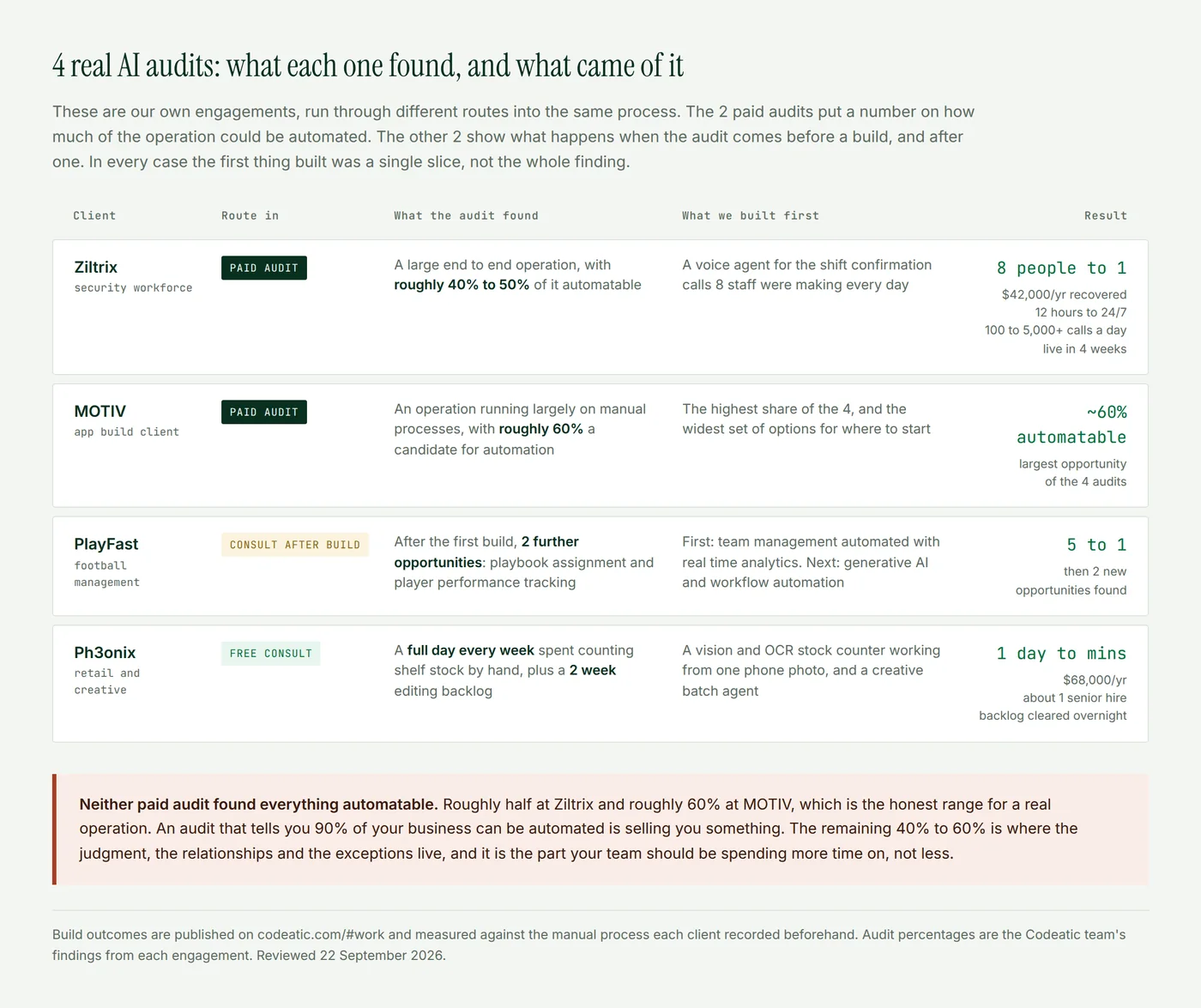
Two things stand out from the table before looking at any client individually. Neither paid audit found everything automatable, and no first build tried to capture the whole finding. Both are deliberate, and both are the difference between an audit that turns into working software and one that turns into a slide deck.
Ziltrix: one slice of a large operation
The problem. Ziltrix is building a platform to run security firms, and its operation is large and end to end: scheduling, staffing, confirmation, coverage. Part of that was 8 staff ringing guards every day to confirm shifts, calling back whenever nobody picked up.
What the audit found. Roughly 40% to 50% of the operation was a candidate for automation. That is a large number for a business of that scope, and it is also a list too long to build at once.
What we built first. Not the 40% to 50%. One slice of it: a voice agent that makes the confirmation calls, handles the back and forth, and hands anything unusual to a person. It was chosen because it was the highest volume, most repetitive task on the list, and the easiest to measure before and after.
The result. 8 staff on confirmation calls became 1, coverage moved from 12 hours to 24/7, daily capacity rose from 100 calls to more than 5,000, and $42,000 a year in salary went back to work that needed people. It was live in 4 weeks. Our guide to how voice agents work covers the technology behind it.
MOTIV: when most of the work is manual
The problem. MOTIV was already a client when we audited them. We had worked with them on their app, and their operation around it was running largely on manual processes, which is common for a young company that has put its energy into the product.
"They're fast, smart, and constantly thinking ahead."
MOTIV, describing working with Codeatic on their app, in a testimonial published on codeatic.com
What the audit found. Roughly 60% of the operation was a candidate for automation, the highest share of the 4 audits here.
What that number means. A high automatable share is an opportunity rather than a verdict. It usually signals a business that has grown faster than its processes, which is a good problem. What a paid audit adds at that point is order: a ranked roadmap of what to automate first, with effort and return attached, so the 60% becomes a sequence of builds rather than a single overwhelming project.
PlayFast: the audit after the build
The problem. PlayFast runs football team management, and before we worked together that management was coordinated manually across 5 people.
What we built first. An MVP that automated team management and added real time analytics, taking the coordination from 5 people to 1.
What the follow up found. PlayFast came back for a free consultation on what else they could do, and it surfaced 2 further opportunities: workflow automation for assigning playbooks to players, and generative AI for tracking how players are performing.
This is the route most businesses never plan for. Once one piece of the work runs by itself, the team starts noticing the next repetitive task on their own, and the second conversation is sharper than the first could have been.
Ph3onix: from a consultation to a vision system
The problem. At Ph3onix, a full working day every week went on walking the aisles with a clipboard to count shelf stock, and the numbers were already out of date by the following Monday. Separately, product image editing was queued into a standing 2 week backlog.
What the consultation found. Both problems were obvious and measurable from the first conversation, which meant a paid audit would have added cost without adding certainty. We went straight to building.
What we built. A vision and OCR stock counter: someone photographs the aisle and the counts land in the system by themselves. Then a creative batch agent that works through the editing queue automatically.
The result. The weekly stock take went from a full day to minutes, worth roughly $68,000 a year, about the cost of a senior hire, and it can now be done whenever it is useful rather than once a week. The editing backlog was cleared overnight and has not rebuilt.
What do the audits have in common?
3 patterns hold across all 4 of these AI audit examples, and they match what the wider evidence says about AI projects.
The automatable share is about half, never all. Roughly 40% to 50% at Ziltrix and roughly 60% at MOTIV. The rest is where judgment, relationships and exceptions live. An audit claiming almost everything can be automated is selling rather than auditing.
The first build is always one slice. This is the lesson the industry data keeps repeating. MIT's Project NANDA reported in July 2025 that 95% of enterprise generative AI pilots delivered no measurable impact on profit and loss, a figure worth reading alongside the published criticism of its methods. Gartner predicted in June 2025 that more than 40% of agentic AI projects will be canceled by the end of 2027, citing unclear business value among the causes. A narrow first build with a measurable before and after is the direct answer to both.
The best first target is high volume and repetitive. Shift confirmation calls, weekly stock counts, team coordination, an editing queue. Not the most impressive task on the list, the one that happens most often in the same way. That is also what makes the result provable.
None of this is a lack of appetite. McKinsey's State of AI found 72% of organizations had adopted AI in at least one business function by 2024. The hard part is choosing where, which is what these audits were for.
Which route into an audit fits your business?
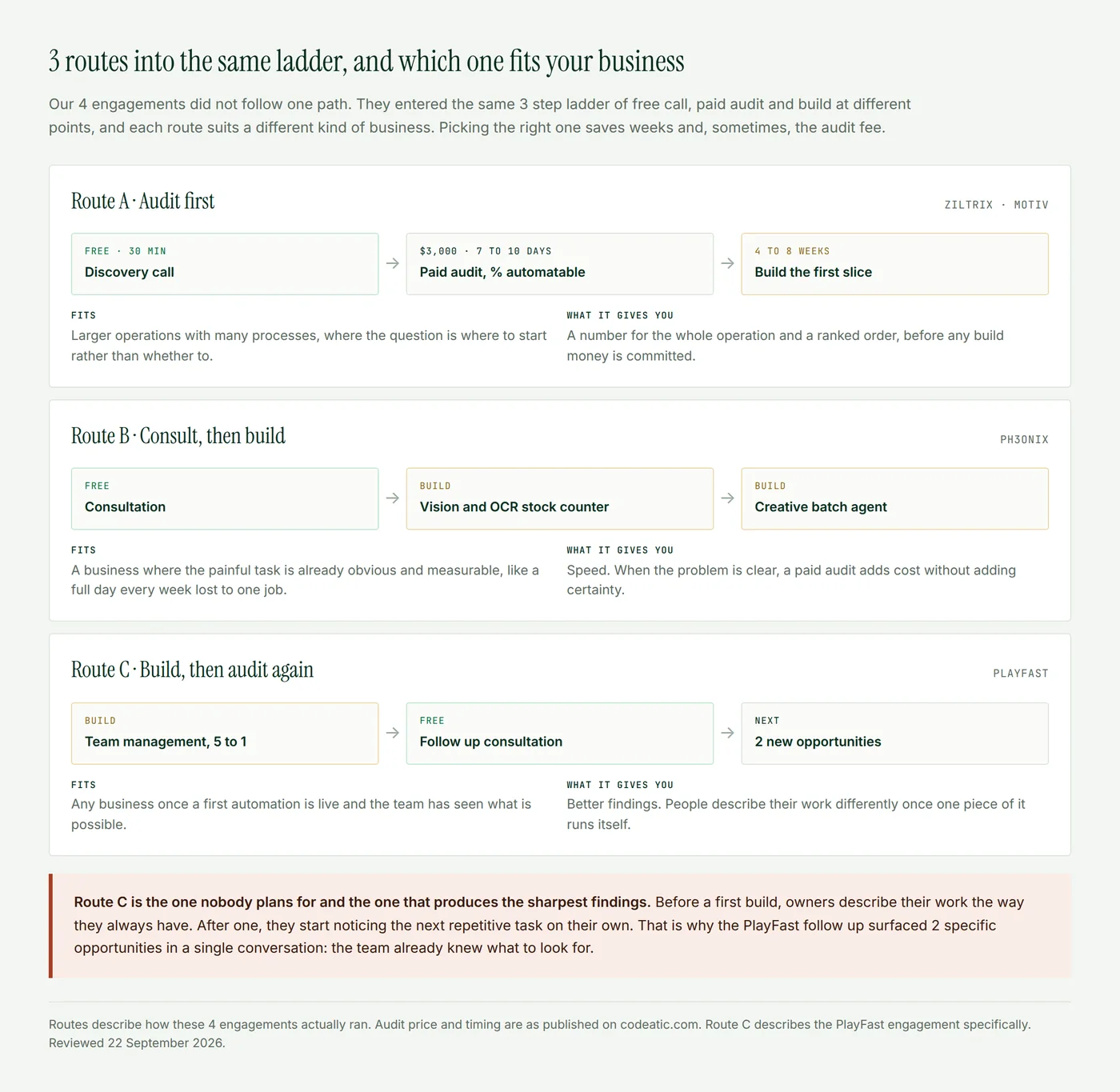
The route matters more than most businesses realize, and it is the part most AI audit examples leave out. A paid audit is the right first step for a large operation with many candidate processes. For a business where the painful task is already obvious, a consultation and a direct build is faster and cheaper. And for any business with one automation already live, a second look almost always finds more, because the team now knows what to look for.
What should you expect from yours?
Realistically, a finding that somewhere between a third and two thirds of your operation could be automated, depending on how much of your work follows the same steps each time. A ranked order rather than a list. And one clear first project with a before number you can measure against.
Be wary of an audit that produces only a score. Phos AI Labs' July 2026 comparison of readiness tools makes the same distinction: some produce a maturity score, some a benchmark, and the best produce a prioritized action plan. Every audit in this post ended with a specific first build, which is the only output that turns into anything.
For how that first build should be run once you have it, our guide on how to build an AI workflow automation that lasts covers the sequence, and workflow automation for service businesses covers where it tends to go.
Where Codeatic fits in
We run all 3 routes. The free AI audit gives you a scored first read of your business in minutes, and our piece on what a free AI audit can and cannot tell you explains how to read it. A free 30 minute discovery call works out which route suits you. The AI Opportunity Audit is a fixed $3,000, takes 7 to 10 days, and produces the ranked roadmap. Builds typically take 4 to 8 weeks and you own everything we build. The full stories behind these 4 clients are in our published work, and if you would rather send a brief than book a call, get in touch.
When an audit is the wrong starting point
When the problem is already obvious and measurable, as it was at Ph3onix: go straight to a consultation and a build. When the business is small enough that the owner can list every recurring task in 10 minutes. And when the question is whether AI you already run is safe and compliant, which is a governance audit and a different job entirely.
The short version
Across these 4 AI audit examples, the paid audits found roughly 40% to 60% of each operation automatable, and never all of it. Every first build took one high volume, repetitive slice: shift confirmation calls at Ziltrix, team management at PlayFast, a weekly stock count and an editing backlog at Ph3onix. The businesses entered through 3 different routes, and the right one depends on whether your problem is already obvious, whether your operation is large, and whether you already have something automated.
How these figures were arrived at
Build outcomes for Ziltrix, PlayFast and Ph3onix are published on our case study page and measured against the manual process each client recorded before the build. The automatable percentages for Ziltrix and MOTIV are the Codeatic team's findings from each paid audit. The MOTIV quotation is from a client testimonial published on codeatic.com and refers to our work together on their app. All 4 clients have agreed to be named. External statistics are attributed inline with the publishing organization and date, including the published criticism of the MIT figure.
Reviewed 22 September 2026 by Usama Tariq, Co-Founder and CTO. If you find an error in this post, email info@codeatic.com and we will publish a correction on the page rather than editing it quietly.
Frequently asked questions
What does an AI audit actually find?
In the audits described here, roughly 40% to 60% of an operation was a candidate for automation, ranked by priority, with one clear first project. The first project is typically the highest volume, most repetitive task, such as confirmation calls or a weekly count done by hand.
Can you give an example of an AI audit?
Ziltrix, a platform for running security firms, had a paid audit that found roughly 40% to 50% of its operation automatable. The first build was a voice agent for shift confirmation calls, which took the work from 8 staff to 1 and went live in 4 weeks.
How much of a business can AI automate?
Rarely all of it. In these audits the figure ranged from roughly 40% to 60%. The remainder is where judgment, relationships and exceptions live, and an audit claiming close to 100% should be treated with suspicion.
Do I need a paid audit or just a consultation?
A paid audit suits a larger operation with many candidate processes, where the question is where to start. If the painful task is already obvious and measurable, a free consultation and a direct build is faster, as it was at Ph3onix.
What should the first automation be after an AI audit?
The task that happens most often in the same way and is easiest to measure, not the most impressive one. That makes the result provable and builds the case for the next project.
Is it worth doing an audit after something is already automated?
Often more than before. At PlayFast, a consultation after the first build surfaced 2 new opportunities in a single conversation, because the team had already seen what automation could do and knew what to look for.
How long does an AI audit take?
Our paid AI Opportunity Audit takes 7 to 10 days at a fixed $3,000. A discovery call is 30 minutes, and the free automated audit takes a couple of minutes.
What happens after the audit?
You get a prioritized roadmap with effort and return for each finding. The usual next step is to build the first slice, run it beside the manual process, measure it, and use the result to decide what comes next.
Abdul Wahab, Co-Founder and CEO, Codeatic
Abdul has spent 5 years building software, across web stacks and mobile in React Native, Flutter and native Android, before moving into product, architecture and AI work. He holds an MS in Computer Science from PUCIT and leads Codeatic, an AI automation agency working with SMBs and startups across the US, Canada, the UK and Saudi Arabia. Connect on LinkedIn.
Technically reviewed by Usama Tariq, Co-Founder and CTO, Codeatic. Usama is an AI and computer vision engineer who builds production systems from unstructured video, image and speech data. He built the REVOX engine at Veedback, developed LLM and computer vision systems at Coeus Solutions GmbH, and led AI model development at OMNO AI. He is an OpenCV OAK-D finalist and a contributor to Workhub, and holds a BS in Computer Science from COMSATS University Islamabad. Connect on LinkedIn.