AI Receptionist Pricing: What $29 a Month Actually Buys
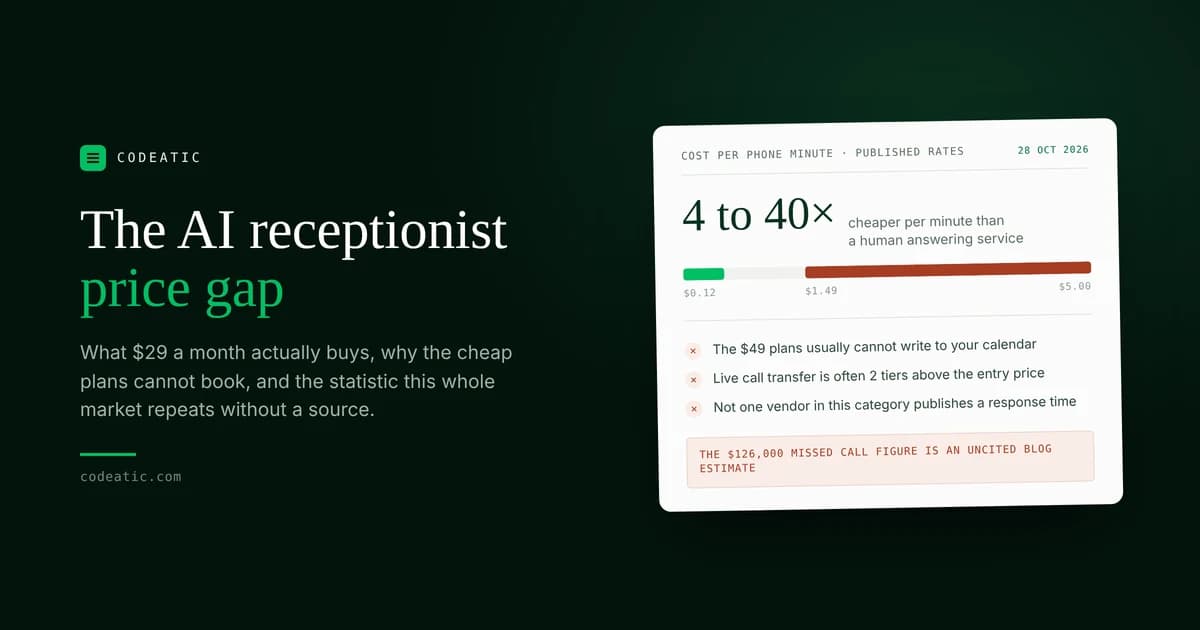
Every AI receptionist with a public price, in one table, read on the same day. The entry plans almost all stop short of booking the appointment, the industry's favorite missed-call statistic traces back to an uncited blog post, and not one company in this category will tell you how fast its agent answers the phone.
On this page
An AI receptionist answers your business phone, works out what the caller wants, and books it without a person involved. They work. The open question is which parts of that job the price you are quoted actually covers, and on that this market misleads buyers.
We priced every AI receptionist with published pricing, traced the industry's favorite statistic back to its source, and read what the research says about how fast a phone answer has to be. Three findings matter more than the rest. The cheapest plans cannot book an appointment. The $126,000 figure everyone repeats has no study behind it. And not one company in this category publishes how fast its agent answers.
Written by Abdul Wahab, Co-Founder and CEO of Codeatic, where we build AI receptionists for auto repair, HVAC and home services businesses in the US and Canada. Technical review by Usama Tariq, Co-Founder and CTO. Reviewed 28 October 2026.
On this page
What does an AI receptionist actually do?
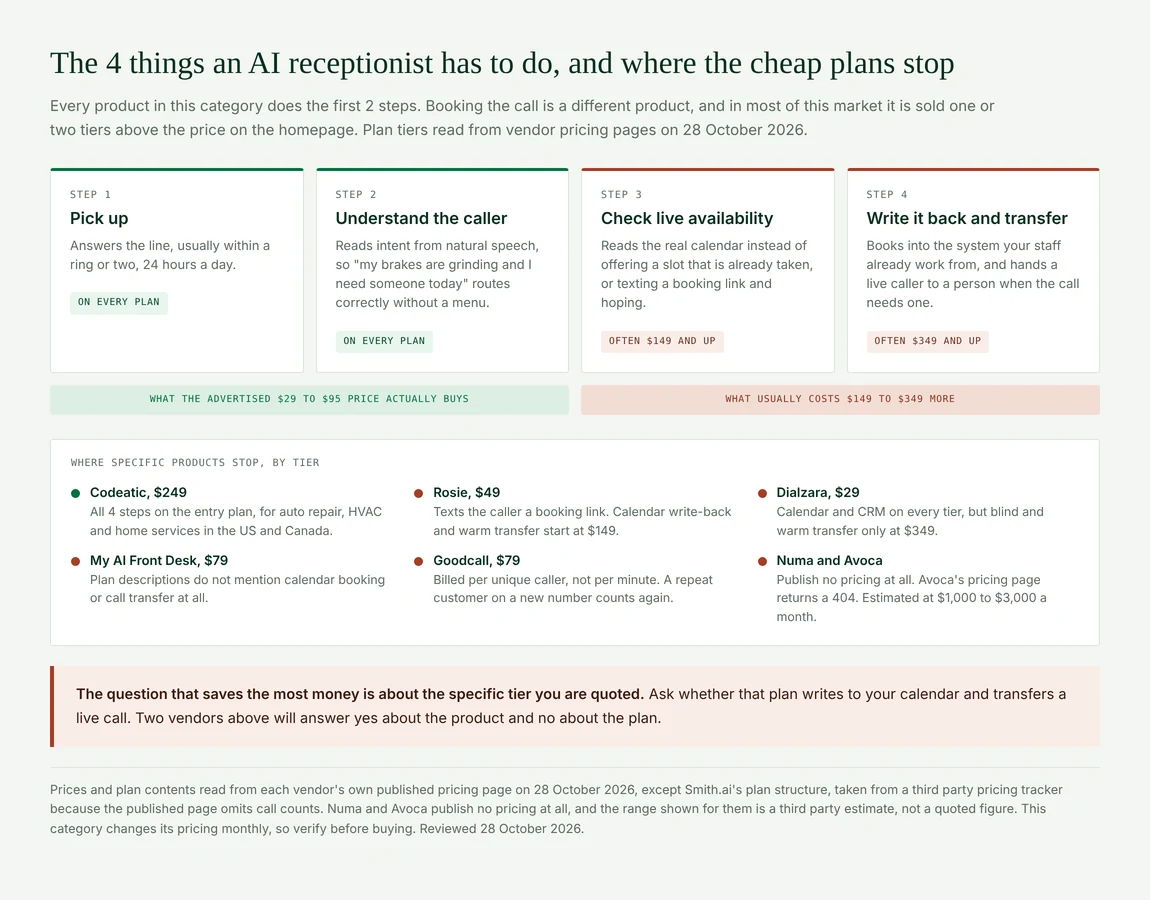
At minimum it answers the phone and takes a message. At the level most businesses want, it reads the caller's intent, checks your real availability, books the slot, and writes it where your team will see it. The gap between those two descriptions is most of the price difference in this market, and almost nobody states it plainly on a pricing page.
A complete one does 4 things. It picks up, usually within a ring or two. Then it has to understand a caller who does not use your menu vocabulary, so "my brakes are grinding and I need someone today" routes correctly. Availability gets checked against the live calendar, so the slot it offers is free, and the booking lands back in whatever system your staff already work from.
Products that stop after step 2 are answering services with better voices. That is a real product with a real market, though most owners think they are buying something more.
How much does an AI receptionist cost?
Between $29 and $599 a month in published pricing, with per minute overage from $0.12 to $0.50. Here is what the market charges, taken from vendor pricing pages on 28 October 2026.
| Product | Entry price | What you get | Overage |
|---|---|---|---|
| Dialzara | $29 | 60 minutes | $0.48 falling to $0.35 |
| Rosie | $49 | 250 minutes | Not published |
| RingCentral AI Receptionist | $49 | 100 minutes | $0.50 |
| My AI Front Desk | $79 | About 200 minutes | $0.12 |
| Goodcall | $79 | 100 unique callers | $0.50 per extra caller |
| Smith.ai | $95 | Plus usage | Not published |
| Slang.ai | $399 per location | No call count published | Not published |
Two products aimed squarely at service businesses, Numa and Avoca, publish no pricing at all. Avoca's own pricing page returns a 404. Competitor estimates put Avoca between $1,000 and $3,000 a month, which is 4 to 12 times the self serve products above.
Our own AI receptionist starts at $249 a month, which sits deliberately above the self serve tier and well below the sales led vertical products. The reason is the next section.
Why can the $49 plans not book an appointment?
Because calendar write-back and live call transfer are almost always sold one or two tiers up, and the entry plans do neither. This is the single most expensive assumption a buyer makes in this category.
Rosie's $49 plan sends the caller a booking link by text. It does not write to your calendar. Calendar booking and warm transfer start on the $149 plan. Dialzara includes calendar and CRM on every tier, but blind and warm transfer appear only on the $349 plan. My AI Front Desk does not mention calendar booking or transfer anywhere in its plan descriptions.
So the $49 you budgeted buys an agent that answers, understands, and then texts the caller a link and hopes. For a dentist that might be fine. For a plumber taking a call about a leak, the caller wanted a time, not a URL.
Pricing by minute or by caller matters too, and the two are not interchangeable. Goodcall bills by unique caller, not by minute, and a returning customer phoning from a different number counts again. If your callers are repeat customers, that model costs more than it looks.
Is an AI receptionist cheaper than hiring someone?
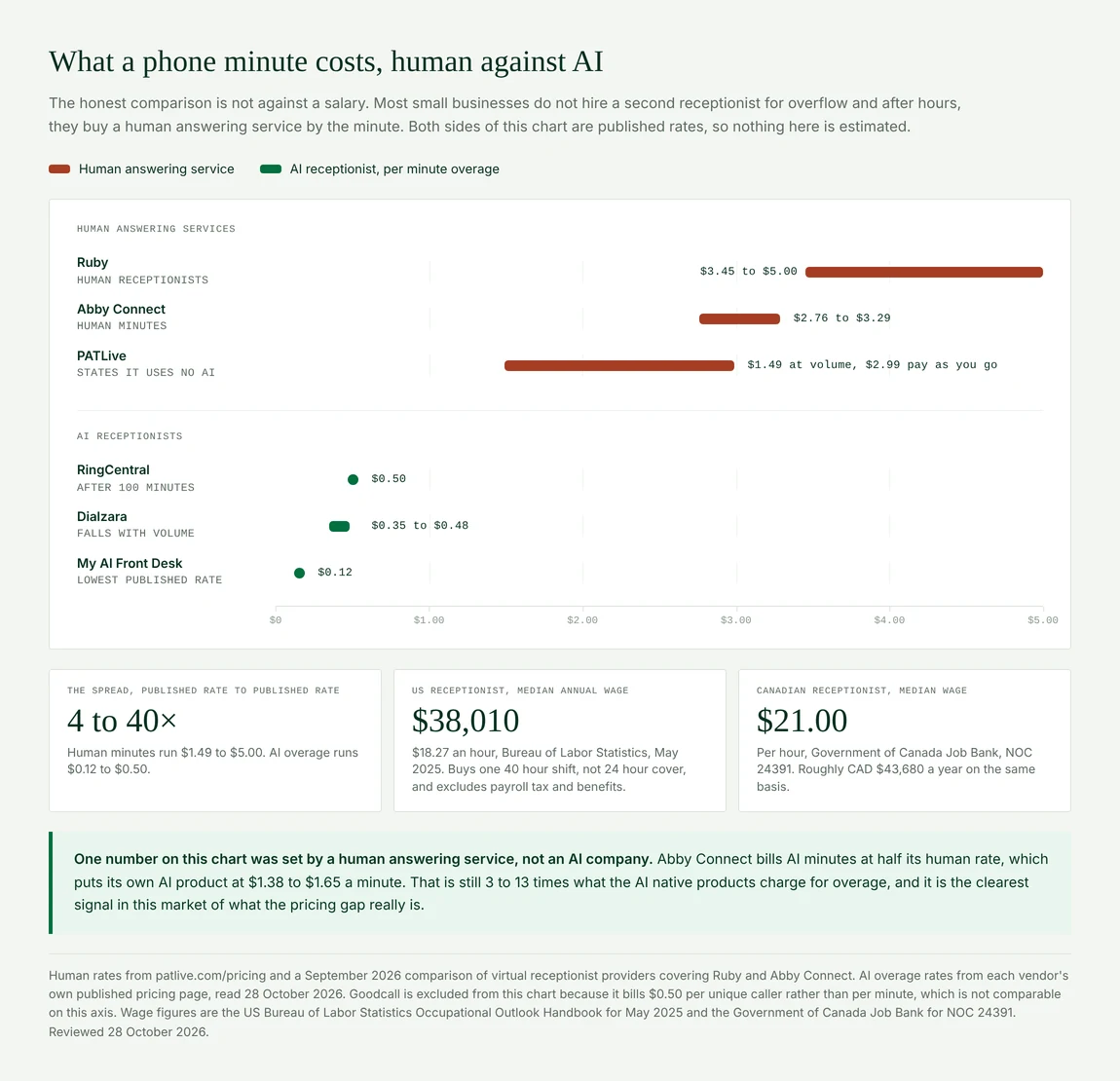
Yes, by a wide margin, and the honest comparison is not against a salary. It is against a human answering service, because that is what most small businesses actually use for overflow and after hours.
A full time receptionist in the US earns a median $38,010 a year, or $18.27 an hour, according to the Bureau of Labor Statistics for May 2025. In Canada the Job Bank median for the same role is $21.00 an hour, which is roughly CAD $43,680 a year. Neither figure includes payroll tax, benefits or cover, and both buy you one 40 hour shift rather than 24 hour coverage.
The sharper comparison is per minute. Human answering services run from $1.49 to $5.00 a minute. PATLive, which states plainly that it does not use AI, charges $2.99 a minute on its pay as you go plan and $1.49 at 5,000 minutes. Ruby runs $3.45 to $5.00. Abby Connect runs $2.76 to $3.29 for human minutes, and notably counts AI minutes as half.
AI receptionist overage runs $0.12 to $0.50 a minute. That is a 4 to 40 times spread, and it is the only cost claim in this whole market that rests entirely on published pricing with no estimating.
For the full comparison with a live answering service and an in-house receptionist, including after-hours coverage and the recording rules, see AI receptionist vs answering service vs hiring a receptionist.
How fast does an AI receptionist need to answer?
Nobody selling one will tell you, because not a single product in this category publishes a response time. We checked the pricing and product pages of every vendor above. None states a figure.
It is worse than an omission. An industry review site built a dedicated Voice Agent Latency Index listing 24 vendors, with a publication threshold of 10 scripted test calls each. As of its June 2026 version, all 24 show zero test calls and zero published values. Someone set up the scoreboard and nobody turned up.
What research does exist sits one layer down, at the developer platform level. An independent run of 2,078 measured conversational turns across 5 voice platforms, with the last call placed on 1 August 2026, found a median time to first audio byte, the gap between a caller finishing a sentence and hearing anything at all, of 1,296 to 1,740 milliseconds, with 95th percentiles from 1,768 to 2,259. Those were measured from the caller's side of a real phone call rather than from the platform's own logs. The same researchers found a platform's own reading comes out roughly 490 milliseconds lower than the identical call measured at the caller's ear.
Set that against what the conversation research says people actually tolerate. Across 10 languages, the modal gap between human speakers is about 200 milliseconds, with 51 to 55 percent of turns changing hands inside 200 milliseconds and 70 to 82 percent inside 500. Below 120 milliseconds a gap is not perceived at all. Past 300 milliseconds, acceptance of what was said measurably drops. At 600 milliseconds and beyond, listeners start drawing conclusions about reluctance, and by 700 they read the pause as bad news coming.
So a typical production voice agent, measured honestly from the caller's side, is answering at 3 to 8 times the gap a human would leave. That is the real state of the art, and the industry has chosen not to talk about it.
When you demo an AI receptionist, time it yourself. Call the number, ask a question, and count the silence before it starts talking. Then ask the vendor for their median and their 95th percentile, and whether those are measured from their logs or from the call.
What goes wrong on real calls?
Interruptions, complaints and emergencies, in that order. The marketing never covers this, so the most useful public account is a 90 day field test by a heating repair firm that documented what broke.
Over 61 answered calls it produced 43 bookings and 12 callbacks closed within a day. Six callers hung up once they realized they were talking to an AI, about 10 percent. The failures clustered in 3 places. Callers with a complaint got steered back toward scheduling, which made them angrier. Slow or hesitant speakers, specifically elderly callers, got cut off because the system read a pause as the end of their turn. And an urgent call was refused a slot because the agent read the calendar literally rather than understanding that a leaking boiler outranks a scheduled service.
That interruption problem is measurable and general. In one benchmark, a 680 millisecond mid sentence pause defeated every endpointing technology tested, with zero clean passes across more than 65 attempts. If your customers are elderly, or stressed, or working out the answer while they speak, this will happen to you.
The fix in that field test was a hard keyword interrupt. Words like leak, no heat and emergency triggered an immediate transfer to the on call engineer instead of a booking flow. In the same test, opening the call by stating plainly that this is an AI assistant reduced complaints and hang ups without reducing bookings.
One more risk is documented in the research but unmeasured in this market. Speech recognition accuracy varies by speaker, with one study of 5 commercial services finding word error rates roughly twice as high for Black speakers as for white speakers. That work tested systems from 2019 to 2024 rather than current phone agents, so treat it as a reason to test with your own callers rather than a verdict on anything sold today.
Where does the $126,000 in missed calls come from?
A blog post, with no study behind it. If you have been pitched an AI receptionist in the last year you have seen this number, usually as "small businesses lose $126,000 a year to missed calls."
We traced it. The figure originates in a call center company's blog as a stated estimate with no methodology, no sample and no underlying research. Every subsequent use cites a site that cites that post. The companion statistic, that 62 percent of business calls go unanswered, is not a measurement either: it is 100 minus a 37.8 percent answer rate observed across 85 businesses, presented as though it were surveyed directly.
Two numbers in that literature do survive checking. Harvard Business Review's 2011 study of online lead response found that contacting a lead within 5 minutes made meaningful contact roughly 100 times likelier than waiting 30, and qualification 21 times likelier. And Clio's legal industry research found law firms miss about 35 percent of their calls.
So missed calls genuinely cost you money. Nobody has credibly measured how much. If you want a real number for your business, multiply your own average ticket by the calls you actually miss, which you can pull from your phone records this afternoon. That number will be defensible and the $126,000 will not.
What should you ask before you buy?
Six questions, in order of how much money a wrong answer costs.
Does this plan write to my calendar, or send the caller a link? Ask about the specific tier you are quoting, not the product.
Can it transfer a live call, and on which plan? Warm transfer is frequently 2 tiers above the advertised entry price.
What is your median response time, and your 95th percentile? Then ask whether that is measured from their logs or from the caller's side of a real call. The difference is about half a second.
What happens when a caller pauses mid sentence? Ask them to demonstrate it rather than describe it.
What happens on a complaint or an emergency? There should be an escalation path that is not a booking flow.
Am I billed per minute or per caller? If per caller, ask how a repeat customer calling from a new number is counted.
Where Codeatic fits
We build AI receptionists for auto repair shops, HVAC businesses and home services companies across the US and Canada, starting at $249 a month. The agent answers, understands the job, checks real availability and books it, rather than texting a link.
From our work on these, the conversation is the easy half. The work is in everything around it. One example we can share without the plumbing: we had to disable a speed optimization that generates a filler reply while the system looks something up, because it was dropping the lookup and leaving the agent silent mid call. A faster agent that goes quiet when a caller asks about availability is worse than a slower one that answers.
That is the category of problem that separates a demo from a system a shop can leave running. We are also not quoting a response time here, because we are measuring it properly from the caller's side rather than our own logs. When we have the number and the method behind it, we will publish both.
If you want to see it rather than read about it, get in touch and we will run a call through it on your own scenarios. If you are earlier than that and want to know what is worth automating at all, the free automation audit takes about 2 minutes.
The short version
Published AI receptionist pricing runs $29 to $599 a month, with overage from $0.12 to $0.50 a minute.
The cheapest tiers usually cannot write to your calendar or transfer a live call. Those start at $149 to $349.
Human answering services cost $1.49 to $5.00 a minute, so the AI saving is real and large.
A US receptionist earns a median $38,010 and covers one shift. A Canadian one earns about CAD $43,680.
No vendor in this category publishes a response time. An industry index built to collect them has 24 vendors and zero measurements.
Measured from the caller's side, typical platforms answer in 1,296 to 1,740 milliseconds against a human gap of about 200.
The $126,000 missed call statistic is an uncited blog estimate. Use your own ticket value instead.
How these figures were arrived at
Every price was read from the vendor's own pricing page on 28 October 2026, except Smith.ai's plan structure, which was taken from a third party pricing tracker because the published page omits call counts, and Numa and Avoca, which publish no pricing and are reported here as third party estimates. Salary figures are the US Bureau of Labor Statistics Occupational Outlook Handbook for May 2025 and the Government of Canada Job Bank for NOC 24391. Human answering service rates are from PATLive and a September 2026 comparison of virtual receptionist providers.
Latency figures come from Openbenchmarks, 2,078 usable turns across 5 platforms with the final call placed 1 August 2026, measuring time to first audio byte from dual channel call recordings and using no platform timestamp anywhere. The turn taking thresholds are from Levinson and Torreira, Frontiers in Psychology, 2015, with the universality finding from Stivers et al., PNAS, 2009. The mid pause endpointing failure is from a 2026 benchmark by the agency Codebridge. Speech recognition disparity figures are from Koenecke et al., PNAS, 2020 and an AAAI 2024 paper on South Asian accented speech.
Three limits worth stating. No benchmark in this space is independent: every one is run by a platform, a vendor or an agency selling into the category, and that includes the ones we cite. The 90 day field test describes a single business in the UK, was published by someone selling AI implementation services, and does not name the product, so treat it as illustrative rather than representative. And the accent research tested systems from 2019 to 2024, not current phone agents.
Prices and products in this category move monthly. Everything here is dated to 28 October 2026. If you find an error, tell us and we will correct the post and note the correction.
Frequently asked questions
What is an AI receptionist?
Software that answers your business phone line, works out what the caller wants from natural speech rather than a menu, and acts on it. A complete one checks live availability and writes a booking into your calendar or job system. A basic one takes a message or texts the caller a booking link.
How much does an AI receptionist cost?
Published entry pricing runs from $29 to $399 a month, with per minute overage from $0.12 to $0.50. Our own starts at $249. Plans that actually write to your calendar and transfer live calls generally start between $149 and $349, so the cheapest advertised price is rarely the one that does the job you want.
Is an AI receptionist cheaper than a human answering service?
Substantially. Human answering services charge $1.49 to $5.00 a minute. AI receptionist overage runs $0.12 to $0.50 a minute. That is a 4 to 40 times difference, based entirely on both sides' published rates.
Can an AI receptionist book appointments?
The better ones can, but check the specific tier. Several popular products send the caller a booking link by text on their entry plan and only write to a calendar one or two tiers up. Ask whether the plan you are quoting checks live availability or offers slots it has not verified.
How fast should an AI receptionist respond?
Faster than the market currently delivers. Human conversation turns over in about 200 milliseconds, and past 600 a listener starts reading hesitation into the silence. Measured from the caller's side, typical voice platforms respond in 1,296 to 1,740 milliseconds. No AI receptionist product publishes its own figure, so time it yourself during the demo.
Do callers hang up when they realize it is AI?
Some do. A documented 90 day test saw about 10 percent of callers hang up on realizing it was an AI. The same test found that saying so openly at the start of the call reduced complaints and hang ups without reducing bookings, which suggests the disclosure is not what loses the caller.
What happens when someone calls with a complaint or an emergency?
This is the weakest point in most deployments. The documented failure is an agent steering an angry caller back into a booking flow, or refusing an urgent job because the calendar was full. Ask any vendor to show you the escalation path, and insist that urgent keywords trigger a transfer to a person rather than a scheduling attempt.
Do AI receptionists struggle with accents?
The research says speech recognition accuracy varies meaningfully by speaker, with error rates roughly twice as high for some groups in a study of 5 commercial services, and above 50 percent for strongly accented speech in another. Both tested systems built between 2019 and 2024, not current phone agents, so nobody has measured this properly for products sold today. Test with your own callers before committing.