AI Receptionist for Auto Repair Shops and Dealerships
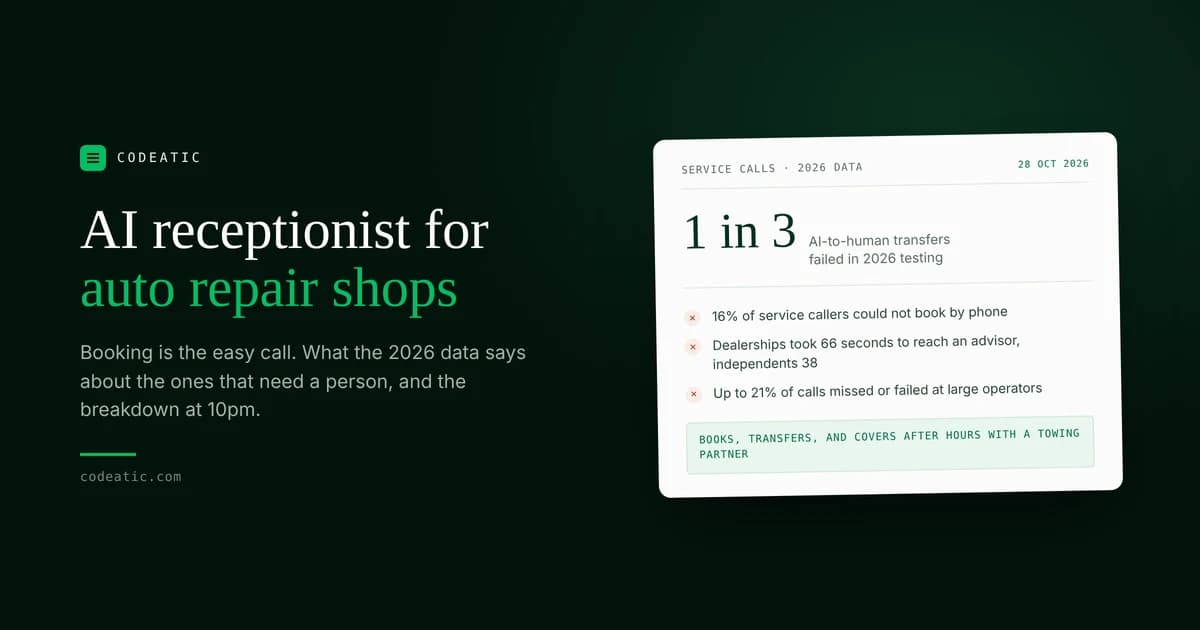
Booking is the call every AI receptionist handles. The 2026 data on service departments says the money is lost on the others: about one in three AI-to-human handoffs failed, 16% of callers could not book, and dealerships took almost twice as long as independents to reach an advisor. What to test, what to do about breakdowns after hours, and how to work out what a missed call is worth.
On this page
An AI receptionist for an auto repair shop answers every call, books the job into your live schedule, and puts the caller through to a person when the call needs one, including at 9pm when the bays are dark and someone is stuck on the shoulder. Booking is the simple part. The 2026 research on service departments says the money is lost on the calls that need a human, and that is where AI on the phone still breaks most often.
This guide covers how many service calls shops and dealerships miss, what the 2026 data says about AI on the service line, what to do about breakdowns after hours, and the questions to ask before you let software answer your phone. It is written for independent repair shops and dealership service departments in the US and Canada.
Written by Abdul Wahab, Co-Founder and CEO of Codeatic, which builds the AI receptionist now live in auto repair shops. Technical review by Usama Tariq, Co-Founder and CTO. Reviewed 28 October 2026.
On this page
What does an AI receptionist do for an auto repair shop?
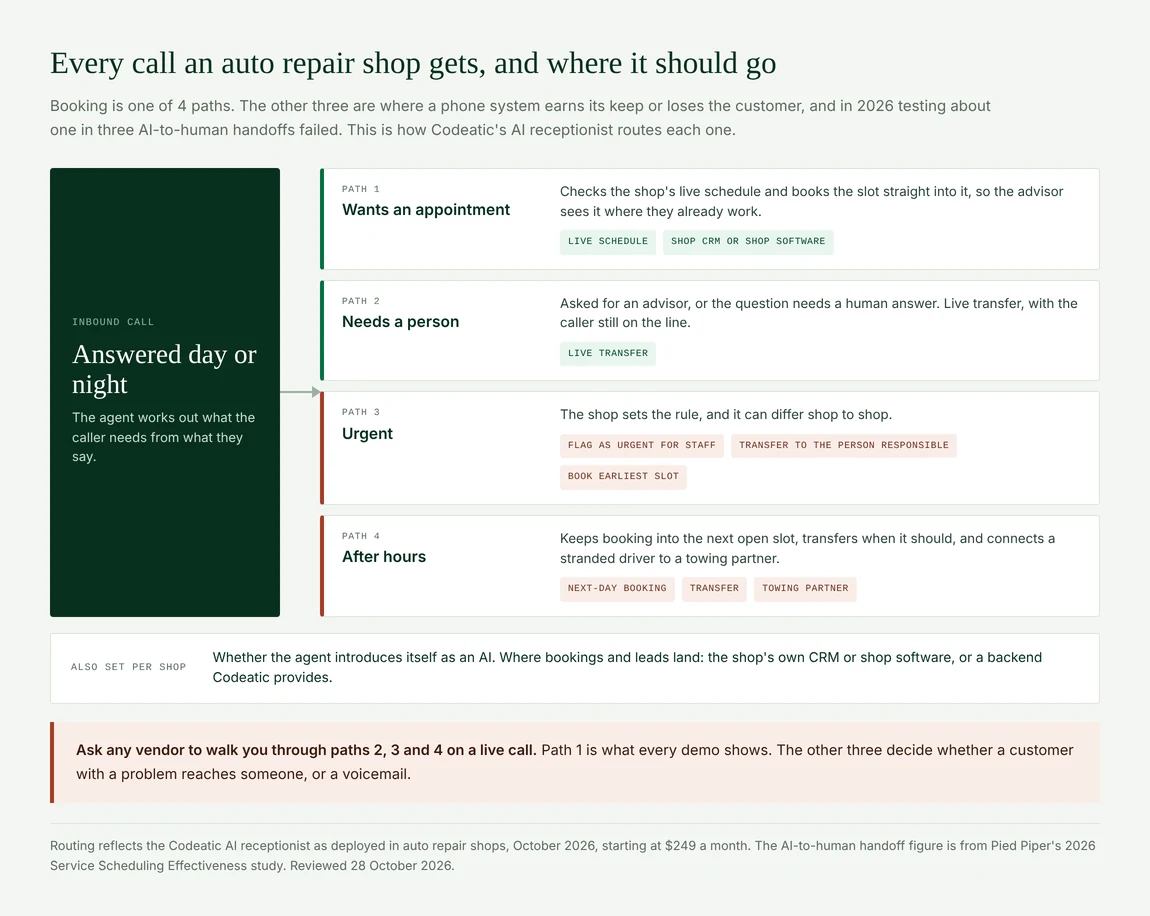
It picks up every call, works out what the customer needs, and either books the job into your schedule or gets the caller to the right person. For a shop, that covers 4 kinds of call: a customer who wants an appointment, one who needs to talk to an advisor now, one calling after you have closed, and one whose car has just died somewhere.
Booking is the part every product demos. What separates a useful one is what happens on the other three. A caller whose transmission is slipping does not want a time slot read back to them; they want someone who can tell them whether to keep driving. A caller at 10pm with a dead battery needs a tow, and your schedule for Thursday is no help to them at all.
For a dealership service department the job is the same with more volume and more transfers. Calls split between service, parts, sales and finance, and every one of those handoffs is a chance to lose the caller.
How many service calls do shops and dealerships miss?
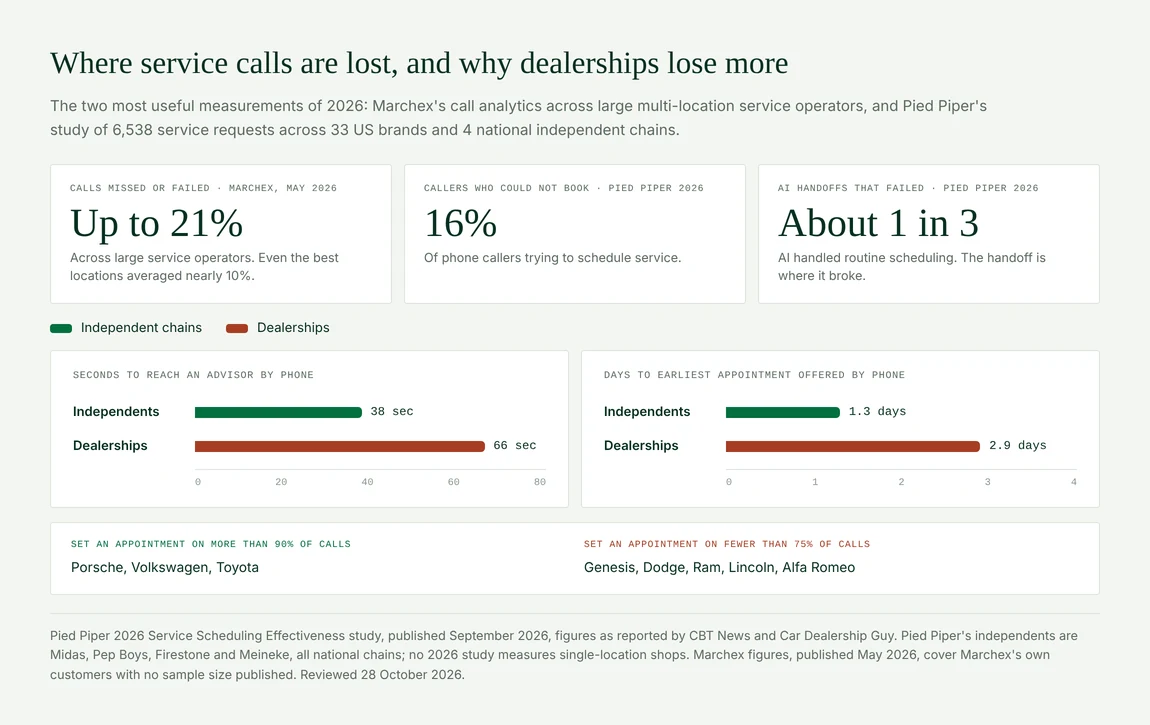
Somewhere between 1 in 10 and 1 in 5 at large service operators, depending on the location, and about 1 in 6 callers in a 2026 industry study could not get an appointment booked by phone at all. The precise number for your shop is in your phone records, and it is worth pulling before you buy anything.
The 2 most useful measurements this year come from different directions. Marchex, which runs call analytics for large automotive service operators, reported in May 2026 that missed or failed calls reached up to 21% across its customers' locations, and that even the best-performing locations averaged nearly 10%. Pied Piper's 2026 Service Scheduling Effectiveness study placed 6,538 service requests by phone and web across 33 US brands and 4 national independent chains, and found that 16% of phone callers could not book.
| What was measured | Figure | Source |
|---|---|---|
| Calls missed or failed at multi-location service operators | Up to 21%, best locations near 10% | Marchex, May 2026 |
| Phone callers who could not book a service appointment | 16% | Pied Piper, 2026 |
| AI-to-human transfers that failed | About 1 in 3 | Pied Piper, 2026 |
| Time to reach an advisor, independents vs dealerships | 38 vs 66 seconds | Pied Piper, 2026 |
| Earliest appointment offered, independents vs dealerships | 1.3 vs 2.9 days | Pied Piper, 2026 |
| Service customers who still prefer to book by phone | About two-thirds | Pied Piper, 2026 |
Both come with limits worth knowing. Marchex measured its own customers, all large multi-location operators, and did not publish a sample size. Pied Piper's "independents" are Midas, Pep Boys, Firestone and Meineke, all national chains, and nothing published this year measures how a 3-bay shop with one advisor on the phone compares.
Marchex also found appointment rates ranging from single digits to more than 60% between locations in the same service network, which points to how calls are handled more than how many come in.
Why do dealerships lose more service calls than independent shops?
More transfers, longer holds and later appointments. In Pied Piper's 2026 study, callers reached an advisor in 38 seconds at the independent chains and 66 seconds at dealerships, and the earliest appointment offered averaged 1.3 days out against 2.9.
Almost twice as long to reach a person and more than twice as long to get in. A dealership call often routes through a switchboard or a BDC before it reaches service, and each hop is another place a caller can hang up. Independent shops tend to have fewer people, which hurts during a rush but means fewer handoffs on an ordinary call.
The study also found the spread inside dealerships is huge. Porsche, Volkswagen and Toyota set an appointment on more than 90% of calls; Genesis, Dodge, Ram, Lincoln and Alfa Romeo did so on fewer than 75%.
Where does AI break on service calls?
On the handoff. Pied Piper found AI improved routine scheduling but often struggled with complex requests and handoffs, and about one-third of AI-to-human transfers failed.
Booking an oil change is a narrow task with a clear end. "My check engine light is flashing and the car is shaking" is a judgment call, and the right move is to get a person on the line fast with the caller still there. A transfer that drops the caller, rings an empty desk, or makes them repeat everything can be worse than no AI at all, because the customer now blames your shop for the robot.
Three things to test on any demo. Ask for a person halfway through a booking and see what happens. Describe a symptom that sounds unsafe and see whether it books you for next Tuesday. And pause mid-sentence the way a stressed caller does, because systems that read a pause as the end of a turn cut people off.
When the AI cannot handle a call, does the customer reach a person, or a voicemail? That one answer decides whether it is worth having.
What should happen when a car breaks down after hours?
The caller should get help on that call: a tow arranged or a person reached for anything urgent, and a booking for the next morning so the car has somewhere to go. Taking a message and calling back at 8am leaves the customer on the shoulder, and a driver stuck at night will call whoever answers.
Voicemail works for "can I book a brake inspection," and fails the one call that matters most, because a breakdown is the moment the customer picks a shop. The shop that answers and gets them towed has the best chance of doing the repair.
A good after-hours setup books routine work straight into the next open slot, hands genuine emergencies to whoever is on call, and connects a stranded driver to a towing partner, with the car headed to your lot.
Which tools help recover missed dealership calls?
Three kinds, and they solve different parts of the problem: call tracking and analytics tell you which calls you missed, a call center or BDC answers more of them with people, and an AI receptionist answers all of them and books or routes each one.
Call tracking and analytics record and score every call, show you the missed ones, and tell you which locations or advisors convert. They measure the leak. On their own they do not answer anything.
A call center or BDC puts trained people on overflow and after hours. It handles judgment calls well. It costs more per call than software, and its people still need to reach the shop's schedule and an advisor.
An AI receptionist answers every call at once without a hold queue and books directly. It is only as good as its handoff to a person and its connection to your schedule.
The combination that covers the most ground uses all three: analytics to find the leak, AI to answer and book every call, and people for the calls AI should not try to handle. For a single independent shop, the AI with a working transfer to the owner or advisor's phone usually covers it.
How do you reduce missed customer calls in a service department with automation?
Measure the misses first, then automate the predictable calls and protect the ones that need a person. In order:
Pull your phone records for 2 weeks. Count missed calls, calls that hit voicemail, and calls after hours. That gives you a real baseline instead of an industry average.
Find your peak. Numa's 2024 dealership data put peak appointment calls between 8 and 11:30am, and the busiest scheduling days on Monday and Tuesday.
Let the AI take booking calls at the peak so advisors stop being pulled off the counter.
Decide what counts as urgent and where it goes: a person, a priority flag, or the earliest slot.
Cover after hours with booking, an on-call transfer, and a towing partner.
Check the result against your baseline after 30 days, using the same phone records.
How much is a missed service call worth?
Your own average repair order multiplied by the calls you miss and the share of them that would have booked. It will probably be smaller than the headline figures in this industry, and it will hold up.
Numa, which sells AI to dealerships, reported that service departments miss up to 216 appointments a month and that franchise dealerships leave up to $1.17 million a year on the table, using a $450 average repair order. The arithmetic only reaches $1.17 million if every one of those 216 missed appointments becomes a $450 repair order, every month, and the post does not describe how the misses were counted.
The scale behind those headlines is large. NADA reports that franchised dealers wrote more than 136 million repair orders in the first half of 2026, with service and parts sales of nearly $83 billion. Losing even a small share of the phone traffic behind that is expensive. You just do not need an inflated number to justify fixing it.
What should you ask before putting AI on your service line?
Ask these on the demo, in this order.
Does it write the booking into my schedule, or text the customer a link? Ask about the plan you are being quoted.
Show me a live transfer. Ask for a person mid-call during the demo and watch what happens.
What does it do with an urgent call? You should be able to set the rule yourself.
What happens after hours? Booking, an on-call person, and a towing partner, or just voicemail with better manners.
Does it connect to the software my shop already uses? If bookings land somewhere your advisors never look, they do not exist.
Can I choose whether it tells callers it is an AI? Some shops want it said up front; it should be your call.
How Codeatic's AI receptionist works in a repair shop
Our AI receptionist is live in auto repair shops, starting at $249 a month. It answers every call, books into the shop's live schedule, and transfers the caller to a person when they ask for one or the call needs one. After hours it keeps booking, and when a customer's car needs a tow it connects them to a towing partner.
Urgent calls are the shop's call. We built it so each shop sets its own rule: mark the call urgent for staff, transfer it straight to the person responsible, or book the earliest open slot. Whether the agent introduces itself as an AI is a per-shop setting too. Bookings and leads go into the shop's own CRM or shop software, or into a backend we provide.
From our work on these, booking turns are where the agent has to check the schedule while the customer waits on the line. We switched off a speed shortcut that let the agent start talking before that check came back, because it was dropping the check and leaving the agent silent mid-booking. We would rather the agent take a moment longer and book the right slot.
If you run a shop or a service department and want to hear it on your own calls, get in touch and we will run a call through it on your own scenarios. If you work with auto shops and want to offer this to them, we also run a partner program; the same link reaches us. For a wider look at what else in your operation is worth automating, the free automation audit takes about 2 minutes, and our explainer on what a voice agent is covers the basics. Our earlier guide to voice agents for auto repair shops goes deeper on the technology side.
The short version
Large service operators miss or fail up to 21% of calls; the best locations still miss nearly 10%.
In a 2026 study of 6,538 service requests, 16% of phone callers could not book.
Dealerships took 66 seconds to reach an advisor against 38 at independent chains, and offered appointments 2.9 days out against 1.3.
AI handles routine booking well. About 1 in 3 AI-to-human transfers failed, so test the handoff before anything else.
After hours, a breakdown is when a customer picks a shop. Answer it, tow it, book it.
Work out a missed call's value from your own repair orders and phone records, not an industry headline.
How these figures were arrived at
The Pied Piper figures come from its 2026 Service Scheduling Effectiveness study release, published September 2026, with the detailed figures as reported by CBT News and Car Dealership Guy, because the full release PDF could not be retrieved. Missed call rates are from Marchex, May 2026. Peak hours and the $1.17 million figure are from Numa's 2024 trends post, published January 2025. Repair order and sales totals are from NADA Data, 2026 Mid-Year Report. The receptionist wage in the FAQ is from the US Bureau of Labor Statistics, May 2025.
Two limits worth stating. Marchex and Numa both sell into this market and report on their own customers, without published sample sizes. Pied Piper's independent figures are national chains, and nothing published this year measures small single-location shops directly.
Everything here is dated to 28 October 2026. If you find an error, tell us and we will correct the post and note the correction.
Frequently asked questions
Can an AI receptionist book appointments for an auto repair shop?
Yes, if it is connected to your schedule. A good one checks live availability and writes the booking where your advisors already work. Some cheaper products only text the caller a booking link, so ask which one you are getting.
Will an AI receptionist replace my service advisor?
No. It takes the routine calls off your advisors so they can deal with the customers in front of them. Diagnosis, estimates and difficult conversations still need a person, which is why the transfer to your team is the feature to test hardest.
Does an AI receptionist work after hours?
It should. After hours it can book routine work into your next open slot, put urgent calls through to whoever is on call, and connect a stranded driver to a towing partner. Without that, after-hours calls go to voicemail and a breakdown goes to whichever shop answers.
How much does an AI receptionist cost for an auto shop?
Ours starts at $249 a month. Entry plans across the market start lower, but the cheapest often text the caller a booking link instead of writing to your schedule, and live transfer is commonly a higher tier. Compare plans on booking and transfer, not headline price.
What does a human receptionist cost compared with AI?
The US Bureau of Labor Statistics puts the median receptionist wage at $38,010 a year, or $18.27 an hour, as of May 2025, before payroll costs. That buys one shift. An AI receptionist answers every call, including nights and weekends, for a monthly fee.
If you are weighing an AI receptionist against an answering service or a new hire, this comparison sets out the costs, hours covered and legal rules side by side.
Do customers know they are talking to an AI?
That depends on the shop's setting. Some shops have the agent introduce itself as an AI assistant on every call; others leave it out. Ours lets each shop choose.
What happens when a customer calls with an urgent problem?
It should follow a rule you set. Depending on the shop, that can mean flagging the call as urgent for staff, transferring it straight to the person responsible, or booking the earliest open slot. Ask any vendor to show you that path on a live demo.
Is an AI receptionist different for a dealership than for an independent shop?
The core job is the same. Dealerships have more call volume and more departments to route between, so the transfer logic matters even more. In 2026 testing, callers took 66 seconds to reach an advisor at dealerships, against 38 at independent chains.