Free AI Audit: What a Free Tool Can and Cannot Tell You
Search for a free AI audit and you will find 3 different products under one name, most of them not looking at your operations at all. How to tell them apart, what a free audit can and cannot see from outside your business, how to act on the report in 10 minutes, and when you need a paid one.
On this page
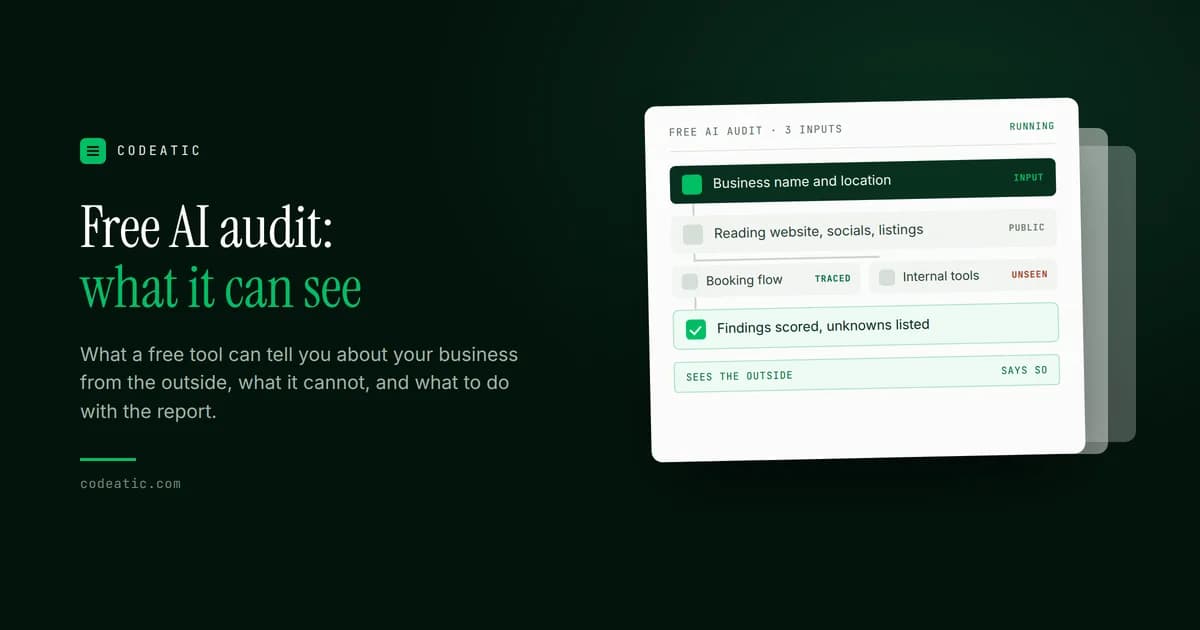
A free AI audit for business reads everything public about how your company operates, from your website and booking flow to your social profiles and listings, and returns a list of processes that AI and automation could take over, each rated for effort, importance and how confident the audit is. It works from the outside, so the good ones tell you exactly what they could not see.
That is one kind of free AI audit. Search the term and you will find at least 3 different products sharing the name, and most of them are not looking at your operations at all. This covers how to tell them apart, what a free audit can and cannot see, how to act on the report in 10 minutes, and when you need a paid one instead.
What is a free AI audit?
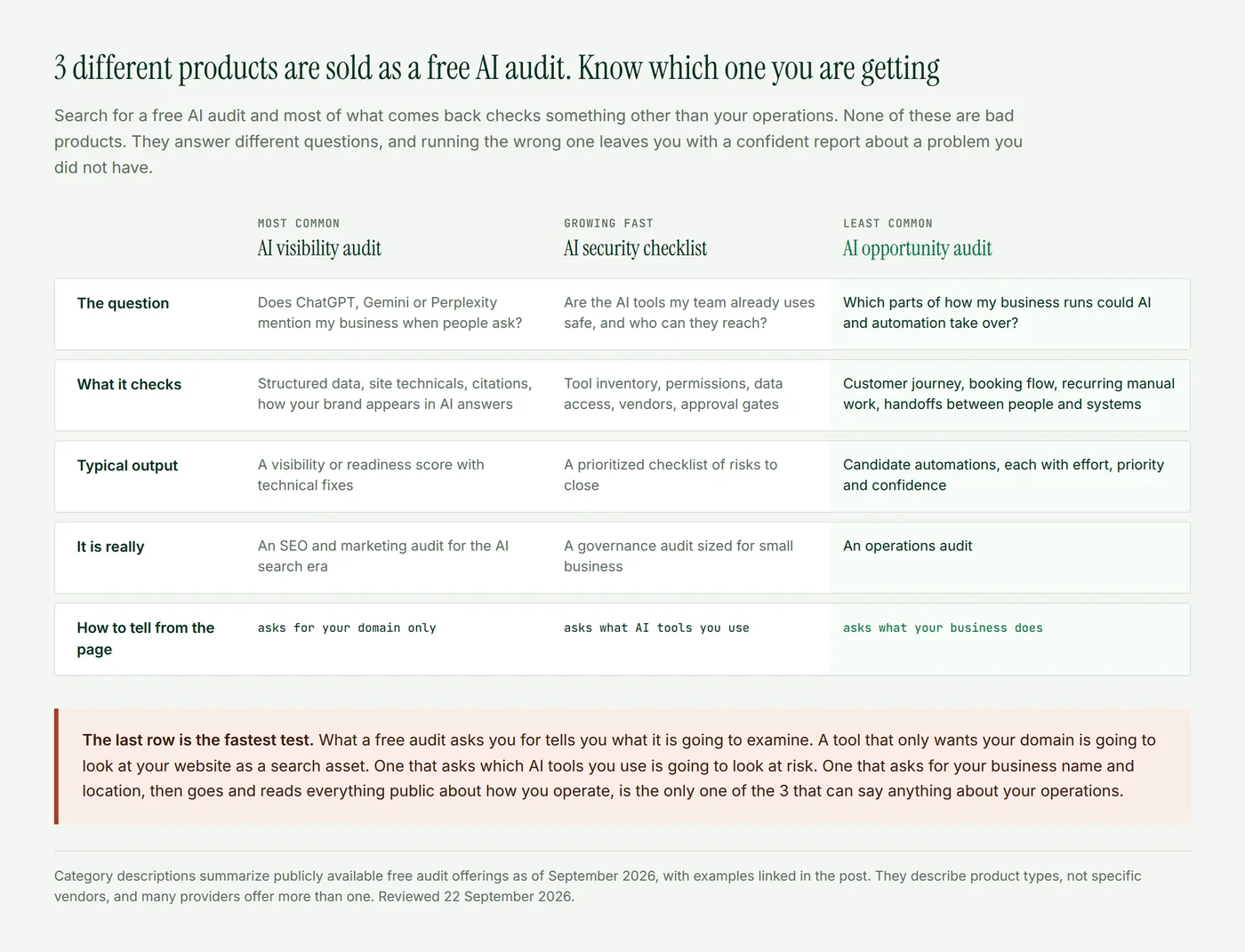
It depends entirely on who is offering it. The same phrase covers 3 products that answer different questions.
The most common is an AI visibility audit, which checks how your brand appears when people ask assistants such as ChatGPT, Gemini, Perplexity, Copilot and Google AI Overviews for a recommendation. Many providers pair a free automated score with a paid human review, such as BlueShore's free readiness score and $200 assessment published in August 2026. These are marketing audits for the AI search era, and a useful one, but they look at your website as a search asset.
The second is an AI security checklist: a short questionnaire covering tool inventory, permissions, approval gates, vendors, data access and insurance for the AI your team already uses. That is a small business version of the governance audit that IBM describes in its October 2025 explainer on AI audits, and it matters once AI is touching your data.
The third, and least common, is the one that looks at how your business runs and where AI could take work off people. That is what ours does, and what this guide is about. For the full picture of what that kind of audit examines, see our guide to an AI audit for business.
What can a free AI audit see from the outside?
More than most owners expect. A business leaves a detailed trail of how it operates, and a tool that reads it the way a customer would can infer a lot.
How customers reach you. Whether there is online booking, a contact form, a phone number only, or a WhatsApp link, and what happens after each.
What the booking process involves. How many steps, whether availability is visible, whether confirmation is automatic or clearly manual.
What you sell and how it is priced. Service lists, quote requests versus published prices, packages that imply recurring work.
How you communicate. Response times promised on the site, how active the social profiles are, what reviews say about waiting or chasing.
What the team seems to do by hand. Job posts for admin roles, forms that clearly get retyped, reports that must be assembled somewhere.
This works across trades because the questions are about the shape of the work, not the industry. The same reading applies to an auto repair shop, a cleaning company, a clinic or a pest control business.
What can it not see?
Everything inside the building. A free audit working from public information cannot see the tools your team uses internally, how many times a task actually happens each week, how long it takes, whether 2 people do it the same way, or what the spreadsheet in the back office holds.
That limit is not a flaw to hide, and the way a free audit handles it is the best test of whether to trust the rest of the report. Ours ends every report with what it assumed, how it arrived at each assumption, and what it could not determine at all. A report that presents inferences from your website as certainties about your operations is overclaiming, and you should weigh everything else in it accordingly.
Third party comparisons of readiness tools make a related point. Phos AI Labs' July 2026 guide notes that some tools produce a maturity score, some a benchmark against peers, and the best produce a prioritized action plan. A score out of 10 tells you where you stand. It does not tell you what to do on Monday.
How do you act on the report?
Every finding in our report is rated on 4 dimensions: how automatable it is, how complex, what priority, and how confident the audit is. Read them together and each finding sorts into 1 of 5 actions.
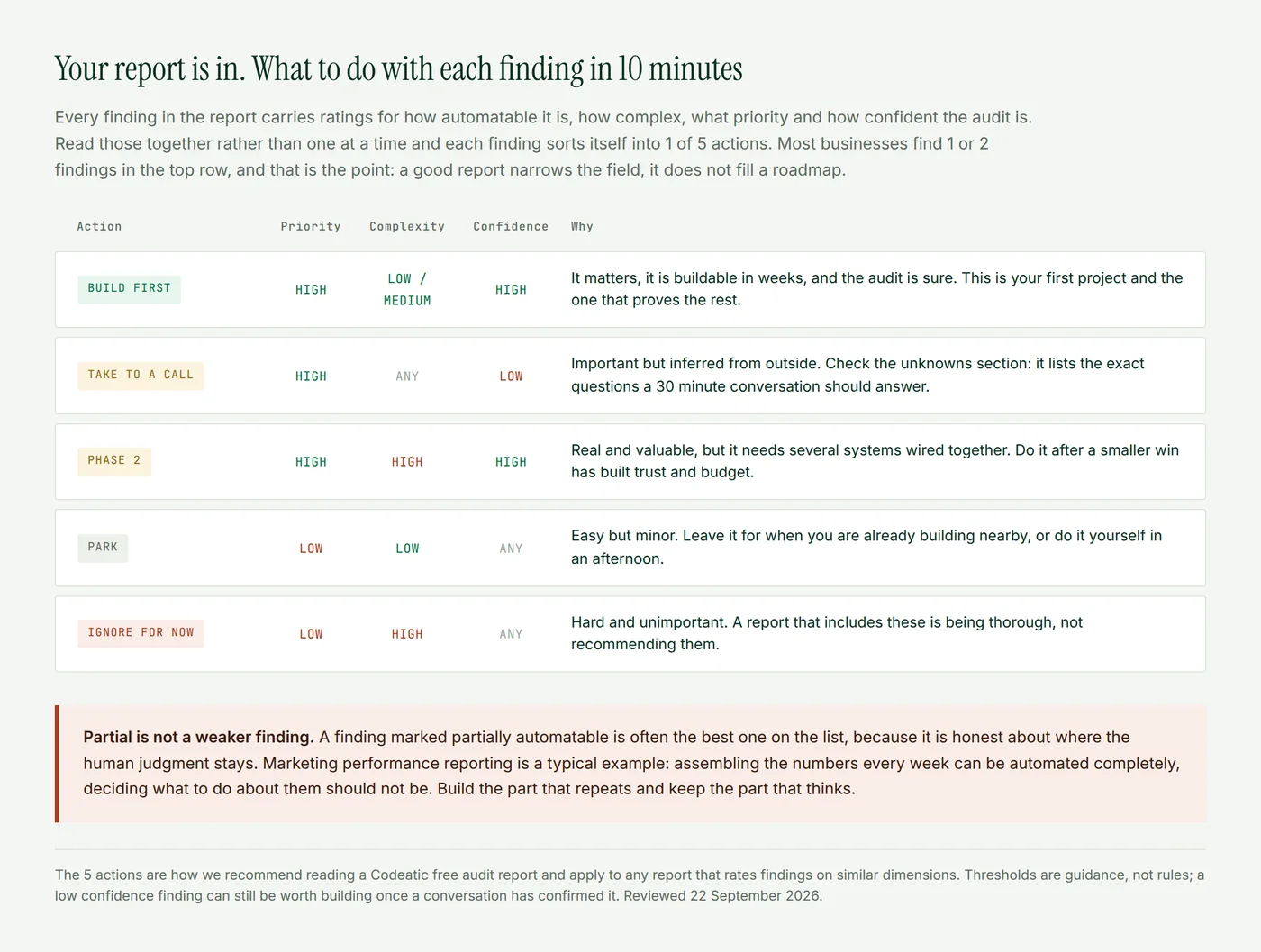
The row most people skip is the second one. A high priority finding with low confidence is not a weak finding. It is an important question the audit could not answer from outside, and the unknowns section of the report tells you precisely what to ask. That turns a free report into a short, specific conversation instead of a generic sales call.
When is free enough, and when do you need a paid audit?
A free audit is enough when you want a first read with no commitment, when you suspect there is value in automation but have no idea where, or when you want to test a favorite idea against the alternatives. It is not enough when you intend to spend money building something, because a build needs a business case and a business case needs numbers from inside the business.
From our work. The difference shows up clearly when an audit can see inside. Ziltrix, a security workforce platform, is a large end to end operation, and its paid audit identified roughly 40% to 50% of that operation as automatable. The first build from it was a voice agent that took shift confirmation calls from 8 staff to 1, moved coverage from 12 hours to 24/7, raised capacity from 100 calls a day to more than 5,000, and recovered $42,000 a year in salary, live in 4 weeks.
MOTIV's paid audit found an operation running largely on manual processes, with roughly 60% of it a candidate for automation. PlayFast shows the follow through: after we automated their team management from 5 people to 1, they came back for a free consultation on what else they could do, and it surfaced 2 further opportunities, workflow automation for assigning playbooks and generative AI for tracking how players are performing. None of those figures could have come from a website. That is what the paid tier is for.
What does a free AI audit really cost you?
Time and a little information, and it is worth being clear about the trade. Free audits exist because they start conversations, ours included. We would like to talk to you after you read the report, and saying so plainly is more useful than pretending otherwise.
What you should watch for is a free audit that is really a sales call in disguise, where the report only arrives after a 15 minute pitch, or where every finding conveniently needs the same product. A genuine free audit gives you something usable on its own, whether or not you ever speak to the provider. Ours asks for your business name, location and a few details about what you do, and the report stands alone.
How ours works
You give it 3 things. Business name, location, and a short description of what you do, so it can find the right public footprint.
It reads what is public. Your website, social profiles and listings, navigating the site the way a customer would to trace how enquiries and bookings actually flow.
It scores what it finds. Each candidate automation is rated for how automatable, how complex, what priority and how confident.
It shows its evidence. Where each finding was observed, why it points to manual work, and the source, so you can check it rather than trust it.
It lists what it could not determine. The assumptions, how it reached them, and the gaps only a conversation can fill.
Where Codeatic fits in
We build what our audits recommend, which gives us a direct interest in the recommendations being right rather than long. Run the free AI audit for a scored first read. If it raises questions, get in touch and a 30 minute discovery call will work through the unknowns. When you are ready to build a business case, the AI Opportunity Audit is a fixed $3,000 and produces a costed, ranked shortlist you can take to any builder.
For what the findings usually turn into, our guides to AI agents and voice agents cover the 2 most common outcomes.
When a free AI audit is the wrong tool
When what you actually want to know is whether AI search engines recommend your business, because that is a visibility audit and an operations audit will not answer it. When you already run AI that touches customer data and need to know it is safe, because that is a governance question. And when you already know precisely what you want automated, because then you need a build estimate, not an audit.
The short version
3 different products are sold as a free AI audit: visibility audits that check how AI search sees your brand, security checklists for the AI tools you already use, and opportunity audits that look at how your business runs. The fastest way to tell them apart is what they ask you for. A good opportunity audit reads your public footprint, rates each finding for effort, priority and confidence, shows its evidence, and says what it could not see. Build the high priority, low complexity, high confidence findings first, and take the low confidence ones to a conversation.
How these figures were arrived at
The 3 categories of free AI audit summarize publicly available offerings as of September 2026, with an example of each linked inline; they describe product types rather than judging specific vendors, and many providers offer more than one type. The 5 action framework in the second figure is how we recommend reading our own reports. Client audit figures describe what paid audits and consultations identified, as reported by the Codeatic team; the Ziltrix build outcomes are published on our case study page and measured against the manual process the client recorded beforehand. External sources are attributed inline with the publishing organization and date.
Reviewed 22 September 2026 by Usama Tariq, Co-Founder and CTO. If you find an error in this post, email info@codeatic.com and we will publish a correction on the page rather than editing it quietly.
Frequently asked questions
What is a free AI audit?
It depends on the provider. The phrase covers AI visibility audits, which check how AI search engines see your brand; AI security checklists, which review the AI tools you already use; and AI opportunity audits, which look at how your business runs and where automation could take work off people.
Is a free AI audit actually free?
Usually yes in money, not in time or information. Free audits exist to start conversations. A genuine one gives you a usable report whether or not you ever speak to the provider; one that only delivers after a sales call is a lead form with extra steps.
What information does a free AI audit need?
An opportunity audit needs enough to find your public footprint, typically your business name, location and a description of what you do. A visibility audit usually wants only your domain. A security checklist asks which AI tools your team uses.
How accurate is a free AI audit?
As accurate as public information allows, which is a real limit. It can infer a great deal from your website, booking flow and listings, but it cannot see internal tools, task volumes or how long work takes. Trust reports that rate their own confidence per finding and list what they could not determine.
What is the difference between a free and a paid AI audit?
A free audit works from outside the business. A paid audit works from inside it, through conversations with the people who do the work, and produces the numbers a build decision needs: volumes, time, cost and a ranked shortlist. Free narrows the field; paid produces a business case.
How long does a free AI audit take?
Minutes for an automated report. Reading it properly takes about 10 minutes if you sort each finding by priority, complexity and confidence together rather than reading them in order.
What should I do after a free AI audit?
Pick the findings that are high priority, low to medium complexity and high confidence, and treat the best of them as a first project. Take the important but low confidence findings to a short conversation, using the report's unknowns as your list of questions.
Can a free AI audit tell me if ChatGPT recommends my business?
Only if it is a visibility audit. An operations audit looks at how your business runs, not how AI search engines describe it. If being recommended by assistants is your question, look for a tool that asks only for your domain.
Abdul Wahab, Co-Founder and CEO, Codeatic
Abdul has spent 5 years building software, across web stacks and mobile in React Native, Flutter and native Android, before moving into product, architecture and AI work. He holds an MS in Computer Science from PUCIT and leads Codeatic, an AI automation agency working with SMBs and startups across the US, Canada, the UK and Saudi Arabia. Connect on LinkedIn.
Technically reviewed by Usama Tariq, Co-Founder and CTO, Codeatic. Usama is an AI and computer vision engineer who builds production systems from unstructured video, image and speech data. He built the REVOX engine at Veedback, developed LLM and computer vision systems at Coeus Solutions GmbH, and led AI model development at OMNO AI. He is an OpenCV OAK-D finalist and a contributor to Workhub, and holds a BS in Computer Science from COMSATS University Islamabad. Connect on LinkedIn.