AI Audit for Business: What It Finds and What It Costs
AI audit means 2 different things. The compliance kind examines AI you already run. The business kind finds where AI and automation should go, and it is the one most small and mid sized companies need first. What it examines, what a report worth having contains, and how a free tool differs from a paid audit.
On this page
An AI audit for business is a structured review of how a company actually operates, to find which processes AI and automation can take over, how much each would return, and how confident anyone can be about that. It is not the same thing as the AI audit that compliance teams run, which examines AI systems a company already has for bias, security and regulatory risk.
Both are called an AI audit, and search results mostly describe the second kind. This guide covers the first, the one most small and mid sized businesses actually need: what it examines, what a report worth having contains, how a free tool differs from a paid audit, and what we have learned running them.
What is an AI audit?
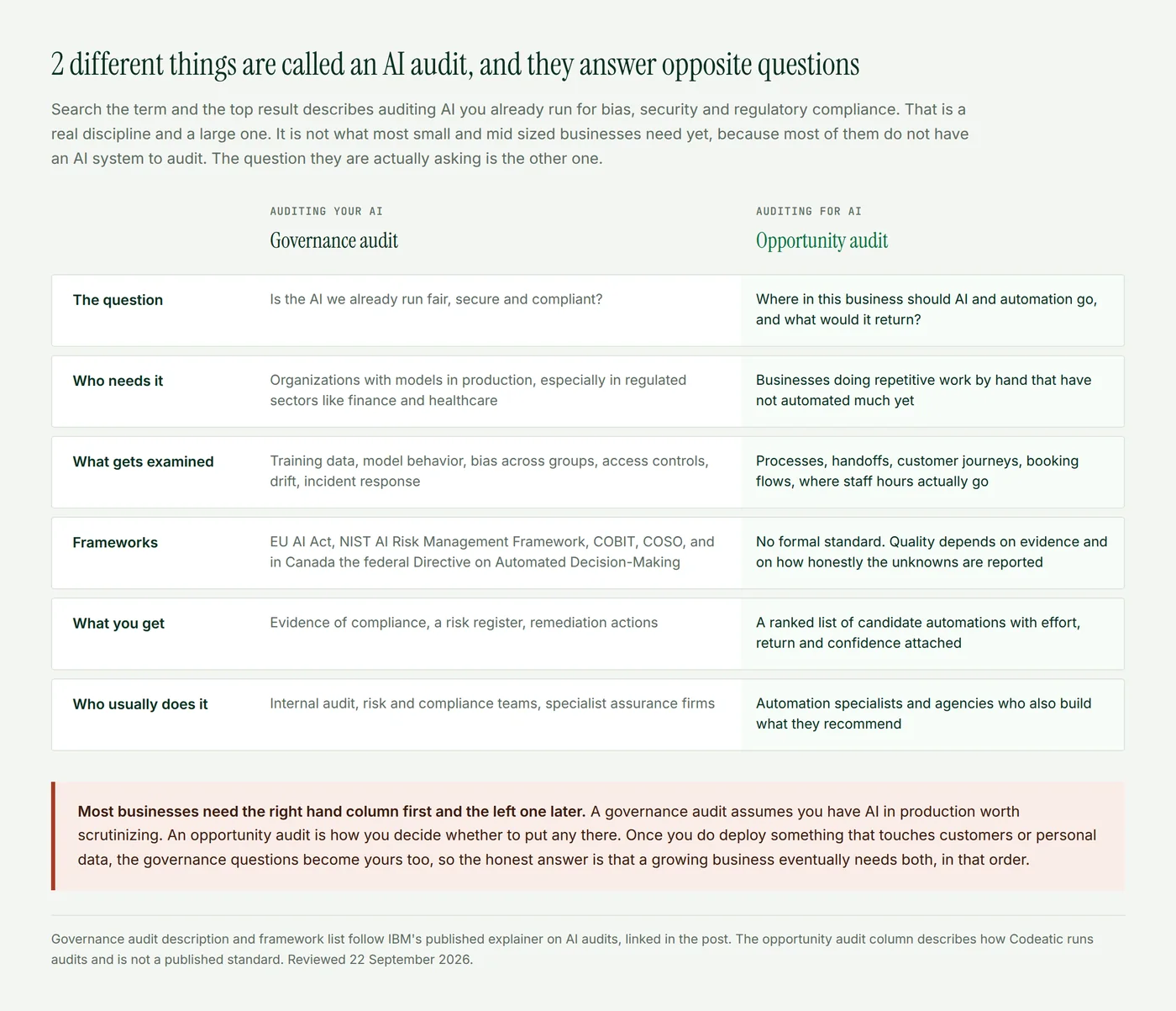
The term covers 2 different jobs that answer opposite questions.
The first audits AI you already run. IBM's explainer defines it as a structured, evidence based examination of how AI systems are designed, trained and deployed, covering data quality, model bias, security and compliance with frameworks such as the EU AI Act and the NIST AI Risk Management Framework. In Canada, the federal Directive on Automated Decision-Making has required government departments to complete an Algorithmic Impact Assessment for high impact systems since 2020.
The second audits a business for AI. It asks where automation should go, not whether existing AI is behaving. That is the version this guide covers, and it is sometimes called an AI readiness audit or an AI opportunity audit to separate it from the compliance kind.
Which kind does your business need?
If you do not yet have AI making decisions in production, you need the opportunity kind. A governance audit of a business with no AI systems has nothing to examine.
If you do run AI that touches customers, personal data or money, you eventually need both. The governance questions arrive the moment something you built starts making decisions, and IBM's Institute for Business Value found in 2024 that while 82% of executives say secure and trustworthy AI is essential to their business, only 24% of current generative AI projects are being secured. The order for a growing business is usually opportunity first, governance once there is something to govern.
What does an AI audit for business examine?
Not your technology. Your work. A useful audit follows the business the way a customer and an employee experience it, and looks for effort that repeats.
The customer journey. How someone finds you, how they enquire, whether booking is possible online or needs a phone call, and where they wait.
Recurring manual work. The tasks somebody does every day or every week that follow the same steps each time.
Handoffs between people and systems. Where information gets retyped from an email into a spreadsheet, or from a phone call into a diary.
Where attention goes. Which tasks consume the time of the people whose judgment the business actually depends on.
What is already in place. The tools, the integrations, and the gaps between them.
Our free audit tool does the first pass of this automatically. It takes a business name and location, then reads the website, social profiles and anything else public about the business, navigating the site the way a customer would to see whether booking exists, how enquiries arrive and what the process looks like from outside. It works the same way for an auto repair shop, a cleaning company, a clinic or a pest control business, because the questions are about the shape of the work rather than the trade.
What should the report contain?
A list of things you could automate is easy to generate and close to worthless alone. What makes a finding usable is the context around it.
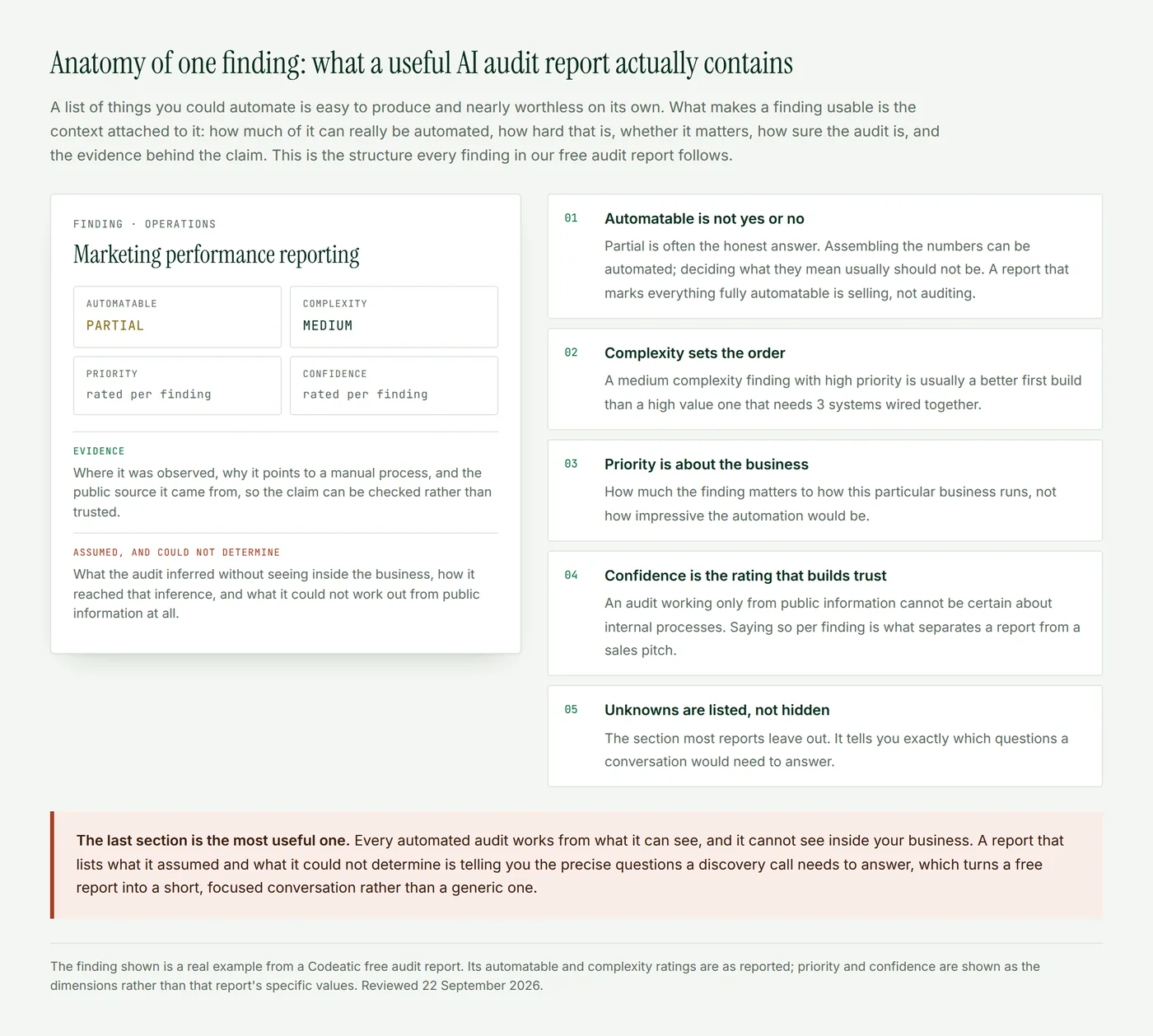
The last element in that figure is the one to look for when comparing audits, from us or anyone else. Any automated audit works from what it can see, and it cannot see inside your business. A report that says plainly what it assumed and what it could not determine is being honest about its limits, and it is also handing you the exact questions a follow up conversation needs to answer.
Free tool, discovery call or paid audit?
| Free audit tool | Free discovery call | Paid AI Opportunity Audit | |
|---|---|---|---|
| Works from | Your public footprint: website, socials, listings | A conversation with the owner | Your actual processes, systems and people |
| Sees inside the business | No, and says so | Partly, through what you describe | Yes |
| Output | Scored findings with evidence and stated unknowns | Shared understanding of how the work runs | A costed, ranked shortlist ready to build |
| Time from you | A few minutes | 30 minutes | Several sessions |
| Cost | Free | Free | $3,000 fixed fee |
| Right when | You want a first read with no commitment | The report raised questions worth discussing | You intend to build and need the business case |
They are designed to run in that order. The free report narrows the conversation, the conversation fills in what the report could not see, and the paid audit turns both into something you can take to a build, with us or anyone else.
Why do an audit before building anything?
Because the evidence on AI projects that skip it is poor. MIT's Project NANDA reported in July 2025 that 95% of enterprise generative AI pilots delivered no measurable impact on profit and loss. The figure has been criticized for its methods, with commentators noting it rests on 52 executive interviews, was not peer reviewed, and uses a narrow 6 month definition of success, and that criticism is worth reading before repeating the number. The direction is not really disputed.
Gartner reached a similar conclusion from a different angle in June 2025, predicting that more than 40% of agentic AI projects will be canceled by the end of 2027, citing escalating costs, unclear business value and inadequate risk controls. Every one of those is a decision made before anything gets built. An audit exists to make those decisions deliberately.
It is not that businesses are hesitant. McKinsey's State of AI found 72% of organizations had adopted AI in at least one function by 2024. The problem is adopting it in the wrong place.
From our work. We have run every version of this: paid audits for Ziltrix and MOTIV, a free audit for PlayFast, and free consultations for Ph3onix, among others. The pattern that repeats is that the thing a business asks us to automate is rarely the thing the audit points to.
Ziltrix is the clearest example of what a good finding turns into. The engagement started with an audit, and what came out of it was a voice agent that took shift confirmation calls from 8 staff to 1, moved coverage from 12 hours to 24/7, raised capacity from 100 calls a day to more than 5,000, and recovered $42,000 a year in salary, live in 4 weeks. None of that required the business to know in advance that phone confirmations were the problem worth solving. That is what the audit was for.
What does an AI audit cost?
It ranges from free to substantial, and the price mostly tracks how much of your business the auditor actually sees.
Automated tools working from public information are usually free, because they cost little to run and they start a conversation. Consultative audits involving interviews and process mapping run from a few thousand dollars for a small business upward. Governance audits of production AI systems in regulated industries are a different category altogether, often run by specialist assurance firms at enterprise prices.
Ours runs as a free self serve tool, a free 30 minute discovery call, and a paid AI Opportunity Audit at a fixed $3,000. Builds that come out of an audit typically take 4 to 8 weeks, and clients own 100% of the code.
How to prepare in 20 minutes
List the 5 tasks your team did most often last week. For each one, note roughly how long it takes, how many times it happened, and whether 2 people would do it the same way. That list is most of what any audit needs from you, and the tasks where the answer to the last question is yes are almost always where the findings end up.
Where Codeatic fits in
We run opportunity audits for small and mid sized businesses and then build what they recommend, which means we have a direct interest in the recommendations being right rather than long. The free AI audit tool gives you a scored first read in minutes. If the report raises questions, get in touch and we will talk them through. When you are ready to build a business case, the AI Opportunity Audit produces a costed, ranked shortlist you can take to any builder, including us.
For background on what the recommendations tend to involve, our guides to AI agents and voice agents cover the two most common outcomes.
When you do not need an AI audit
When you already know exactly which task you want automated and why, because then you need a build estimate, not an audit. When the business is small enough that the owner can list every recurring task from memory in 10 minutes. And when what you actually need is the governance kind: if you run AI in production in a regulated sector, an opportunity audit will not answer your regulator's questions.
The short version
AI audit means 2 different things. The compliance kind examines AI you already run. The business kind, which most small and mid sized companies need first, finds where AI and automation should go. A useful report rates each finding for how automatable it is, how complex, how important and how confident the audit is, shows the evidence, and lists what it could not determine. Start with a free read of your public footprint, use a conversation to fill the gaps, and pay for a full audit only when you intend to build.
How these figures were arrived at
The governance audit description and framework list follow IBM's published explainer. The opportunity audit process, the finding structure and the tier comparison describe how Codeatic runs audits and are not a published standard. The example finding in the second figure is from a real free audit report; its automatable and complexity ratings are shown as reported, while priority and confidence are shown as dimensions rather than that report's values. Client outcomes are published on our case study page and measured against the manual process each client recorded before the build. External statistics are attributed inline with the publishing organization and year, including the published criticism of the MIT figure.
Reviewed 22 September 2026 by Usama Tariq, Co-Founder and CTO. If you find an error in this post, email info@codeatic.com and we will publish a correction on the page rather than editing it quietly.
Frequently asked questions
What is an AI audit for business?
A structured review of how a company operates, to find which processes AI and automation can take over, what each would return, and how confident the audit is about each finding. It is different from a governance audit, which examines AI systems a company already runs.
What is the difference between an AI audit and an AI governance audit?
A governance audit checks whether AI you already run is fair, secure and compliant, using frameworks such as the EU AI Act and NIST's AI Risk Management Framework. An opportunity audit, sometimes called an AI readiness audit, finds where AI should go in the first place. Most small businesses need the second one first.
What does an AI audit look at?
The customer journey, recurring manual tasks, the handoffs where information gets retyped between people and systems, where skilled staff spend their attention, and what tools are already in place. It examines the work, not the technology.
Is a free AI audit worth doing?
As a first read, yes, provided it shows its evidence and says what it could not determine. A free tool working from your public footprint cannot see inside the business, so the honest ones say so per finding. Treat it as a way to narrow the conversation, not as a business case.
How much does an AI audit cost?
Automated tools are usually free. Consultative audits for small and mid sized businesses run from a few thousand dollars; ours is a fixed $3,000. Governance audits of production AI in regulated industries are a separate category, typically at enterprise pricing.
How long does an AI audit take?
A free automated report takes minutes. A discovery call takes 30 minutes. A full paid audit takes several working sessions with the people who actually do the work, spread across a couple of weeks depending on how many processes are in scope.
What happens after an AI audit?
You get a ranked shortlist with effort, return and confidence attached. The sensible next step is to build the highest priority finding that is also low enough in complexity to prove quickly, run it beside the manual process, and only then move to the next one.
Do I need an AI audit if I already know what to automate?
Usually not. If you know the task and the reason, you need a build estimate. An audit earns its cost when you suspect there is value in automation but do not know where it is, or when you have a favorite idea and want it tested against the alternatives.
Abdul Wahab, Co-Founder and CEO, Codeatic
Abdul has spent 5 years building software, across web stacks and mobile in React Native, Flutter and native Android, before moving into product, architecture and AI work. He holds an MS in Computer Science from PUCIT and leads Codeatic, an AI automation agency working with SMBs and startups across the US, Canada, the UK and Saudi Arabia. Connect on LinkedIn.
Technically reviewed by Usama Tariq, Co-Founder and CTO, Codeatic. Usama is an AI and computer vision engineer who builds production systems from unstructured video, image and speech data. He built the REVOX engine at Veedback, developed LLM and computer vision systems at Coeus Solutions GmbH, and led AI model development at OMNO AI. He is an OpenCV OAK-D finalist and a contributor to Workhub, and holds a BS in Computer Science from COMSATS University Islamabad. Connect on LinkedIn.