AI Automations: Grok vs Claude, and What Each Costs
Pages ranked for AI automations is published by a platform selling the platform, and not one of them prints a price. We did the arithmetic: 3 business automations, costed on both Grok and Claude.
On this page
AI automations are jobs that start on a trigger, use a language model to make the judgment a rule cannot, act through your own tools, and write the result back where your team works. That last clause is the one that matters. A draft sitting in a window waiting for someone to read it is assistance. An automation finishes.
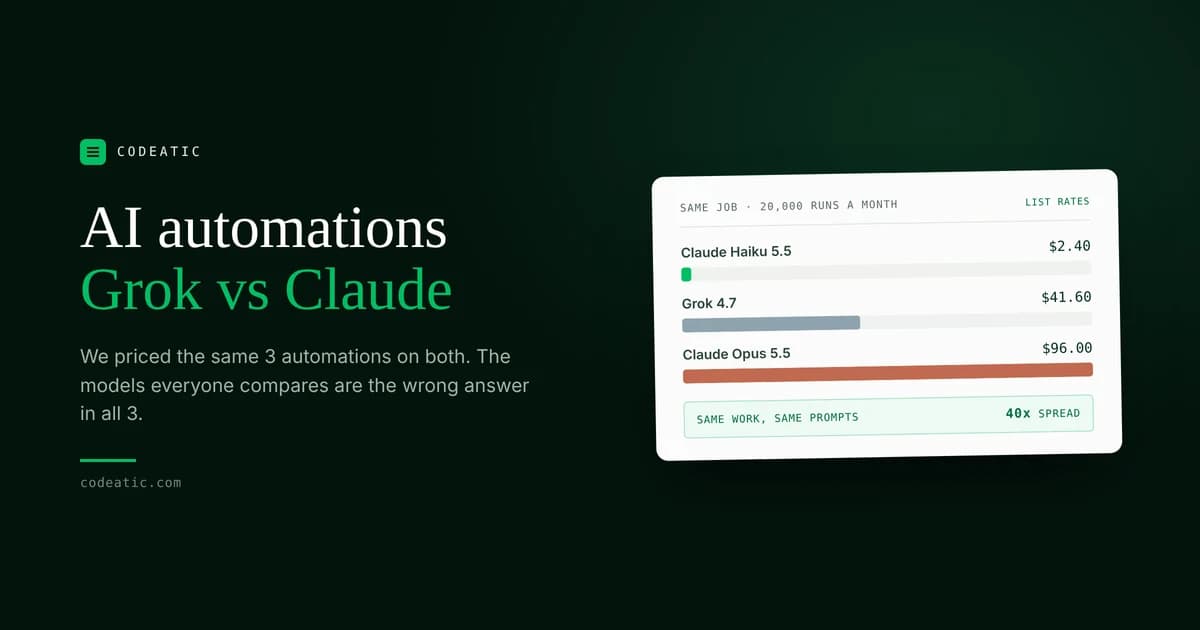
Almost every page ranking for this term right now is published by a platform selling you the platform, and not one of them prints a price. So we did the arithmetic. We took 3 ordinary business automations, costed each one on Grok and on Claude at published October 2026 list rates, and found a 35x spread between the obvious choice and the correct one. The flagship model everybody compares is the wrong answer in all 3 cases.
Written by Abdul Wahab, Co-Founder and CEO of Codeatic, where we build this category of system for service businesses in the US, Canada and the UK. Technical review by Usama Tariq, Co-Founder and CTO. Reviewed 17 October 2026.
On this page
- What AI automations are, and what they are not
- Grok vs Claude: which one actually runs automations
- What the same automation costs on each
- Which platform is best for your case
- Who controls the AI underneath
- Can it reason well enough to run unattended
- Where a subscription stops and a build starts
- How to get started
- AI for automation testing
- The jobs, the engineers and the courses
- Frequently asked questions
What are AI automations, and how do they differ from the automations you already have?
An AI automation has 4 parts: a trigger, a model call that exercises judgment, an action through a tool, and a write-back to a system of record. Drop any one of them and you have something else. Drop the trigger and you have a chatbot. Drop the judgment and you have the rule-based automation your business has run for years, the kind where a form submission creates a row in a sheet. Drop the write-back and you have a draft nobody actioned.
The useful distinction is not artificial intelligence for automation versus traditional automation. It is whether the step in the middle needs a decision. A rule can route an email containing the word "invoice". It cannot read 3 paragraphs of a frustrated customer, work out that the complaint is really about a missed appointment rather than the bill attached to it, and route on that. That judgment is the entire reason to put a model in the path, and it is also the reason these systems need a validation layer that rule-based automations never needed.
Most products sold as AI automation today stop one step short. They draft, summarize and suggest, then wait for a person to approve. That is genuinely useful and it is not automation, because the work still happens at the speed of whoever is at a desk. Knowing which half of the category you are buying is the single most expensive thing to get wrong.
Grok vs Claude: which one actually runs AI automations?
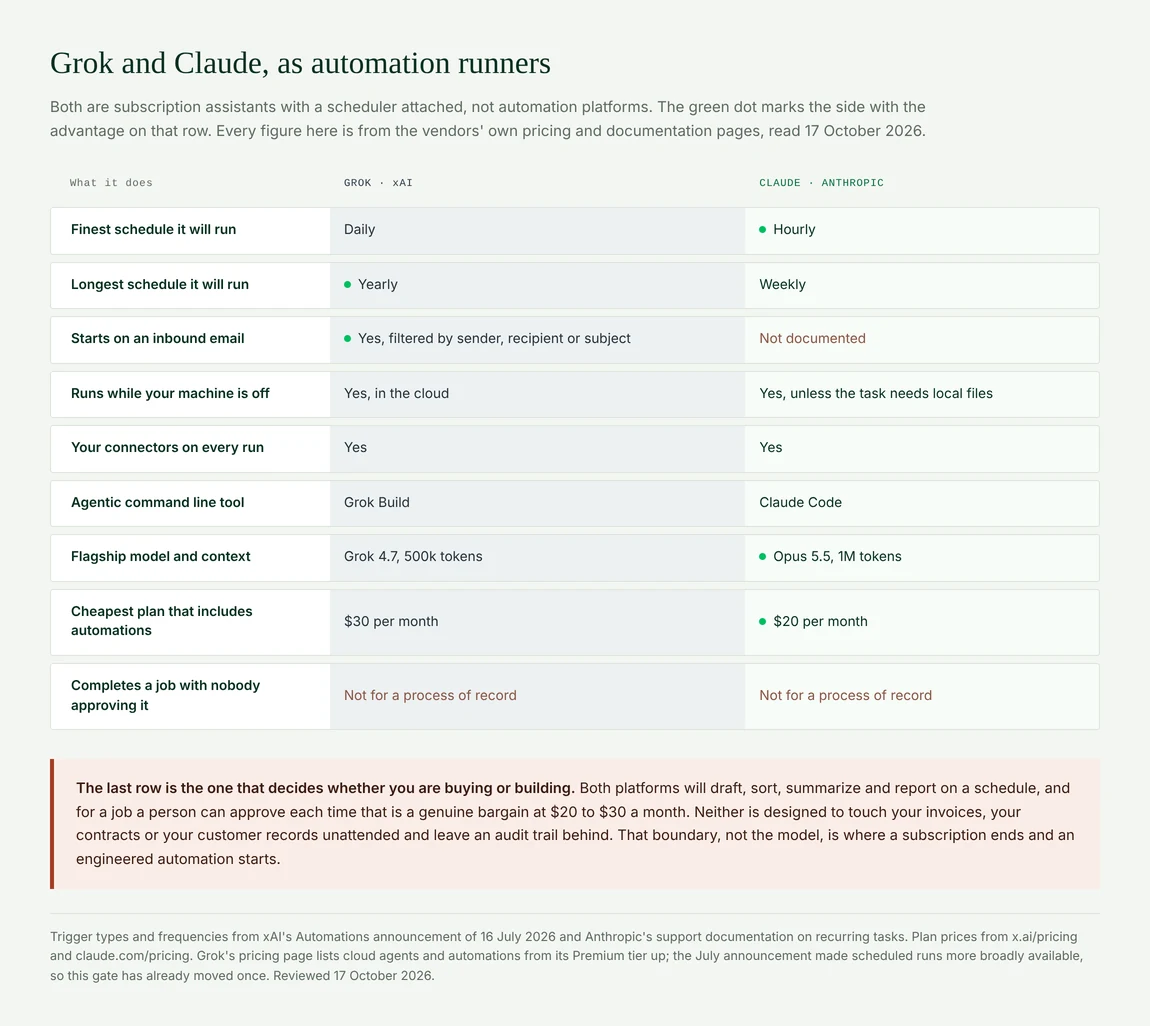
Grok wins on trigger variety, Claude wins on frequency and plan access, and neither runs a production business process on its own. They are closer than the marketing on either side suggests, and both are subscription assistants with a scheduler attached rather than automation platforms.
Grok Automations launched on 16 July 2026. They fire on a schedule set to run once, daily, on weekdays, weekly, monthly or yearly, and they also fire on inbound email matched by sender, recipient or subject. xAI's own description of the setup is plain:
Describe the work once, choose when it runs, and Grok takes it from there. When an automation fires, Grok opens a real conversation, does the work, and saves the result to its run history.
Claude's scheduled tasks cover hourly, daily, weekly, weekdays or manual runs, carry whatever connectors, skills and plugins you have set up, and run remotely so they fire while your laptop is shut. Anthropic's support documentation puts them on every paid plan, which means the floor is the $20 Pro tier. Grok's current pricing page lists cloud agents and automations from its $30 Premium tier up, though the July announcement made scheduled runs broadly available, so the tier that gates this has moved once already in 3 months.
| Capability | Grok | Claude |
|---|---|---|
| Finest schedule | Daily | Hourly |
| Longest schedule | Yearly | Weekly |
| Email trigger | Yes, by sender, recipient or subject | Not documented |
| Runs while your machine is off | Yes, in the cloud | Yes, unless the task needs local files |
| Connectors available on each run | Yes | Yes |
| Agentic command line tool | Grok Build | Claude Code |
| Flagship model and context | Grok 4.7, 500k tokens | Opus 5.5, 1M tokens |
| Cheapest plan with automations | $30 per month | $20 per month |
The command line tools are where the two genuinely diverge, and they are the layer an engineer builds real automations with. DataCamp ran both on the same rigged dataset in 2026 and reported a split worth repeating: Grok Build returned fewer findings but every statistic it cited matched the data, while Claude Code found a production defect the author had missed and also invented 2 sample counts. The lesson is not that one tool is better. It is that checking discipline matters more than model choice, which is exactly why an unattended automation needs a validation step rather than a better prompt.
How much do AI automations cost to run?
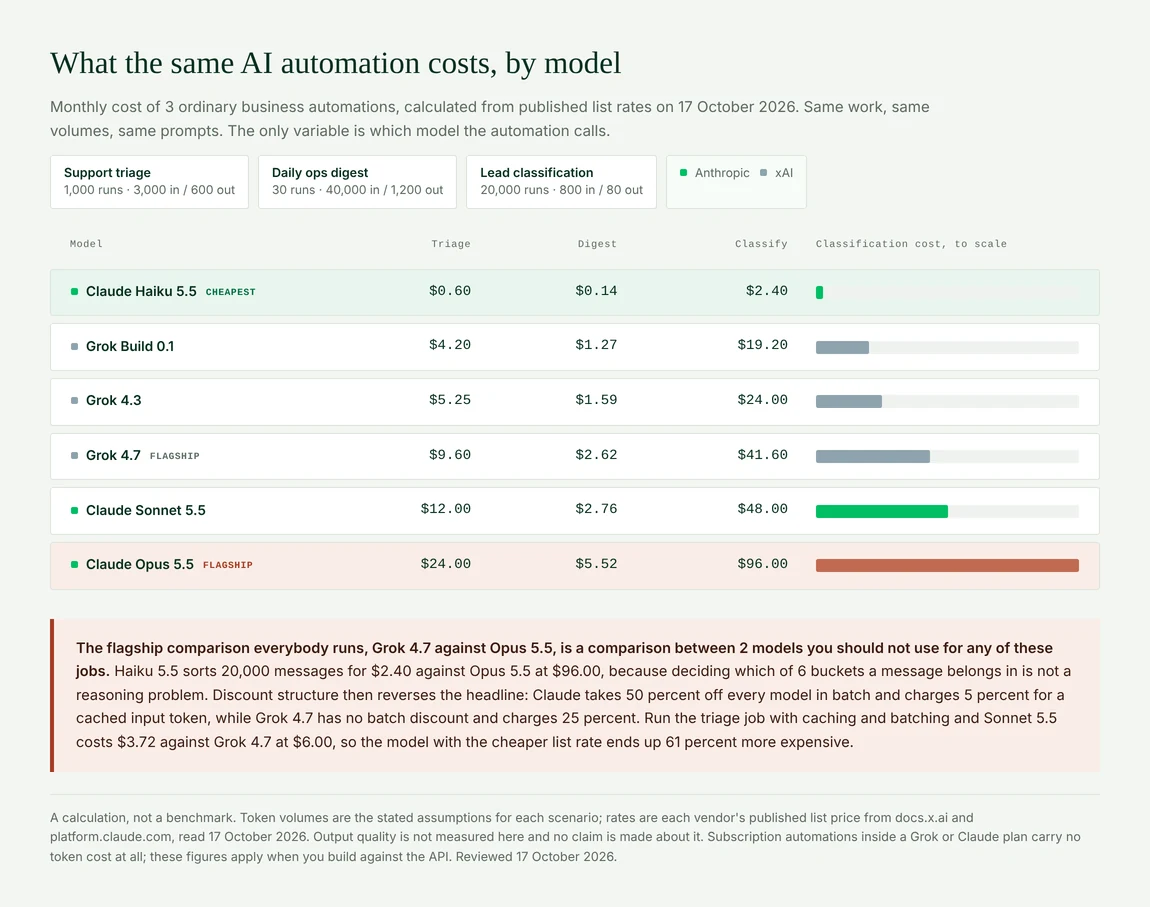
Between $0.19 and $96 a month for the same automation, depending entirely on which model you point it at. Here is the arithmetic for 3 jobs we are asked for constantly, priced at published list rates on 17 October 2026.
Take support triage: read an incoming ticket against your policy, decide what it is about, draft a reply. Call it 1,000 tickets a month, 3,000 input tokens per ticket of which 2,400 is a stable policy prompt, and 600 tokens of output. On Grok 4.7 that is $9.60 a month. On Claude Opus 5.5 it is $24.00. On Claude Sonnet 5.5, $12.00. On Claude Haiku 5.5, 60 cents.
| Model | Support triage, 1,000 runs | Daily digest, 30 runs | Classification, 20,000 runs |
|---|---|---|---|
| Claude Haiku 5.5 | $0.60 | $0.14 | $2.40 |
| Grok Build 0.1 | $4.20 | $1.27 | $19.20 |
| Grok 4.3 | $5.25 | $1.59 | $24.00 |
| Grok 4.7 | $9.60 | $2.62 | $41.60 |
| Claude Sonnet 5.5 | $12.00 | $2.76 | $48.00 |
| Claude Opus 5.5 | $24.00 | $5.52 | $96.00 |
Two findings fall out of this that the vendor pages cannot tell you. The first is that the flagship comparison everyone runs, Grok 4.7 against Opus 5.5, is a comparison between 2 models you should not be using for any of these jobs. Haiku 5.5 does the classification work for $2.40 against Opus 5.5 at $96.00, a 40x difference on a task where the cheap model is entirely capable, because deciding which of 6 buckets a message belongs in is not a reasoning problem.
The second finding only shows up once you apply the discounts both vendors publish. Claude's batch API takes 50 percent off every model, and a cached input token on Sonnet 5.5 costs $0.10 against $2.00 fresh, which is 5 percent. Grok 4.7 has no batch discount at all, and its cached input runs at $0.50 against $2.00, which is 25 percent. Put the same support triage job through caching and batching where the work tolerates a delay and Sonnet 5.5 lands at $3.72 a month while Grok 4.7 stops at $6.00. The model with the cheaper headline output rate ends up costing 61 percent more, purely on discount structure.
None of this is the number most readers actually need, though, and it is worth saying plainly. If you run these jobs inside a Grok or Claude subscription rather than building against the API, you pay the flat $20 to $30 a month and no token fees at all. Token pricing starts mattering at the point you need the job to run without a person approving it, at volume, inside your own systems. That boundary, not the model, is the real decision.
Which AI platform is best for AI automations?
There is no best platform, there is a best match to your trigger and your tolerance for a human in the loop. The honest decision rule, after a lot of these builds, is 4 questions long.
- Does it need to run more than once a day? Claude schedules hourly, Grok does not. That alone settles a lot of cases.
- Does an inbound email start it? Grok triggers on email natively. Claude does not document an email trigger, so you are adding an orchestration layer.
- Can a person approve every run? If yes, either subscription will do and you should pick on price and on which connectors you already use. If no, neither subscription is the answer and you are building.
- Does it touch money, contracts or customer records? Then the question stops being about the model and becomes about the validation and audit trail around it.
On AI automation tools more broadly, the orchestration layer and the model layer are separate choices and most buyers conflate them. Zapier, n8n and Make decide how the work is wired. Grok and Claude decide the quality of the judgment in the middle. You can change the second without touching the first, and designing so you can is worth more than picking correctly today.
Who controls the AI that your automations depend on?
Two very different structures, and for once this is a practical procurement question rather than a philosophical one. If you are about to make a business process depend on a model, the entity behind it is part of what you are buying.
Grok no longer comes from an independent company. SpaceX acquired xAI in an all-stock deal on 2 February 2026 that valued xAI at $250 billion, as Quartz and public records of the transaction both describe. In May 2026 Musk said xAI would cease to exist as a separate company, with Grok and X becoming SpaceX's AI division. The company was rebranded SpaceXAI in July 2026, and on 4 October 2026 was announced as being renamed again. Grok itself continues and the product has kept shipping throughout.
Anthropic is a public benefit corporation whose board is, in its own words, "elected by stockholders and our Long-Term Benefit Trust". The Trust is a separate body, currently Neil Buddy Shah, Richard Fontaine and Ben Bernanke, that participates in choosing directors. Whether that structure does what it is intended to do is a fair argument, and it is a different shape of risk from a single controlling founder.
Neither of these is a reason to avoid either vendor. Both are reasons to design for portability: keep your prompts and your business logic in your own repository, not in a vendor's workflow builder, and keep the model call behind an interface you can repoint. xAI publishes a model retirement guide, which tells you plainly that models you build on do get withdrawn. We treat vendor independence as a build requirement for exactly this reason, not as a prediction about anybody's corporate future.
Can AI reason well enough to run a business process unattended?
Yes for bounded decisions, no for unbounded ones, and the dividing line is whether a wrong answer is detectable. Both vendors now expose reasoning as a dial rather than a feature: Grok 4.7 takes a reasoning_effort parameter, and Claude has extended thinking. More reasoning costs more tokens and more latency, and it buys you less than people expect on the jobs automations actually consist of.
The failure mode worth designing around is not that the model cannot reason. It is that it reasons fluently and wrongly, and says so with the same confidence either way. The DataCamp test above is a clean illustration: the stronger analysis came with 2 fabricated sample counts sitting inside otherwise good work. No amount of reasoning effort fixes that, because the model cannot tell which of its own outputs is the invented one.
What does fix it is making wrong answers detectable. Constrain the output to a fixed set of values and reject anything outside it. Check every number the model emits against the source record rather than trusting the sentence it appears in. Route low-confidence cases to a person instead of to the action. From our work, the automations that survive 6 months in production are not the ones on the best model. They are the ones where a bad run is visible within minutes and costs nothing.
Where does a subscription stop and a build start?
A subscription is the right answer more often than an agency likes to admit. If a person can approve each run and the volume is modest, a $20 Claude plan or a $30 Grok plan will do work that would have cost real money to build 2 years ago, and you should take that deal.
The boundary is attendance. The moment the job has to happen when nobody is at a desk, or has to touch a system the connectors do not reach, or has to be auditable after the fact, you are past what either subscription does. That is the work we do. For Ph3onix we put document extraction behind an OCR pipeline so the data arrived structured instead of being retyped. For PlayFast a free audit found a process spread across 5 separate tools, and we took it from 5 to 1, after which they came back for a second consultation.
We start almost everything with a free AI audit, because the most common finding is that 2 of the 6 jobs a business wants automated should not be, and a paid engagement that begins by telling you what to skip is worth more than one that quotes for all 6. A full audit runs at $3,000 against the $75,000 and up that the enterprise consultancies charge for the same scope. The deeper reasoning behind that process is in our guide to AI audits for business.
How do you get started with AI automation in your business?
Start with one job that already has a written process, a measurable outcome and a tolerable failure. The order matters more than the tooling.
- Pick the job by its denominator, not its drama. Something that happens 200 times a month beats the annual nightmare, because you learn 200 times faster.
- Write the rule a human follows today. If nobody can write it down, the process is not ready and no model will rescue it.
- Run it as a draft first. Let the model propose and a person approve for 2 weeks. You are measuring how often it is right before you let it act.
- Connect the system of record last. Both platforms carry connectors for the common stack, and Claude ships integrations into tools like HubSpot and QuickBooks, so a CRM write-back is usually configuration rather than code. Do it once the judgment is trustworthy.
- Instrument the failure, not the success. Count the runs you had to correct. That number, tracked weekly, is the only honest measure of whether this is working.
No-code builders are a reasonable place to run steps 1 through 3, and they are where most businesses should stay. They tend to hit a ceiling at error handling, at anything needing a real retry policy, and at audit trails, which is also roughly where the jobs that justify a build begin. Our walkthrough of how to build an AI workflow automation covers that transition in detail, and workflow automation for service businesses works through it on live examples.
Can you use AI for automation testing?
Yes, and it is one of the better-behaved uses, because test automation has a built-in correctness check. Both Grok Build and Claude Code run headless with a flag and slot into a CI pipeline, which means a model can write a test, run it, read the failure and iterate without anyone watching.
This works precisely because the feedback is unambiguous. A test either passes or it does not, so the fabrication problem that makes unattended business automation risky gets caught by the test runner itself. The limit is that a model will happily write a test that passes while asserting the wrong thing, so coverage generated this way needs reviewing for whether it tests the requirement, not just whether it is green.
AI automation jobs, engineers and courses: what the work actually involves
The volume of searches for an AI automation engineer, an AI automation specialist and an AI automation course says something true: this is becoming a trade. It is worth being accurate about what the trade consists of, because it is not prompt writing.
The work is roughly 20 percent model behavior and 80 percent everything around it: mapping a process nobody has documented, choosing where a human stays in the loop, designing the retry and escalation path, handling the records that arrive malformed, and building the dashboard that shows whether any of it is working. The people who are good at this came from integration, operations or QA more often than from machine learning. If you are hiring an AI automation agency or an engineer, the question that separates candidates is not which models they know. It is what they do when a run fails at 2am.
Where Codeatic fits
We build the automations that sit past the subscription boundary, for service businesses mostly in the US, Canada and the UK: voice agents that answer when the shop is closed, document pipelines, lead triage that runs on the enquiry rather than on someone remembering to check. We are model-agnostic by design, for the portability reasons above, and we will tell you when a $20 subscription covers what you need.
If you want to know which of your processes are in which category, the free automation audit reads your current setup and returns a rated list, including the jobs we think you should leave alone. Or talk to us about a specific one.
The short version
- An AI automation needs a trigger, a judgment, an action and a write-back. Most products sold as one stop at the draft.
- Grok triggers on email and schedules out to yearly. Claude schedules hourly and starts $10 a month cheaper. Neither runs an unattended production process on its own.
- The same automation ranges from $0.60 to $96 a month on model choice alone. The flagship models everyone compares are the wrong answer for all 3 jobs we costed.
- Claude's discount structure, 50 percent batch on every model and 5 percent cached input, beats Grok's on long-running jobs even where Grok's headline rate is lower.
- Grok now ships from a SpaceX division. Anthropic is a public benefit corporation with a Long-Term Benefit Trust. Design for portability either way.
- Reasoning is sufficient for bounded decisions. Make wrong answers detectable and the model matters far less than the validation around it.
How these figures were arrived at
Every price in this post is a published list rate read on 17 October 2026 from the vendors themselves: xAI's developer pricing, Anthropic's API pricing, x.ai/pricing and claude.com/pricing. Automation mechanics come from xAI's Automations announcement of 16 July 2026 and Anthropic's support documentation on recurring tasks. The hands-on command line comparison is DataCamp's. Corporate structure is from Quartz and Anthropic's own company page. Robot prices are eWeek's August 2026 survey.
The cost table is a calculation, not a benchmark. It assumes the token volumes stated for each scenario and applies each vendor's published rate, including cached input and batch discounts where that vendor offers them. It does not measure output quality, which varies by task and which we make no claim about here. Run the same arithmetic on your own volumes and you will get a different absolute number and the same ranking. Published rates move, so treat anything here as dated to 17 October 2026 and check before you commit. If you find an error in these figures, tell us and we will correct the post and note the correction.
Frequently asked questions
Who controls AI?
No single body does. Each major model is controlled by the company that trains it, and those companies have very different structures. The model behind Grok is now part of SpaceX following its acquisition of xAI on 2 February 2026. Anthropic, which makes Claude, is a public benefit corporation whose directors are elected by stockholders together with its Long-Term Benefit Trust. For a business, the practical form of this question is narrower: whoever controls the model controls its pricing, its retirement schedule and its terms, so keep your logic portable.
How much does AI cost?
For running automations, $20 to $30 a month on a subscription, or fractions of a cent per run on an API. The 3 automations costed above ranged from $0.14 to $96 a month depending on model and volume. A built system is different: the token cost is usually the smallest line item, and the real spend is the design, integration and validation work around it.
Which AI platform is best?
For automations specifically, Claude if you need hourly runs or the lowest plan price, Grok if an inbound email is your trigger. For anything that must run unattended against your own systems, neither subscription is the answer and the platform question becomes an architecture question instead.
Can AI reason?
It can reason well enough to make bounded decisions reliably, such as classifying a message or choosing between known options. Both Grok and Claude now let you turn reasoning up or down per request. What it cannot do is reliably tell you when its own reasoning went wrong, which is why production automations constrain the output and verify the facts rather than trusting the explanation.
How much do AI robots cost?
Physical robots are a separate category from the software automations in this post, and far more expensive. As of eWeek's August 2026 survey, entry-level humanoids start around $4,900 for a Unitree R1 Air, mid-range units run $13,500 to $29,900, and higher-end models reach roughly $100,000. Many industrial humanoids have no public price. Nothing in this post requires hardware.
Is AI automation the same as automation?
No. Conventional automation executes a rule you wrote. AI automation puts a judgment in the middle of that rule, which is what lets it handle inputs you did not anticipate. The tradeoff is that a rule fails predictably and a judgment fails plausibly, so AI automation needs validation that rule-based automation never did.
Can I build this myself, or do I need an AI automation agency?
If a person can approve each run, build it yourself on a subscription and keep the money. Bring in help when the job has to run unattended, write to a system of record, or stand up to an audit, because that is where the cost of getting it wrong exceeds the cost of building it properly. A reputable firm should be willing to tell you which of your processes fall on the do-it-yourself side.
Which model should I actually pick for an automation?
Match the model to the difficulty of the decision, not to the importance of the process. Classification, routing, extraction and tagging run fine on the cheapest tier available. Reserve a flagship model for genuine multi-step analysis. Pointing a flagship at a sorting task is the most common and most expensive mistake we see, and in the figures above it costs up to 40 times more for no gain.