Workflow Automation for Auto Shops and Service Trades
A repair shop, a commercial cleaning firm and a waste collection round look like 3 different businesses and run an identical 5 stage pipeline. Where the automation goes at each stage, which stage each industry loses most at, what the manual version costs, and the builds we have shipped for businesses running this exact shape.
On this page
Workflow automation for a service business means the job record moves itself: the enquiry becomes a booking, the booking becomes a work order on a technician's phone, the completed work becomes an invoice, and the invoice chases itself. Nobody retypes anything, and nothing falls between the stages.
A repair shop, a commercial cleaning firm and a waste collection round look like 3 different businesses. Operationally they are the same business with different vehicles. All 3 run an identical 5 stage pipeline, and all 3 lose money at the same 2 stages. This covers where the automation goes, what it is worth, and what we have built for businesses running exactly this shape.
Why a repair shop and a waste round are the same business
Strip out the trade and every service operation does 5 things in order. Work arrives. It gets scheduled. Somebody does it. Somebody proves it was done. Somebody gets paid.
The trade changes what happens at each stage, not the stages themselves. That is why an automation built for a mechanic transfers almost directly to a cleaning contractor: the objects are different, the joints between them are identical. It also explains why buying trade specific software solves less than people expect. The problem is rarely that your software does not understand brake pads. It is that stage 3 ends in a notebook and stage 5 starts in a spreadsheet, and a person carries the information between them.
Where does workflow automation actually go?
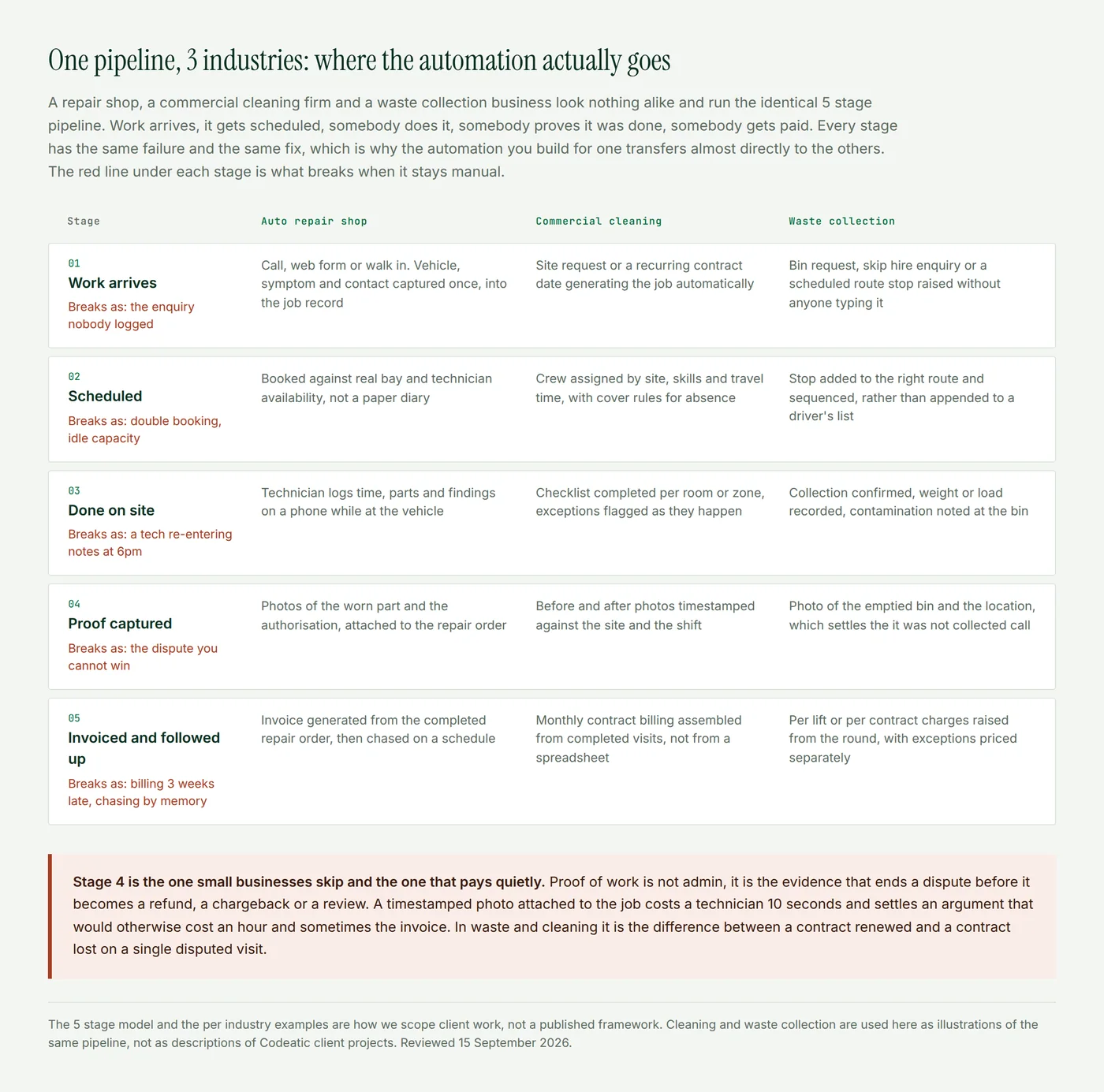
Two observations from running this across client work. The stage most businesses want to automate first is stage 2, scheduling, because that is where the visible chaos is. The stage that usually pays back faster is stage 5, because late invoicing is a cash flow problem compounding silently in the background while everyone worries about the diary.
And stage 4, proof of work, is the one almost nobody thinks of as automation at all. It is 10 seconds of a technician's time and it is the difference between winning and losing a dispute.
What is the manual version costing you?
The numbers in this category come mostly from field service software vendors, so treat them as directional rather than precise. They point the same way regardless.
Industry analysis of field service operations puts administrative tasks at roughly 30% of an average technician's working hours, which is close to a third of the day spent on paperwork, phone calls and fetching information. A 2026 trades playbook reports that 73% of field technicians say they spend excessive time on paperwork, and that businesses integrating job management with their accounting system save 15 to 20 hours a week on manual data entry alone.
On the office side, workforce data compiled in 2026 puts manager time on scheduling and related admin at 6 to 11 hours a week, close to a quarter of a working week spent purely on coordination. The same compilation notes the well documented finding that 88% of business spreadsheets contain errors, which matters because the spreadsheet is usually what holds stages 2 and 5 together in a business that has not automated them.
Take the middle of those ranges for a 3 technician shop and you are looking at the better part of a full time salary spent moving information between stages that could move itself.
Auto and tech shops specifically
Repair businesses have a particular version of the problem: the work happens away from the keyboard. A technician with a vehicle on the lift or a device open on the bench is not going to walk to the office to log a part, so the logging happens later, from memory, or not at all.
Three automations that consistently earn their place in a shop.
Job intake that captures once. Vehicle or device, symptom, customer, contact, all recorded at the moment of the enquiry and never retyped. If you also want the phone answered when nobody can pick up, our voice agent piece for repair shops covers that specific case.
Mobile capture at the bay or bench. Time, parts and findings logged on a phone where the work is happening, with photos attached to the job. This single change removes most of the 6pm paperwork and most of the billing disputes.
Authorisation and invoice off the same record. The estimate, the customer approval and the final invoice all generated from one job record, so the number the customer approved is the number they receive.
Tech repair shops add one more: status. A queue of devices with no automatic customer updates generates a constant stream of is it ready calls, and each one interrupts the person doing the repairs.
Cleaning and waste: the proof problem
These 2 industries share a characteristic that changes the priority order. The customer is usually not present when the work is done.
For a commercial cleaning contractor, the client sees an office in the morning and has no idea what happened at 10pm. For a waste operator, the customer sees an empty bin or a full one and draws conclusions. In both, the most expensive recurring cost is not inefficiency, it is the disputed visit: the claim that nobody came, or that it was not done properly, which arrives weeks later when nobody can remember.
So in these businesses stage 4 moves to the front of the queue. A timestamped photo against the site and the shift, captured automatically as part of completing the job, settles those conversations permanently. Route and rota automation matters too, but proof is what protects contract renewals, and contract renewals are the whole business model.
What we have built
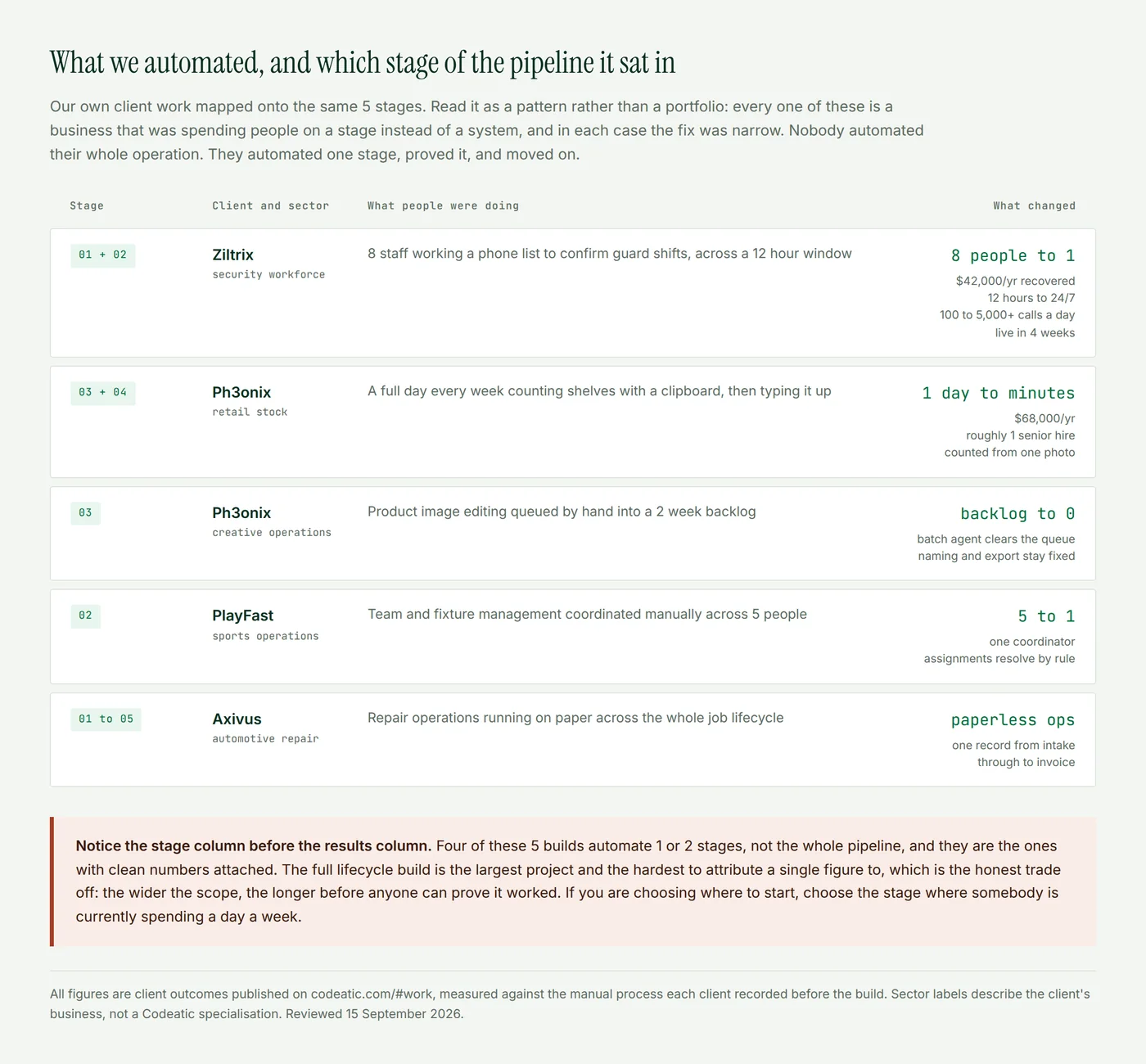
From our work. The pattern across these builds is that none of them automated an entire operation. Ziltrix replaced a phone list with a voice agent at stages 1 and 2, taking shift confirmation from 8 people to 1, coverage from 12 hours to 24/7, daily capacity from 100 calls to more than 5,000 and recovering $42,000 a year in salary, live in 4 weeks. The shift records still write by rule. Ph3onix replaced a clipboard with a photo at stages 3 and 4, turning a full day a week of shelf counting into minutes and saving roughly $68,000 a year, about the cost of a senior hire, while the reorder thresholds stayed exactly as they were. A separate batch agent took their 2 week image editing backlog to zero, and PlayFast went from 5 people coordinating fixtures to 1.
The lesson we keep relearning is that the scope has to be narrow enough to prove. Both of those projects started with a broader brief and got cut in half before they worked. The full lifecycle build in that table, the paperless automotive operations platform, is the largest project and the hardest to attach a single clean number to, which is the honest trade off with scope.
Which stage should you automate first?
Find the stage where someone spends a day a week. Not the stage that annoys you most. The one consuming actual hours.
Check it is consistent. If 2 people do it differently, fix the process before automating the disagreement.
Automate the handoff, not the task. Most of the waste in a service pipeline is at the joints between stages, not inside them.
Measure the before. Time it for a week. Without a baseline you cannot prove the build worked, and unprovable value is the first thing cut.
Run it beside the manual process for 2 weeks before you remove the manual process.
For the general version of this decision, including what these automations cost to run and how they fail once nobody is watching, our guide to workflow automations covers the platform choice and the maintenance side.
Where Codeatic fits in
We build workflow automation for service businesses, usually where an off the shelf job management tool does not reach: a system with no clean API, a process that needs judgment in the middle, or a set of stages held together by a spreadsheet and somebody's memory.
If your whole problem is that jobs arrive by phone and get written on a pad, a standard field service platform will probably solve it cheaper than we will, and we will tell you that. The AI Opportunity Audit maps your 5 stages, finds where the hours actually go and returns a costed shortlist, and there is a free self serve version if you want to run it yourself first. Our published client work has the detail behind the figures above.
When not to automate a stage
When it runs a few times a month, because the payback never arrives and you have added something to maintain. When the process is inconsistent between people, because you will encode the inconsistency. And when the stage is where customers actually experience your business, such as the conversation about extra work or a complaint, since automating the part people value is how efficiency turns into churn.
The short version
Every service business runs the same 5 stages: work arrives, gets scheduled, gets done, gets proved, gets invoiced. Repair shops lose most at stage 3, because the work happens away from a keyboard and the logging happens later or never. Cleaning and waste businesses lose most at stage 4, because the customer is not there and the disputed visit is the expensive event. Automate the handoffs between stages rather than the tasks inside them, start where somebody is spending a day a week, and baseline it before you build so you can prove it worked.
How these figures were arrived at
The 5 stage model, the per industry examples and the ordering advice come from how we scope client work, not from a published framework. Commercial cleaning and waste collection appear as illustrations of the same pipeline and are not descriptions of Codeatic client projects. Client figures are outcomes published on our case study page, measured against the manual process each client recorded before the build. Statistics on technician admin time, paperwork and scheduling overhead come from field service software vendors and industry compilations rather than independent studies, which is why they are attributed inline with their source and year and presented as directional rather than precise.
Reviewed 15 September 2026 by Usama Tariq, Co-Founder and CTO. If you find an error in this post, email info@codeatic.com and we will publish a correction on the page rather than editing it quietly.
Frequently asked questions
What is workflow automation for a service business?
It is making the job record move itself through the 5 stages of a job: arrival, scheduling, completion, proof and invoicing. Instead of a person carrying information between a phone call, a diary, a notebook and a spreadsheet, each stage hands off to the next automatically.
Which workflow should an auto repair shop automate first?
Mobile capture at the bay, if technicians are logging time and parts from memory at the end of the day. If the paperwork is already digital, move to invoicing off the completed repair order, since late billing is usually the quieter and more expensive problem.
Does workflow automation work for cleaning and waste businesses?
Yes, and the priority is different. Because the customer is rarely present when the work happens, proof of work matters more than scheduling. Timestamped photos captured as part of completing a job settle disputed visits, and disputed visits are what cost contracts.
Do I need AI for workflow automation?
Not for most of it. The 5 stage pipeline runs on rules: triggers, conditions and actions. AI earns its place only at steps where information arrives unstructured, such as reading a photographed document or a written enquiry, or where something has to be drafted in words.
How much time does this actually save?
Industry figures put technician admin at roughly 30% of working hours and manager scheduling time at 6 to 11 hours a week, with 15 to 20 hours a week reported saved when job management is integrated with accounting. Those come from vendors, so treat them as directional and time your own tasks for a week instead.
Should I buy field service software or have something built?
Buy first. If an off the shelf platform covers your stages, it will be cheaper and faster than anything custom. Custom work is for the cases where a system has no usable API, where pricing or job costing does not fit a standard model, or where a stage needs judgment that no connector handles.
What breaks after you automate?
Connected apps change their APIs, credentials expire, and an unexpected input arrives that the build never saw. The dangerous part is that most failures are silent, so build alerting and a check that the automation ran at all, not just that it ran without errors.
How long does a build take?
For one stage touching 2 or 3 systems with usable APIs, a few weeks from scoping to running alongside the manual process. Multi stage builds take considerably longer and are harder to attribute a clean result to, which is why we recommend starting with one stage.
Abdul Wahab, Co-Founder and CEO, Codeatic
Abdul has spent 5 years building software, across web stacks and mobile in React Native, Flutter and native Android, before moving into product, architecture and AI work. He holds an MS in Computer Science from PUCIT and leads Codeatic, an AI automation agency working with SMBs and startups across the US, Canada, the UK and Saudi Arabia. Connect on LinkedIn.
Technically reviewed by Usama Tariq, Co-Founder and CTO, Codeatic. Usama is an AI and computer vision engineer who builds production systems from unstructured video, image and speech data. He built the REVOX engine at Veedback, developed LLM and computer vision systems at Coeus Solutions GmbH, and led AI model development at OMNO AI. He is an OpenCV OAK-D finalist and a contributor to Workhub, and holds a BS in Computer Science from COMSATS University Islamabad. Connect on LinkedIn.