Voice Agent for Auto Repair Shops: The Missed Call Fix
A repair shop's phone is its booking system, and it rings hardest when nobody can pick it up. What those calls are worth, which ones to hand a voice agent first, why after hours is where the tow ins are, and the bay capacity ceiling that makes most vendor revenue claims fiction.
On this page
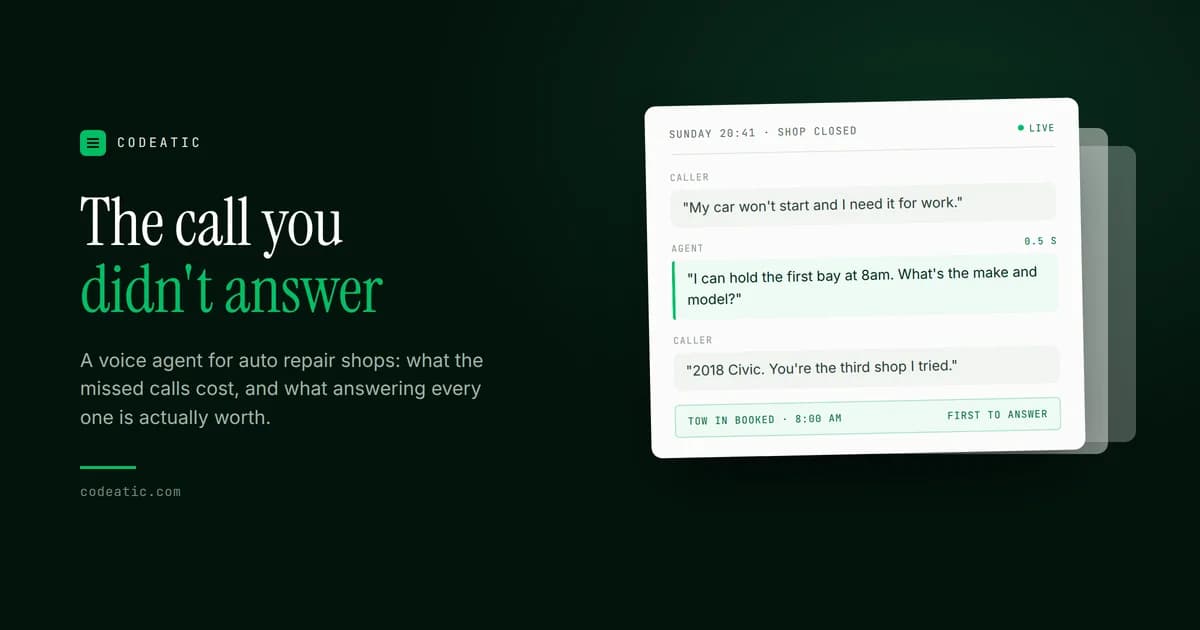
A voice agent answers your shop's phone when nobody can: after hours, at 9am when the counter is three deep, and during the zero revenue status calls that pull your service advisor away from the calls that book work. It captures the vehicle, the problem and the contact, and holds a bay against your real diary.
For an auto repair shop the case is unusually simple, because the phone is the booking system. A call that rings out is not a missed conversation, it is an empty bay on Tuesday. This covers what those calls are worth, which ones to hand over first, and the constraint that makes most vendor revenue claims nonsense.
On this page
- Why do shops miss calls they would book?
- What kind of calls does a shop actually get?
- Why is after hours where the money is?
- What is answering every call worth?
- The bay ceiling nobody mentions
- What we built, and what it taught us
- How a repair shop starts
- How these figures were arrived at
- Frequently asked questions
Why do shops miss calls they would happily book?
Not because anyone in a repair shop is careless. Because the phone rings when hands are dirty. The tech is under a vehicle, the advisor is writing up a drop off, and there is a customer at the counter who is physically present in a way the caller is not.
The timing makes it worse. Car Wars analysis across roughly 3,000 dealership service operations found the peak call window is 8:00am to 11:30am, which is exactly when morning drop offs and check ins are happening. The busiest hour for calls is the busiest hour for everything else.
How many get lost varies by who is counting, and this is a category where nearly every published number comes from a company selling call answering. The more defensible figure comes from Marchex call analytics across multi-location service operators, which puts unanswered, dropped or mishandled calls at 20% to 30%, with the best locations near 10%. Treat anything dramatically higher than that with suspicion, including on this page.
What is not disputed is what callers do next. Hold is not a waiting room: one analysis of nearly 3,000 dealerships found that 31.8% of unconnected calls were customers hanging up while on hold, against an average hold time of 3 minutes and 5 seconds. They call the next shop.
What kind of calls does a shop actually get?
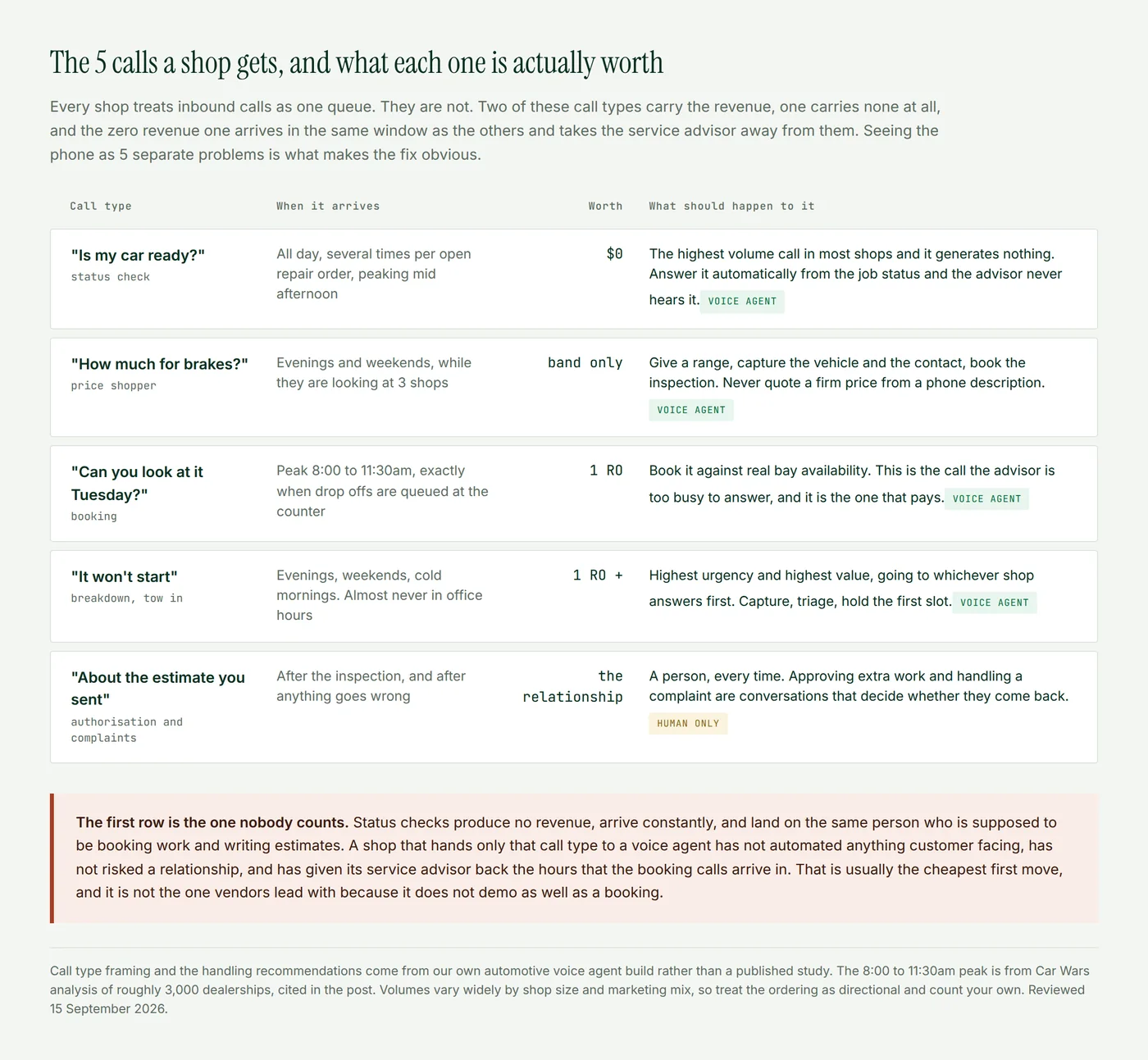
The first row is the one worth sitting with. Status checks generate no revenue, arrive constantly, and land on the person who is supposed to be booking work. Hand only that call type to a voice agent and you have automated nothing customer facing, risked no relationship, and handed your advisor back the hours the booking calls arrive in.
It is also worth knowing how valuable the calls a repair shop does answer are. Car Wars benchmark data reported phone leads converting into appointments 74% of the time against 40% for internet leads. The people who call are further along in the decision than the people who fill in a form, which is precisely why letting the phone ring out is more expensive than it feels.
Why is after hours where the money is?
This is the part of the case that is specific to auto repair. Cars fail on the way home from work, on Sunday mornings, and on the first cold day of the year. The no start and the tow in are the highest urgency calls a shop gets, they carry above average repair order value, and they go to whoever answers first. Not whoever is best. Whoever answers.
76 of the 168 hours in a week fall outside a standard 8 to 6 weekday operation. For most independents the honest description is that the shop is unreachable for more than half of the week, during the exact hours when the vehicle problems that cannot wait actually happen.
Voicemail does not bridge it. Figures published by Hiya and compiled in 2026 reviews put voicemail abandonment above 80%, and a separate compilation puts it at 85% of callers who never call back. Either way, the answering machine is not answering anything.
What is answering every call worth to a repair shop?
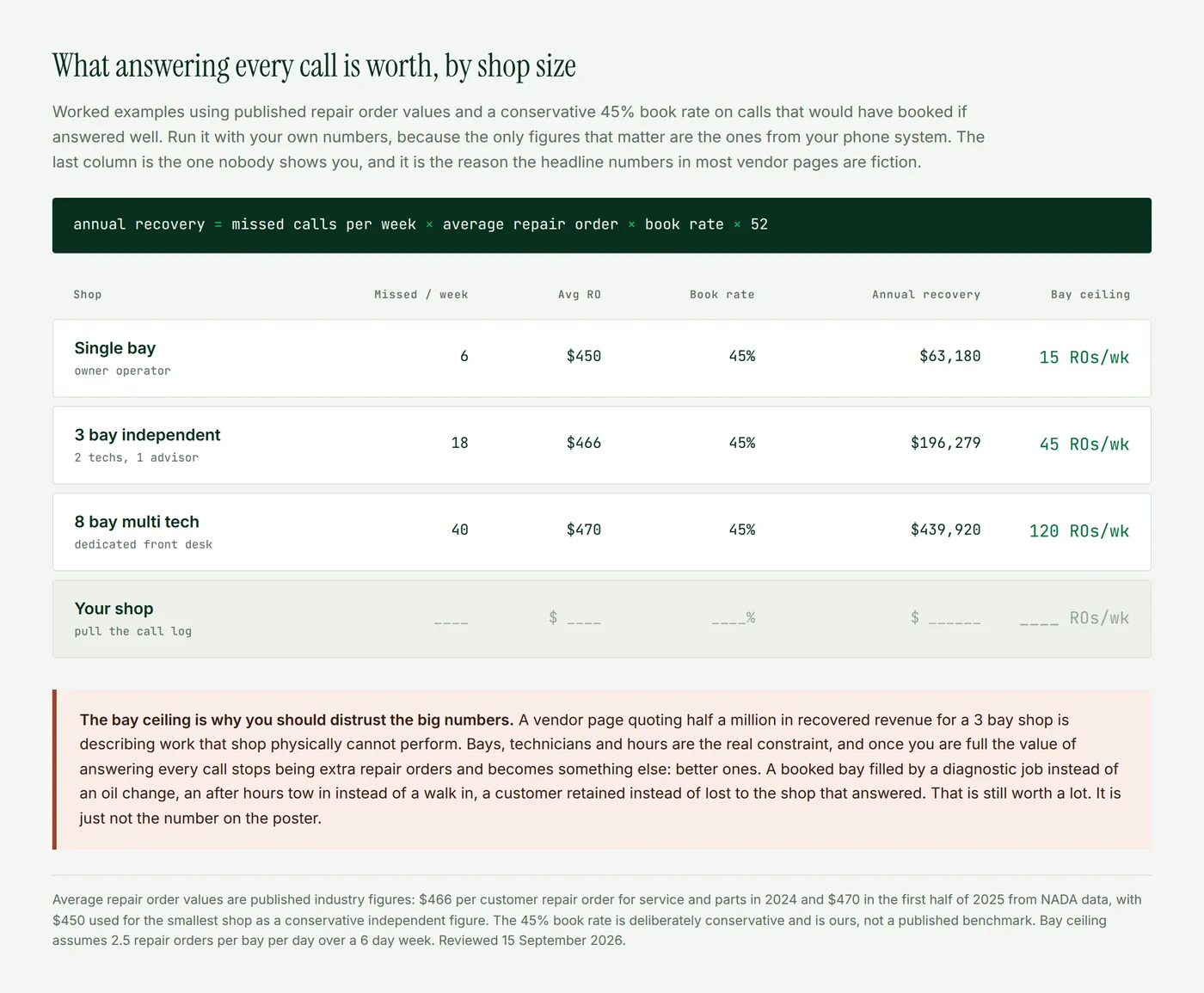
Two things about that table. The book rate of 45% is deliberately conservative and it is ours rather than a published benchmark, because a missed call is not automatically a lost customer and treating it as one is how vendors inflate the case. And the repair order values are published industry figures rather than yours: NADA data put service and parts at $466 per customer repair order in 2024 and $470 in the first half of 2025.
The bay ceiling nobody mentions
You cannot service more cars than you have bays and technicians. A vendor page promising a 3 bay shop half a million dollars in recovered revenue is describing work that shop physically cannot perform, and every owner reading it knows that, which is why those pages do not convert the people they should.
Once you are at capacity, answering every call stops producing extra repair orders and starts producing better ones. The bay that would have held an oil change holds a diagnostic job. The Sunday tow in takes the Monday slot instead of the walk in who could have come Thursday. The customer who would have found another shop stays yours, and AAA consumer research puts a loyal repair customer at roughly $4,200 over the relationship. That is a real return. It is just a different argument, and it is the one that survives contact with a shop owner who can count bays.
What we built, and what it taught us
From our work. We built a voice agent for mechanic shops that takes inbound calls and books appointments entirely by voice, with one deployment serving multiple shops and routing by the number the caller dialled. It runs on LiveKit for orchestration, Deepgram for speech, an OpenAI model for reasoning and Silero for detecting when the caller has stopped speaking. It is a demo still under test rather than a live shop deployment, and we would rather say that than imply otherwise.
The engineering lesson was that the model was never the hard part. Response lag started at 1.5 seconds, which on a live call is long enough that people talk over it, and we brought it to 0.5 seconds almost entirely by working on voice activity detection thresholds and the round trip to the booking system. We also had to switch off preemptive generation, the trick of speaking a filler phrase while the real answer computes, because it was dropping the booking call afterwards and leaving the line silent. On a phone call, silence is worse than slowness.
The deployment that is live and measured is in a different industry: Ziltrix, a security workforce platform, where shift confirmation calls went from 8 staff to 1, coverage from 12 hours to 24/7, daily capacity from 100 calls to more than 5,000, and $42,000 a year in salary recovered, live in 4 weeks. The call pattern is the same shape as a shop's.
How a repair shop starts
- Pull last month's call log and split it by hour. Count what came in outside opening hours and what rang out during them. This takes 20 minutes and it is the entire business case.
- Start with status calls only. Lowest risk, highest volume, zero revenue at stake, and it buys your advisor back the morning.
- Add after hours booking next. The tow in at 9pm is the call with the clearest value and nobody is currently answering it.
- Set the bypass list. Fleet accounts, regulars and anyone who has complained recently go straight to a person.
- Never let it quote a firm price. A range and an inspection booking. A phone description of a noise is not a diagnosis, and a quoted number you cannot honour is an argument on the driveway.
Where Codeatic fits in
We build voice agents for service businesses, and the auto repair receptionist is the build we know best. If you run a shop and want to see one working, we can walk you through a live demo call rather than a recording, and tell you honestly whether your call volume justifies it.
Our guide to how voice agents work covers latency, cost and the disclosure rules, and the customer service piece covers where a voice agent makes service worse rather than better. Our published client work has the detail behind the Ziltrix numbers, and the AI Opportunity Audit is the paid version of step 1 above.
When a repair shop should not buy a voice agent
When the owner answers the phone and genuinely gets to all of it, which is true of plenty of single bay operations. When you are already booked 3 weeks out and turning work away, because more booked work is not your problem and the honest sale is nothing. And when your issue is not answer rate but what happens after the answer, since a faster route to a bad experience is not an improvement.
The short version
An auto repair shop's phone is its booking system, and it rings hardest exactly when nobody can pick it up. A voice agent answers every call, at any hour, and holds a bay against your real diary. Start with status calls, because they are the highest volume and worth nothing, then add after hours booking, which is where the tow ins are. Expect the gain to cap at your bay capacity, and once it does, the value shifts from more work to better work and retained customers. Never let it quote a firm price, and always route fleet accounts and complaints to a person.
How these figures were arrived at
The call type framing, the handling recommendations and the 45% book rate come from our own automotive voice agent build, not from a published study. Repair order values are published industry figures from NADA, with a conservative $450 used for the smallest shop. The bay ceiling assumes 2.5 repair orders per bay per day over a 6 day week, which you should replace with your own throughput. Most missed call statistics circulating in this industry are published by companies selling phone answering, so we have leaned on Marchex and Car Wars data where possible and attributed each figure to its source and year inline. The automotive latency figures are from a demo still under test, measured from the end of caller speech to the first audio the caller hears. The Ziltrix figures are client outcomes published on our case study page, measured against the manual process the client recorded before the build.
Reviewed 15 September 2026 by Usama Tariq, Co-Founder and CTO. If you find an error in this post, email info@codeatic.com and we will publish a correction on the page rather than editing it quietly.
Frequently asked questions
How does a voice agent help an auto repair shop?
It answers every inbound call instantly, including after hours and when several people call at once, captures the vehicle and the problem, and books against your real bay availability. In practice the biggest gain is absorbing status check calls, which generate no revenue but occupy the service advisor during the hours when booking calls arrive.
Can a voice agent book a job into my shop's diary?
Yes, if your scheduling system has an API or a usable integration path. The agent checks real availability and holds the slot rather than taking a message. If your diary is a paper book, that becomes the first thing to solve.
Will it quote prices to customers?
It should give a range and book an inspection, never a firm price. A phone description of a noise is not a diagnosis, and a number the shop cannot honour turns into an argument at collection. Quoting is a rules and human decision, not something to leave to a model.
What happens when a customer wants to speak to a person?
It transfers, immediately. A well configured agent also transfers on detected frustration, and a bypass list sends fleet accounts, regulars and recent complainants straight to a human without ever reaching the agent.
How much revenue do missed calls actually cost a shop?
Multiply your missed calls per week by your average repair order by a conservative book rate by 52. At a $466 repair order and a 45% book rate, a 3 bay shop missing 18 calls a week is looking at roughly $196,000 a year. The realistic ceiling is your bay capacity, so treat larger vendor claims with caution.
Do customers mind talking to an AI when their car breaks down?
Far less than they mind voicemail at 9pm with a car that will not start. Disclose that it is an AI assistant in the first sentence, keep the scope narrow, and transfer quickly when asked. Being answered matters more to a stranded driver than who answers.
Is a voice agent only for big shops and dealerships?
No, and the economics can be clearer for small ones. A single bay operator has nobody to answer the phone while working, so the proportion of calls lost is often higher than at a shop with a dedicated front desk. The absolute numbers are smaller but the leak is proportionally larger.
How long does it take to set up?
For a shop with a schedulable system and clear service rules, a few weeks from scoping to running alongside your existing phone handling. The variable is almost never the AI, it is whether your diary and customer records can be reached programmatically.
Abdul Wahab, Co-Founder and CEO, Codeatic
Abdul has spent 5 years building software, across web stacks and mobile in React Native, Flutter and native Android, before moving into product, architecture and AI work. He holds an MS in Computer Science from PUCIT and leads Codeatic, an AI automation agency working with SMBs and startups across the US, Canada, the UK and Saudi Arabia. Connect on LinkedIn.
Technically reviewed by Usama Tariq, Co-Founder and CTO, Codeatic. Usama is an AI and computer vision engineer who builds production systems from unstructured video, image and speech data. He built the REVOX engine at Veedback, developed LLM and computer vision systems at Coeus Solutions GmbH, and led AI model development at OMNO AI. He is an OpenCV OAK-D finalist and a contributor to Workhub, and holds a BS in Computer Science from COMSATS University Islamabad. Connect on LinkedIn.