What Is an AI Agent? A Practical Guide for Business Owners
An AI agent takes a goal and completes the steps itself across your systems, which is what separates it from a chatbot that only talks. This guide covers how agents work, what they cost, where they pay off in a small business, and the four tests that decide whether a task is worth handing over at all.
On this page
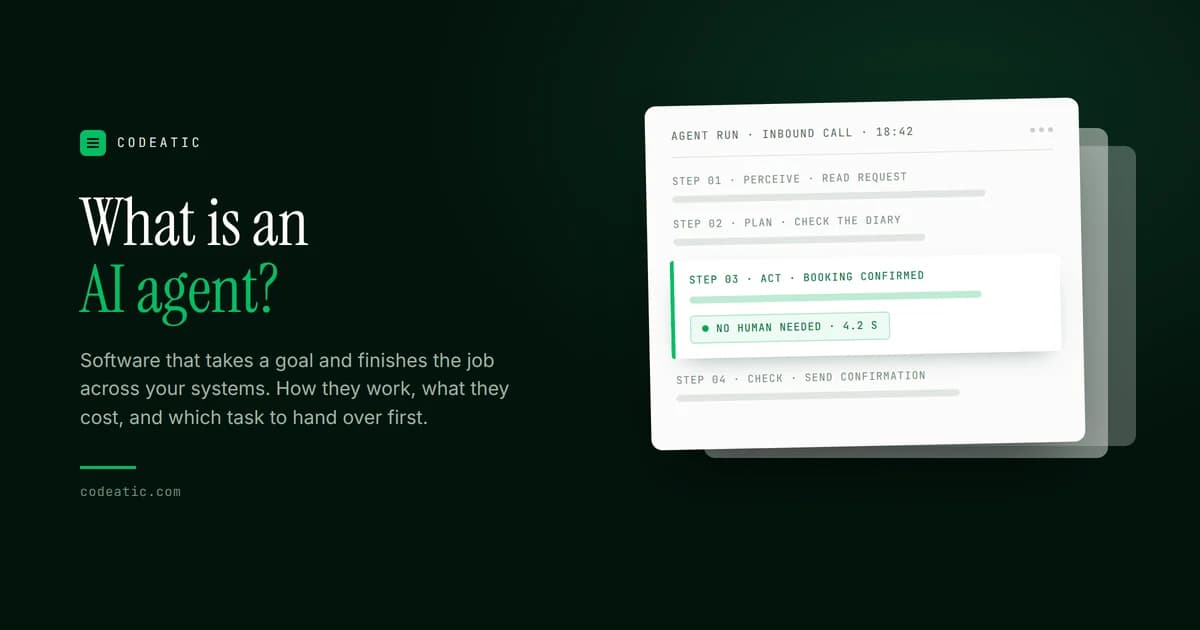
An AI agent is software that takes a goal, works out the steps needed to reach it, and carries those steps out across your real systems without a human approving each one. A chatbot gives you words back. An agent books the appointment, updates the record, sends the follow up, and tells you when it is done.
That distinction sounds academic until you are the one paying for it. Most of what is sold as an AI agent in 2026 is a chatbot with a few buttons, and most agent projects that fail were scoped as though the technology were magic rather than a tool with a specific shape. This guide covers what an agent actually is, how to tell a real one from a rebranded one, where they pay for themselves in a small business, and how to pick a first project that will still be running in six months.
What is an AI agent?
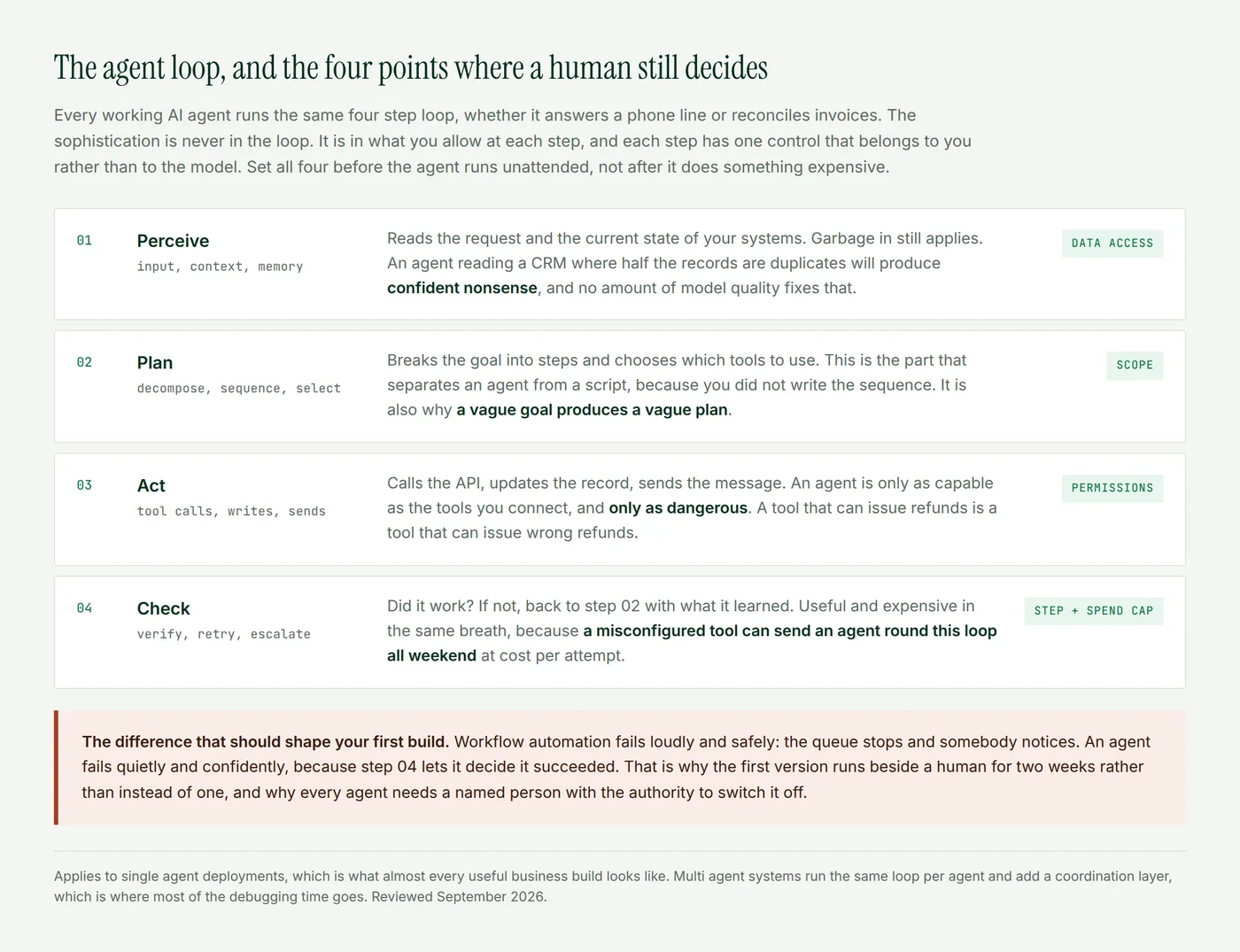
An AI agent is a system that perceives its environment, reasons about a goal, uses tools, and acts over multiple steps with a meaningful amount of autonomy. Strip away the marketing and there are seven things that separate an agent from everything else being sold under the same word.
- It takes a goal, not an instruction. You give it an outcome to reach. It is not waiting for you to specify each move.
- It plans its own sequence. The order of steps comes from the model, not from a flowchart you drew in advance.
- It uses tools. It calls your APIs, reads your database, sends messages, moves files. It has effects outside a chat window.
- It observes the result. After acting, it checks what happened rather than assuming the action landed.
- It retries and adapts. When a step fails, it revises the plan instead of stopping the queue.
- It carries memory. It knows what happened earlier in the task, and often across tasks, so it is not meeting your business fresh every time.
- It knows when to stop. A well built agent escalates to a human at a defined boundary instead of improvising past it.
Miss the first two and you have a chatbot. Miss the middle three and you have workflow automation with a language model attached. Miss the last one and you have a liability.
IBM defines an AI agent as a system that performs tasks on behalf of a user by designing its own workflow and using available tools. Google Cloud frames it around reasoning, planning and memory with enough autonomy to decide and adapt. Both land in the same place: the agent owns the how, you own the what.
AI agent vs chatbot vs workflow automation
Three different products, one word, and a lot of confused purchase decisions. The honest comparison:
| Chatbot | Workflow automation | AI agent | |
|---|---|---|---|
| Decides the steps | No | No, you draw the flow | Yes |
| Handles the unexpected | Falls back to a human | Breaks | Replans and retries |
| Touches your systems | Rarely | Yes, on fixed rules | Yes, by choosing tools |
| Cost model | Per conversation | Per run, predictable | Per step, variable |
| Best for | FAQs and triage | Identical repeated tasks | Variable tasks with a clear goal |
| Fails by | Saying it does not know | Stopping the queue | Doing the wrong thing confidently |
The last row is the one to sit with. Automation fails loudly and safely. Agents fail quietly and expensively, because the same autonomy that makes them useful also lets them decide they succeeded. That single difference should shape your permissions, your spend caps, and how much you let run unattended in month one.
Gartner has a name for the confusion. It calls the practice of rebranding existing chatbots and robotic process automation as agentic agent washing, and estimates that only around 130 of the thousands of vendors making agentic claims are doing the real thing. Run the seven point list above at any vendor before you talk about price.
How does an AI agent actually work?
Underneath every agent, from a voice receptionist to a coding assistant, sit three components. Vendors will use these words, so they are worth knowing.
- The model is the reasoning engine. It decides what to do next. This is the part everyone talks about and the part you will spend the least time on.
- Tools are the functions the agent is allowed to call. Your calendar, your CRM, a payment API. An agent is exactly as capable as the tools you connect, and exactly as dangerous.
- Memory is what it carries between steps and sessions. Without it, every interaction starts from zero and the agent cannot learn that this customer already called twice.
Around those sit the guardrails, and the guardrails are the actual engineering. Deciding what the agent may touch, what it must escalate, how many attempts it gets, and how much it may spend getting there is where a demo becomes a system you can leave running.
What can AI agents actually do for a small business?
The pattern is consistent. Agents pay for themselves fastest on high volume, low judgment work that currently interrupts somebody expensive. Not the strategic work. The interruptions.
- Inbound calls and booking. A voice agent that answers every call, qualifies the job, checks the diary, and books it. The calls a small team misses after 6pm are pure lost revenue, and they are the easiest revenue in the business to recover.
- Quote and enquiry triage. Reading what comes in, extracting the details, scoring it, and routing it to the right person with a draft reply attached.
- Back office reconciliation. Matching invoices to jobs, flagging what does not add up, chasing what is late on a schedule nobody has to remember.
- Field and inventory capture. Vision based agents that read a photo of a shelf, a part, or a damaged panel and write the result into the system of record without anybody typing it.
- Reporting nobody has time to run. Pulling from three systems on a schedule and producing the summary a manager would otherwise assemble by hand on a Friday afternoon.
From our work. On Ziltrix, a security workforce management platform, we put a voice agent into the dispatch process so routine scheduling calls resolve without a dispatcher picking up. On Ph3onix we went the vision route instead, with agents handling inventory scanning and product photography cleanup that used to be manual.
The lesson from both was the same, and it had nothing to do with the model. Each one only became reliable after we cut the job description in half. The first scope was too broad in both cases. Narrowing it is what made the thing work.
Why do so many AI agent projects get cancelled?
More than 40 percent of agentic AI projects will be cancelled by the end of 2027 because of escalating costs, unclear business value, or inadequate risk controls, according to Gartner.
Read the reasons rather than the number. Cost, value and controls are all decided before a line of code is written. That is not a verdict on the technology, it is a verdict on how these projects get scoped.
What we see going wrong, in order of frequency:
- No number attached to the job. If you cannot say what the agent is worth per month in hours saved or revenue captured, the project has no defense the first time budgets tighten.
- The scope is a department, not a task. An agent for customer service fails. An agent that reschedules appointments ships.
- Messy underlying data. An agent reading a CRM full of duplicates produces confident nonsense. This is the most common blocker we hit and it is not an AI problem.
- No owner and no off switch. Somebody has to be accountable for what the agent does, with the authority to stop it.
- Nobody measured the before. If you did not record how long the task took last quarter, you cannot prove the agent helped, and unprovable value gets cut.
Worth holding onto for context: US Census Bureau data from May 2026 shows roughly 37 percent of American firms with 250 or more employees using AI in producing goods or services, against under 20 percent of the smallest firms. Adoption surveys report wildly different numbers because they measure different things, from one experiment with a chatbot to AI embedded in daily operations. The gap that matters is not who has tried AI. It is who has one thing running in production.
How to choose your first AI agent
Score any candidate task on four tests before committing. The fourth carries a veto.
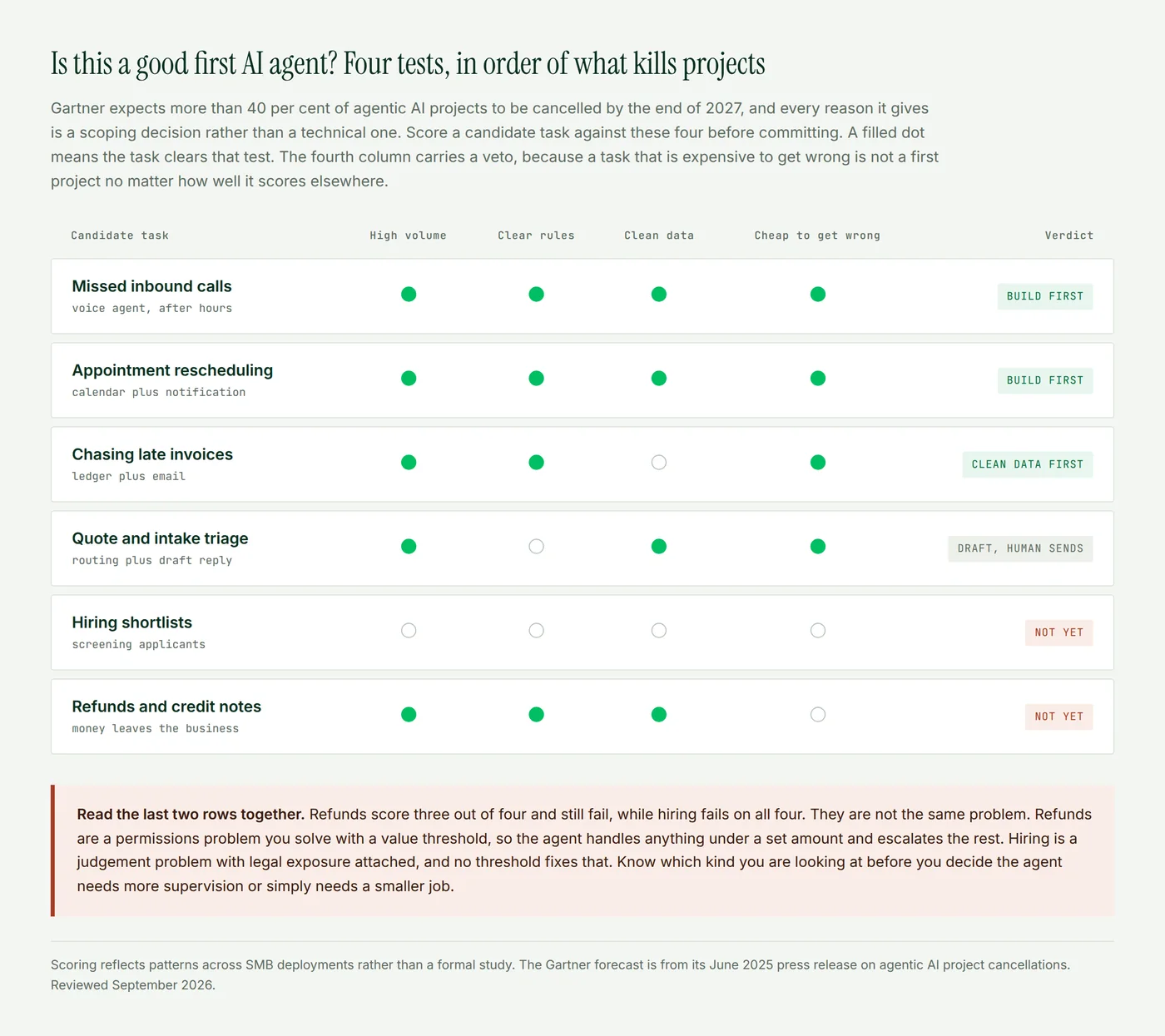
Then work in this order. Measure the task as it stands today, including how long it takes and how often it happens. Build the narrowest possible version. Run it beside the person currently doing the work for two weeks and compare. Only once it holds up do you widen the scope or remove the supervision. Every step you skip here comes back as a cancelled project in the Gartner statistic above.
What does an AI agent cost?
Two costs, and most buyers budget for one.
Build cost is the engineering: integrations, guardrails, and testing against real messy inputs rather than clean demo data. For a single narrowly scoped business agent this is usually weeks rather than months. Complexity comes from how many systems it has to touch, not from the AI itself.
Run cost is per action, forever. Every pass through the loop costs money. An agent retrying fifteen times because a tool is misconfigured will burn budget quietly all weekend, which is why step limits and spend caps are part of the build rather than a later optimization.
The number to compare against is not another vendor's quote. It is the fully loaded cost of the person currently doing the task, multiplied by the hours it consumes, plus whatever the business loses when the task does not get done at all.
The twenty minute version
If you do nothing else after reading this, do this. Open your phone system and find how many inbound calls went unanswered last month. Open your inbox and count how many enquiries waited more than a day for a first reply. Those two numbers are the cheapest agent business case you will ever build, they take twenty minutes to find, and they tell you whether the rest of this matters to you at all.
Where Codeatic fits in
We build AI agents and automation for SMBs and startups, mostly voice agents, vision based automation, and workflow agents that sit across existing systems. We are not the right call if you want an agent for everything. We are the right call if you have one expensive, repetitive task and want it working in production rather than demoed.
Our AI opportunity audit maps your current workflows, scores each candidate against the four tests above, and returns a costed shortlist with the expected saving on each. You can take that shortlist and build it yourself. Plenty of people do.
When not to build an agent
Three situations where the honest answer is no. When the task happens twice a month, because the payback never arrives. When the underlying process is broken, because automating it just means running a broken process faster. And when a mistake is expensive or irreversible, which is a permissions and threshold problem to solve before autonomy, not after.
The short version
An AI agent takes a goal and completes it across your systems, which is what separates it from a chatbot that only talks and from automation that only follows the flow you drew. The technology is ready for narrow, well defined jobs and unreliable on broad, fuzzy ones. Pick one task with high volume, clear rules, clean data and a cheap failure mode. Cap the spend, cap the steps, name an owner. Run it beside a human for two weeks before you trust it alone.
Frequently asked questions about AI agents
What is an AI agent in simple terms?
It is software you give a goal to instead of an instruction. It works out the steps, uses your tools to carry them out, checks whether it worked, and tries again if it did not. Think of it as a fast junior employee who never gets bored and never applies judgment you have not explicitly given it.
What is the difference between an AI agent and ChatGPT?
ChatGPT in its basic form responds with text. An AI agent takes actions in your systems. The same underlying model can power both. What makes it an agent is the tools it is connected to and the permission to act without asking each time.
Are AI agents the same as agentic AI?
Close enough for practical purposes. Agentic AI is the category, an AI agent is the thing you deploy. Some vendors use agentic loosely to describe a chatbot with buttons, so treat the word as a prompt to ask what it actually does.
Can a small business realistically use AI agents?
Yes, and often more easily than a large one, because there is less legacy software in the way and fewer people to convince. The constraint is rarely budget. It is having one task repetitive enough and defined enough to hand over.
How long does it take to build an AI agent?
A single tightly scoped agent connected to two or three systems is typically a few weeks from scoping to running in production alongside a human. Timelines stretch when the data is messy or when a system it needs has no usable API.
Are AI agents safe to run without supervision?
Only where a mistake is cheap and reversible. The workable pattern is graduated autonomy. The agent drafts and a human approves. Then it acts on low value cases and escalates the rest. Then it runs within limits you set. Every agent needs a spend cap, a step limit, and a named person who can switch it off.
Will AI agents replace jobs?
In small businesses what we see is tasks moving rather than roles disappearing. The calls still get answered, the invoices still get chased, and the person who was doing that at 9pm gets their evening back. The honest risk is different: a business that automates a broken process just gets to run it faster.
What is MCP and do I need to care?
The Model Context Protocol is a standard way for agents to connect to tools and data sources, so an integration built once works across different systems. You do not need to understand it, but you should ask whether your build uses an open standard or locks you into one vendor's connectors.
Abdul, Founder and CEO, Codeatic
Abdul has spent five years building software, starting as an Android engineer and now leading Codeatic, an AI automation agency working with SMBs and startups across the US, Canada and Saudi Arabia. He holds an MS in Computer Science from PUCIT. His team has shipped voice agents, vision automation and custom AI workflows into live business operations. Connect on LinkedIn.