AI Business Automation: What Manual Work Really Costs
Part 1 of 2. Manual work arrives in 2 and 5 minute slices spread across people hired to do something else, so it never reaches your profit and loss. The 7 costs that stay invisible, what 5 ordinary recurring tasks add up to over a year, and how to measure your own number in a week.
On this page
AI business automation is worth considering not because AI is impressive, but because the manual work it replaces is costing you money you have never counted. In a business of around 10 people, 5 ordinary recurring tasks add up to roughly 1,218 hours a year, and not one of them is anybody's actual job.
This is the first of 2 posts on AI business automation. This one is about the problem: the costs that never reach your profit and loss, where they hide, and how to measure yours in a week. The second covers what to do about it. If you already know your numbers and want the fix, skip ahead when it publishes.
On this page
- Why does manual work stay invisible?
- What are the hidden costs of manual work?
- What does it actually add up to?
- What is context switching really costing?
- What it does to your best people
- How do you measure your own number?
- Why does AI change which tasks qualify?
- What comes next
- How these figures were arrived at
- Frequently asked questions
Why does manual work stay invisible?
Every business watches the costs that arrive as invoices. Salaries, rent, software, insurance. Those get reviewed, negotiated and cut.
Manual work arrives differently. It shows up as 2 minutes here, 5 minutes there, spread across people who were hired to do something else. No invoice, no line item, no owner. The business absorbs it the way a house absorbs a draught: constantly, and without anyone deciding to.
That distribution is the whole problem. If one person spent their entire week re-typing customer details between systems, you would notice within a month. Spread the same work across 6 people in 4 minute slices and it becomes invisible for years.
What are the hidden costs of manual work?
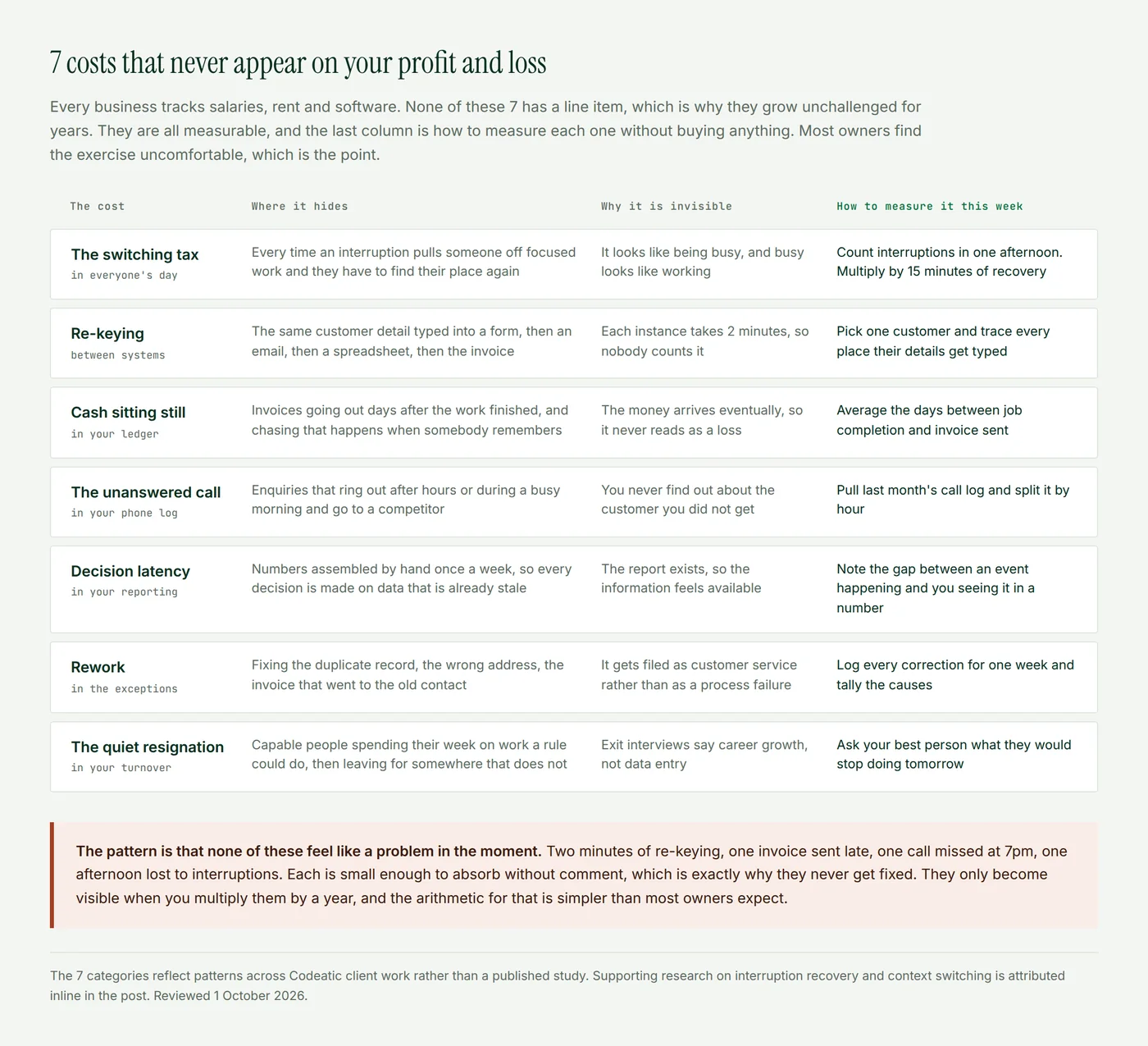
What these have in common is that each one is individually reasonable. Nobody is going to raise an issue about typing an address twice. The cost only exists at the scale of a year, and almost nobody looks at it that way.
What does it actually add up to?
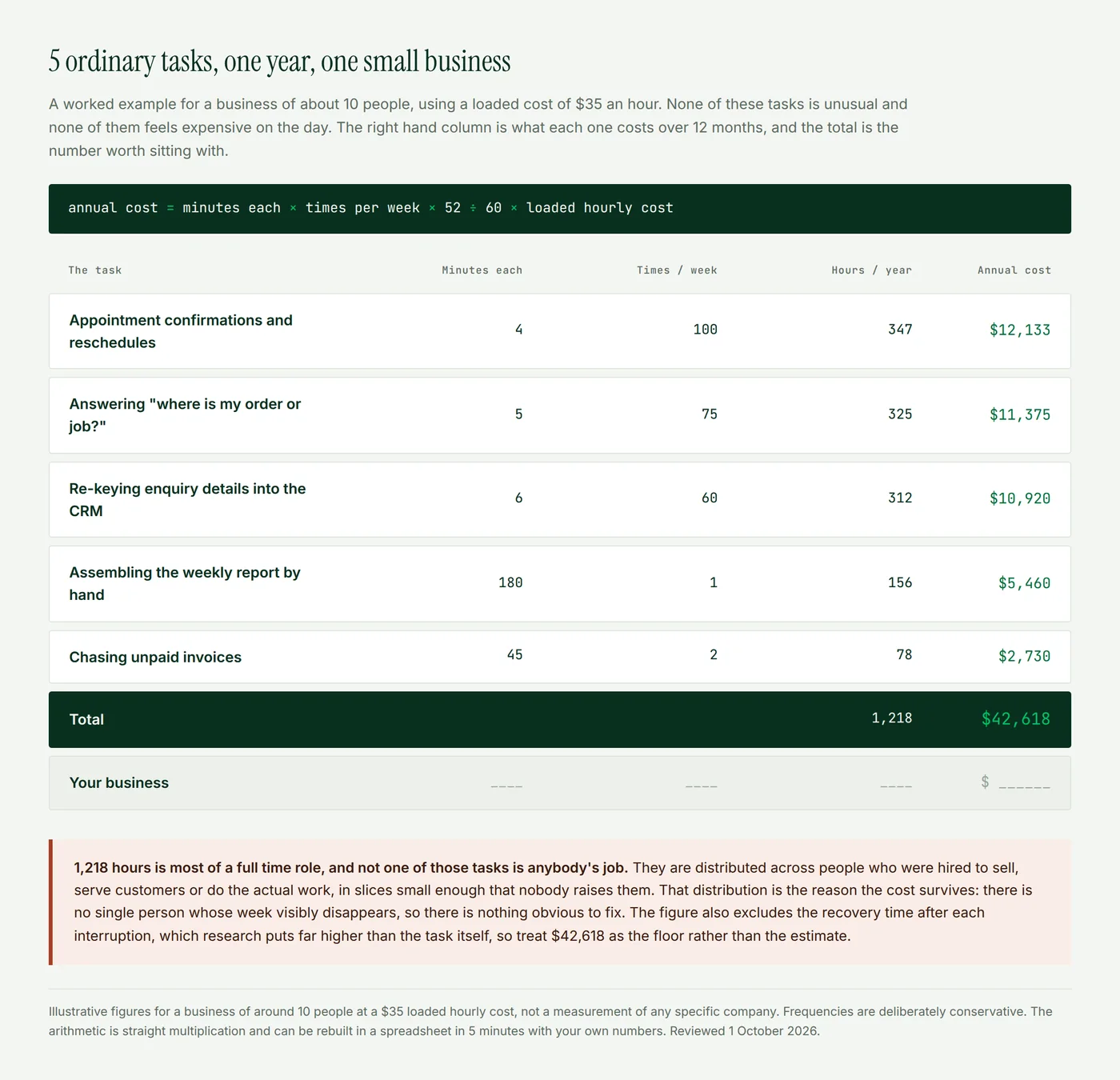
Three things worth noting about that table. The frequencies are deliberately conservative, the loaded hourly cost of $35 is modest for most markets, and it covers only 5 tasks. Add document handling, data cleanup, onboarding steps and supplier chasing and the number grows considerably.
It is also the floor rather than the estimate, because it counts only the task itself and none of the recovery time around it.
What is context switching really costing?
Interrupting focused work costs far more than the interruption. Research from the University of California, Irvine, led by Gloria Mark and widely cited since its publication in 2008, found it takes an average of 23 minutes and 15 seconds to fully regain focus after a significant interruption, and that people spend only about 11 minutes on a task before switching away from it.
The frequency has got worse. Microsoft's workplace research, reported in 2026, found employees are interrupted every 2 minutes during core working hours, around 275 times a day, and Atlassian estimates context switching can consume up to 40% of productive time. Harvard Business Review put application toggling in 2022 at more than 1,200 times a day, costing roughly 4 hours a week per person just reorienting.
Tool fragmentation shows up in recent survey data too. GitLab's 2026 Global DevSecOps Report, based on a Harris Poll survey of 3,266 professionals, found disconnected processes cost teams nearly a full working day, about 7 hours, per person per week.
Apply even a fraction of that to the 5 tasks in the table and the real figure moves well past $42,618. This is why automating a 5 minute task that happens 75 times a week is worth more than 5 minutes times 75 suggests. You are not just removing the task. You are removing the interruption.
What it does to your best people
The financial cost is the easy half. The harder one is what repetitive work does to the people doing it.
Your most capable person is usually the one who ends up absorbing process gaps, because they are the one who can be trusted to catch what falls through. That means the person with the best judgment in your business spends a meaningful share of their week on work that needs no judgment at all. They rarely complain about it. They leave instead, and the exit conversation is about growth rather than about data entry.
Asana's Anatomy of Work research puts 60% of workers' time on coordination: communicating about work, searching for information, switching between apps and chasing status updates, rather than on the work itself. In a small business that coordination has no department to hide in. It lands on whoever is most reliable.
From our work. We run this exercise at the start of every audit, and the same thing happens almost every time: the task the owner wants automated is not the one costing the most. People arrive asking about the thing that annoys them, which is usually infrequent and visible. The expensive one is almost always something nobody mentions, because it is spread across several people in small pieces.
At Ziltrix, a security workforce platform, the audit found roughly 40% to 50% of the operation automatable, and the single biggest line was shift confirmation calls, which 8 staff were making daily. Replacing that recovered $42,000 a year in salary and went live in 4 weeks. At Ph3onix, a full working day every week went on counting shelf stock by hand, worth about $68,000 a year, roughly a senior hire. Neither business had those numbers written down before we counted them. Almost nobody does.
How do you measure your own number?
- List every task someone did more than 5 times last week. Not projects. Tasks. The list usually runs to 15 or 20 and takes 20 minutes.
- Put a minute figure and a frequency against each. Estimates are fine. You are looking for the order of magnitude, not precision.
- Multiply by 52 and by your loaded hourly cost. Loaded means salary plus employer costs, which is usually 1.25 to 1.4 times the headline figure.
- Cross out anything where the steps change each time. Those are judgment tasks and they are not the target.
- Pull your phone log and split it by hour. Unanswered calls are the one hidden cost that is both easy to count and directly revenue linked.
- Ask your best person what they would stop doing tomorrow. The answer is usually the right first candidate, and it costs nothing to ask.
At the end of that you have a number. Whatever you do next, you can measure against it, which is more than most businesses can say when they start buying software.
Why does AI business automation change which tasks qualify?
The automation half of AI business automation has been available and affordable for years, and plenty of these tasks could have been automated a decade ago. What has changed is the kind of task that qualifies.
Ordinary automation needs structured input. A form field, a database row, a fixed trigger. It cannot read an email written by a customer in their own words, interpret a photographed delivery note, or hold a conversation on the phone. Those steps had to stay manual, and because a process is only as automated as its least automatable step, one human step in the middle kept the whole workflow manual.
AI changes that specific thing. It handles the messy input at the edges, which lets the rules handle everything in between. That is why work which was genuinely stuck 5 years ago is now straightforwardly automatable, and why the arithmetic above is worth redoing even if you looked at automation before.
None of that is a reason to put AI everywhere, and good AI business automation uses very little of it. We have written about where a model belongs in a workflow and where it does not, and the short version is that most steps should stay deterministic.
What comes next
This post deliberately stops at the diagnosis. Part 2 of this AI business automation series covers the fix: which task to automate first, what it costs to build, how to tell whether it worked, and what we actually do for clients.
If you would rather not wait, the free AI audit reads your public footprint and returns scored findings with the evidence behind each one, in a couple of minutes. Or get in touch and we will tell you honestly whether your numbers justify doing anything at all.
For context on what the fix usually looks like, our guides to workflow automations and workflow automation for service businesses cover the ground, and 4 real audits shows what these numbers looked like for other businesses.
When the honest answer is to do nothing
When your tally comes to a few thousand dollars a year, because the build and its maintenance will cost more than that. When the tasks that dominate your list all involve judgment, since automating those is a different and harder problem. And when the real issue is that 2 people do the same job differently, because automating that encodes the disagreement rather than resolving it.
The short version
The case for AI business automation starts with a number most owners have never calculated. Manual work does not appear on your profit and loss, which is why it survives. It arrives in 2 and 5 minute slices spread across people hired to do something else, so no single person's week visibly disappears. For a 10 person business, 5 ordinary recurring tasks come to roughly 1,218 hours and $42,618 a year before you count the recovery time around each interruption, which research suggests is larger than the tasks themselves. Measure your own number first. It takes a week, it costs nothing, and without it you cannot tell whether any solution worked.
How these figures were arrived at
The 7 hidden cost categories reflect patterns across our AI business automation client work rather than a published study. The annual cost table is an illustrative worked example for a business of around 10 people at a $35 loaded hourly cost, not a measurement of any specific company; frequencies were chosen conservatively and the arithmetic is straight multiplication you can rebuild in a spreadsheet. Research on interruption recovery, context switching and coordination time is attributed inline with the publishing organization; several figures come from industry compilations of primary research rather than the studies themselves, which is why they are presented as directional.
Reviewed 1 October 2026 by Usama Tariq, Co-Founder and CTO. If you find an error in this post, email info@codeatic.com and we will publish a correction on the page rather than editing it quietly.
Frequently asked questions
What is AI business automation?
Using AI alongside rules based automation to run recurring business processes without a person driving them. The rules handle anything that must come out the same every time, and AI handles the steps where information arrives in a messy form, such as an email, a phone call or a photographed document.
How much does manual work cost a small business?
More than most owners estimate, which is why the case for AI business automation usually rests on arithmetic rather than enthusiasm. It is distributed rather than concentrated. In a worked example for a 10 person business, 5 ordinary recurring tasks come to around 1,218 hours and $42,618 a year at a $35 loaded hourly cost, before counting the recovery time after each interruption.
Why do these costs not show up in the accounts?
Because they arrive as fragments of salaried time rather than as invoices. Nobody files an expense for typing an address twice. The cost exists only at the scale of a year, and the accounts are not organized to show it.
What is context switching costing my team?
Research puts recovery from a significant interruption at about 23 minutes, with context switching consuming up to 40% of productive time and app toggling alone costing roughly 4 hours a week per person. This is why removing a frequent small task is worth more than the task's own duration suggests.
How do I calculate the cost of a recurring task?
Minutes per occurrence, multiplied by occurrences per week, multiplied by 52, divided by 60, multiplied by your loaded hourly cost. Loaded usually means salary times 1.25 to 1.4 to account for employer costs.
Which tasks are worth automating?
The ones that happen often and follow the same steps each time. Cross out anything where the steps change depending on the situation, because those need judgment and are a harder problem. Frequency matters more than the duration of any single instance.
Could I not have automated this years ago?
Some of it, yes. What has changed is that a process is only as automated as its least automatable step, and steps involving unstructured input, such as reading an email or taking a phone call, used to block the whole workflow. AI handles those specific steps, which unlocks processes that were genuinely stuck before.
What should I do before buying AI business automation?
Measure. List the recurring tasks, put minutes and frequency against each, and work out your annual figure. Without that number you cannot judge a quote or prove afterwards that anything improved.
Abdul Wahab, Co-Founder and CEO, Codeatic
Abdul has spent 5 years building software, across web stacks and mobile in React Native, Flutter and native Android, before moving into product, architecture and AI work. He holds an MS in Computer Science from PUCIT and leads Codeatic, an AI automation agency working with SMBs and startups across the US, Canada, the UK and Saudi Arabia. Connect on LinkedIn.
Technically reviewed by Usama Tariq, Co-Founder and CTO, Codeatic. Usama is an AI and computer vision engineer who builds production systems from unstructured video, image and speech data. He built the REVOX engine at Veedback, developed LLM and computer vision systems at Coeus Solutions GmbH, and led AI model development at OMNO AI. He is an OpenCV OAK-D finalist and a contributor to Workhub, and holds a BS in Computer Science from COMSATS University Islamabad. Connect on LinkedIn.