AI Auditing Tools in 2026: What They Cost, Who Needs One
The real AI auditing tools, Credo AI, Holistic AI, IBM watsonx.governance, OneTrust, Asenion and Scytale, with published 2026 pricing of roughly $30,000 to $90,000 a year at mid-market. The free options that cover you below that, and the 4 stage test for which one you actually need.
On this page
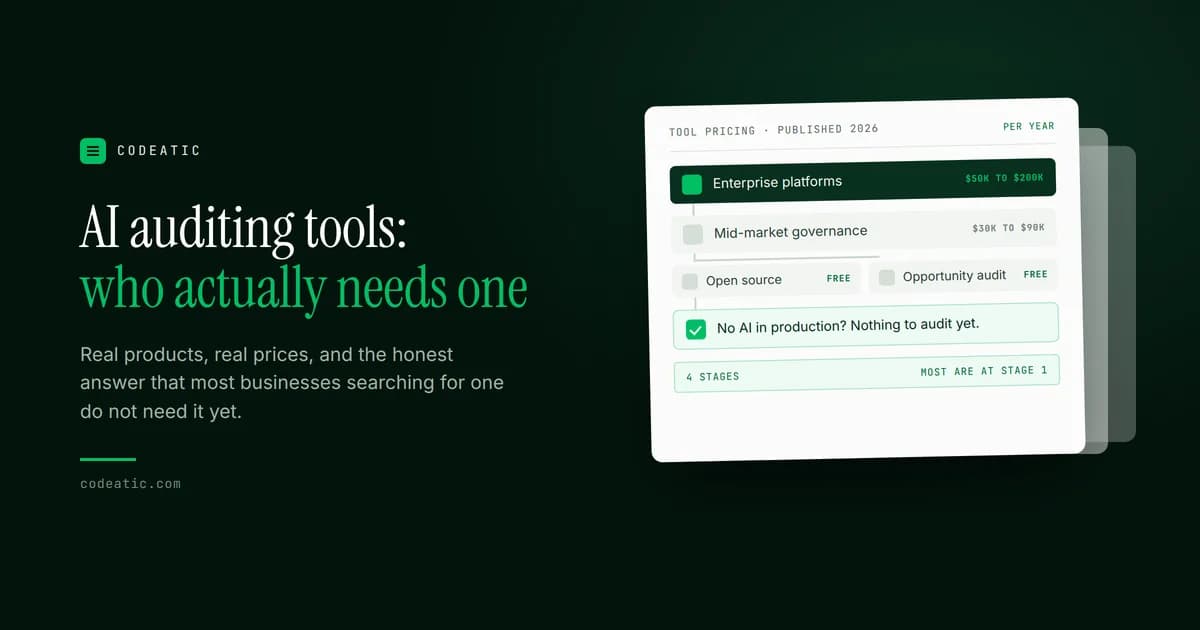
AI auditing tools are software products that inventory the AI systems you run, test them for bias and risk, and generate the evidence a regulator or customer asks for. The serious ones, Credo AI, Holistic AI, IBM watsonx.governance, OneTrust, Asenion and Scytale, are priced for organizations running portfolios of models: roughly $30,000 to $90,000 a year at mid-market and $50,000 to $200,000 at enterprise.
Which means the honest answer for most businesses searching this term is that you do not need one yet. This covers what the real tools do, what they cost, the free options that cover stages 1 and 2, and how to tell which stage you are actually at.
On this page
- What are AI auditing tools?
- Which AI auditing tools exist, and what do they cost?
- Which tool do you actually need?
- The free options nobody mentions
- Why most people searching this term want something else
- How to evaluate a tool without a trial
- The deadlines that change the answer
- How these figures were arrived at
- Frequently asked questions
What are AI auditing tools?
Software that does 4 jobs, and most platforms do some mix of them.
- Discovery and inventory. Finding every AI system in the organization, including the ones a team started using without telling anyone, and keeping a register of them.
- Risk assessment and testing. Running models against tests for bias, hallucination, privacy leakage and robustness, and scoring the result.
- Compliance mapping. Translating the EU AI Act, the NIST AI Risk Management Framework and ISO/IEC 42001 into controls, then tracking which you meet.
- Evidence generation. Producing the model cards, impact assessments and audit trails somebody will eventually ask for.
Note what is not on that list: finding where AI would help your business. That is a different product entirely, and the confusion between them is the single most expensive mistake in this category.
Which AI auditing tools exist, and what do they cost?
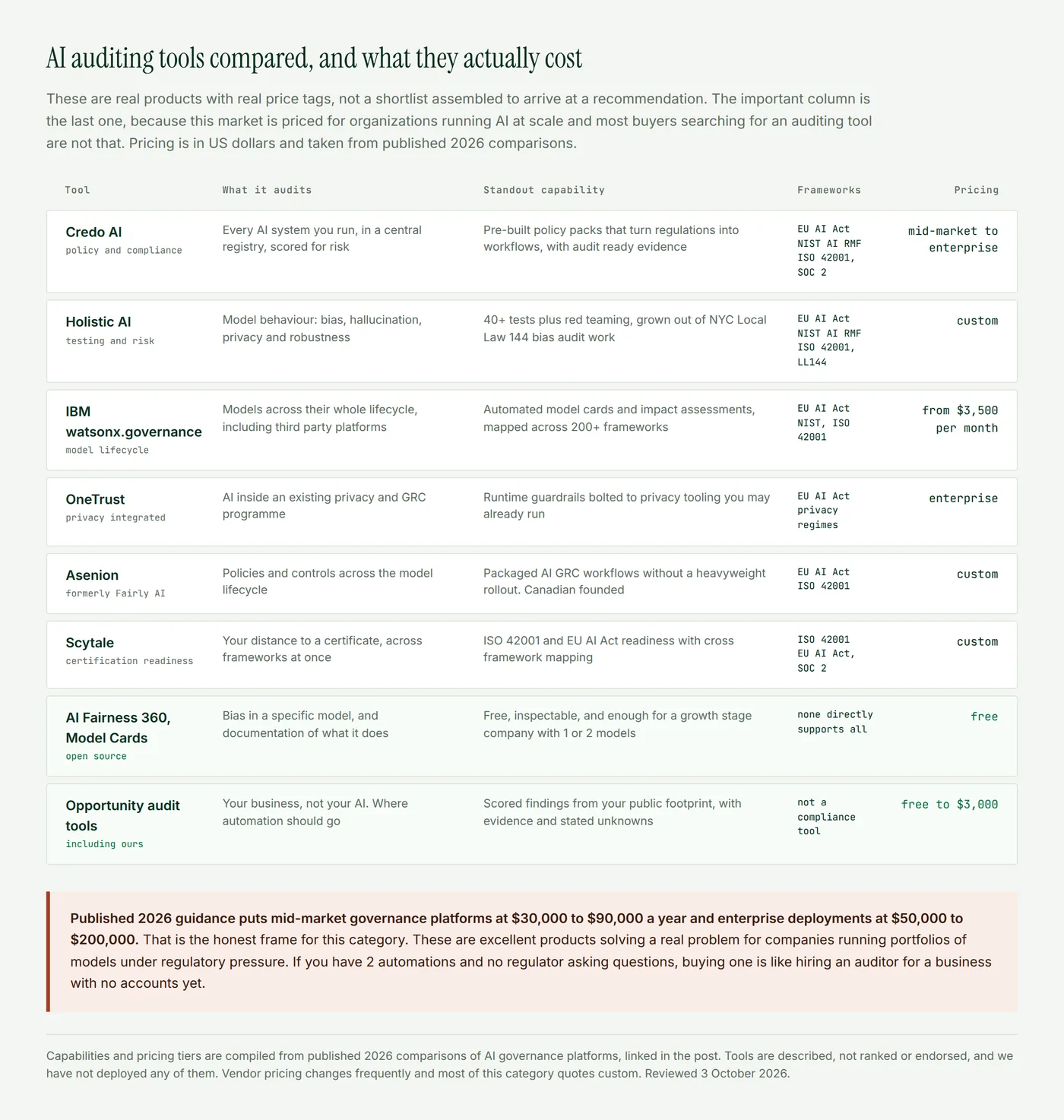
A few notes on that table, since this market rewards reading carefully.
Credo AI is the most frequently cited pure play governance platform, built around an AI registry with policy packs that map to the EU AI Act, NIST AI RMF, ISO 42001 and SOC 2. One 2026 buyer's guide describes its compliance mappings as spanning more than 10 frameworks.
Holistic AI came at this from the opposite direction. It grew out of algorithm audit work under New York City's Local Law 144 bias auditing requirement into a full platform, and its strength is still testing: 40 or more tests covering bias, hallucination, privacy and robustness, plus red teaming.
IBM watsonx.governance is the one with a published entry price, from $3,500 a month for its Risk and Compliance Basic tier, and it suits organizations already standardized on IBM.
Asenion, formerly Fairly AI, is Canadian founded and positions itself as packaged AI GRC workflows without a heavyweight platform rollout, which makes it the more realistic option for a smaller regulated business.
Which tool do you actually need?
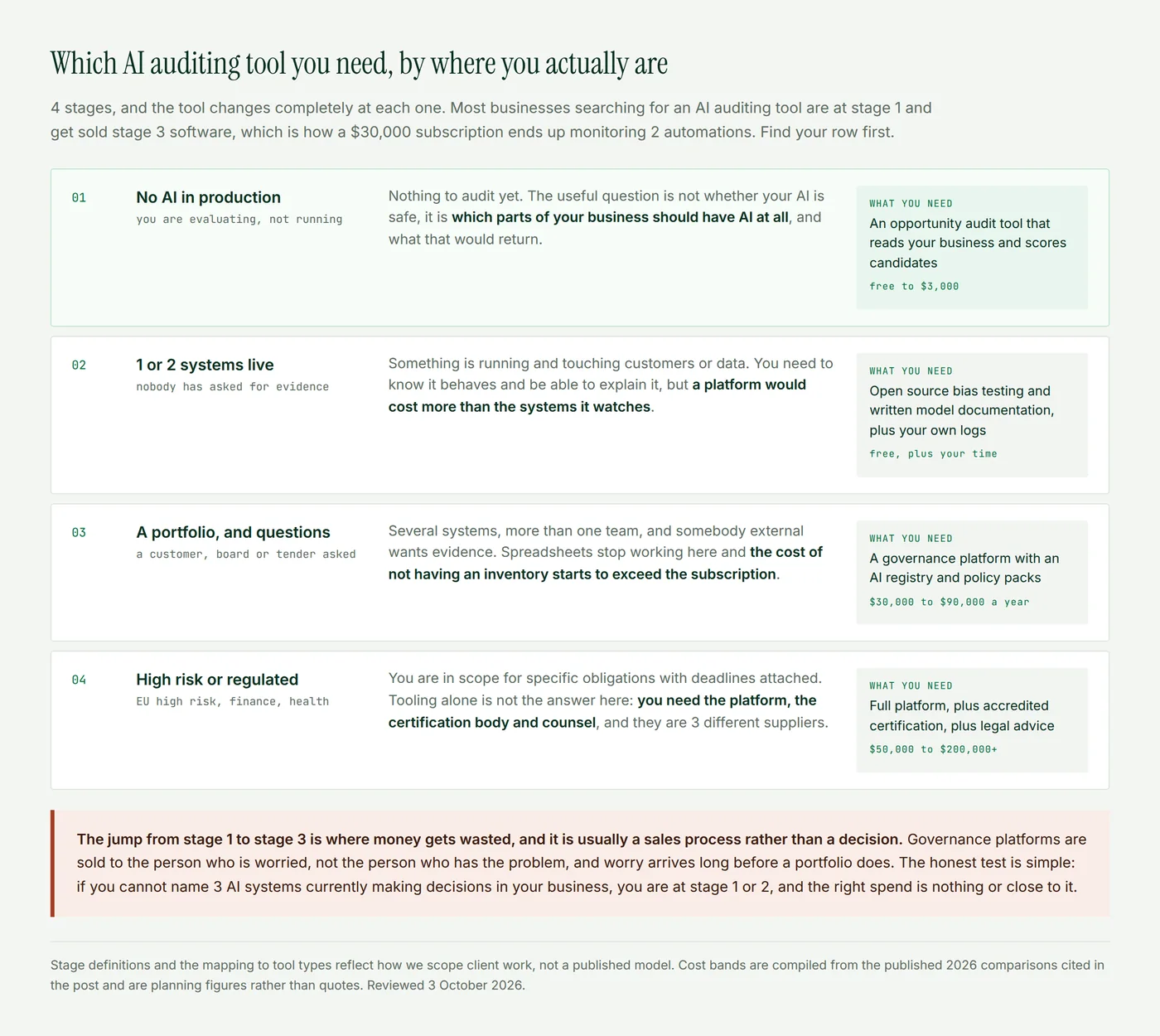
The test in that callout is worth repeating because it settles the question in 10 seconds. If you cannot name 3 AI systems currently making decisions in your business, you are at stage 1 or stage 2, and a governance platform would be monitoring an inventory that fits on a napkin.
The free options nobody mentions
At stages 1 and 2 the tooling you need costs nothing, and the commercial guides rarely say so because there is no subscription in it.
For bias testing on a specific model, IBM's open source AI Fairness 360 toolkit does the job and you can read the implementation. For documentation, Google's Model Cards format gives you a structure for recording what a model does, what it was trained on and where it should not be used. One 2026 comparison recommends exactly that combination for growth stage companies, moving to commercial platforms only when manual compliance tracking hits its limits.
Add a logging discipline, every model input and output stored with a timestamp and the prompt version, and you have covered most of what a platform would do for you at 2 systems. The platform earns its money at 20.
Why most people searching this term want something else
In our experience, a business owner typing AI auditing tools into a search box is rarely asking about bias testing. They are asking some version of: is AI worth it for us, where would it go, and how do we find out without committing.
That is an opportunity audit, and it is a different category of tool. It examines your business rather than your models. It is the only one of the 2 that works when you have no AI running yet, and it is free or close to it.
From our work. Our own free audit tool sits in that second category. It takes a business name and location, reads the public footprint, and returns scored findings with the evidence behind each one and an explicit list of what it could not determine. It is not a compliance tool and we are careful to say so.
What the paid version finds is the part worth knowing. At Ziltrix, a security workforce platform, the audit identified roughly 40% to 50% of the operation as automatable, and the first build took shift confirmation calls from 8 staff to 1, recovering $42,000 a year in salary and going live in 4 weeks. At Ph3onix, a full working day every week spent counting shelf stock by hand became minutes, worth about $68,000 a year. Neither of those numbers would appear in any governance platform, because governance platforms answer a different question.
How to evaluate a tool without a trial
- Count your AI systems first. If the number is under 3, stop here. No tool on the market improves on a spreadsheet at that scale.
- Ask what the vendor's own ISO 42001 position is. A governance vendor that has not certified its own management system is worth a question.
- Ask for a framework mapping, not a framework list. Every platform claims EU AI Act support. Ask to see the controls behind it.
- Check whether it covers agents, not just models. Several platforms added runtime agent monitoring only in 2025 and 2026, and some still have not.
- Ask about deployment. Self hosted matters if you have data residency obligations, and several platforms are cloud only.
- Get the renewal price in writing. This category quotes custom, which means year 2 is a negotiation you have already lost leverage in.
The deadlines that change the answer
Timing is the one genuine reason to buy early. The EU AI Act Omnibus political agreement reached on 7 May 2026 sets the high risk Annex III deadline at 2 December 2027, which makes EU AI Act capability a near term procurement requirement for anyone deploying high risk AI into the EU market.
If that applies to you, the stage 4 answer applies regardless of your size, and tooling alone will not be enough. If it does not apply to you, nobody has set you a deadline, and buying as though they had is how a budget disappears.
Where Codeatic fits in
We do not sell AI governance software and we are not a certification body. We build AI automation for small and mid sized businesses, which means we live at stage 1 and stage 2 where most readers of this page actually are.
The free AI audit is the stage 1 tool: it reads your business, scores where automation could go, and costs nothing. Our guides to what an AI audit for business involves and what a free audit can and cannot tell you cover how to read the output, and artificial intelligence auditing covers the services side with the same price honesty. If you want a human instead, get in touch.
When to buy no tool at all
When you cannot name 3 AI systems making decisions in your business. When nobody external has asked you for evidence. And when the thing you actually want to know is whether AI would help you at all, because no governance platform answers that question and several will happily take your money while not answering it.
The short version
Real AI auditing tools inventory your AI systems, test them, map them to frameworks and generate evidence. Credo AI, Holistic AI, IBM watsonx.governance, OneTrust, Asenion and Scytale are the names that recur, priced at roughly $30,000 to $90,000 a year mid-market and up to $200,000 at enterprise, with IBM publishing an entry tier from $3,500 a month. Below that, open source bias testing and model documentation cover you to about 2 systems for nothing. And if you have no AI in production, you need an opportunity audit instead, which is a different product that costs nothing to start.
How these figures were arrived at
Tool capabilities, framework coverage and pricing tiers are compiled from published 2026 comparisons of AI governance platforms, attributed inline with the source. We have not deployed any of the commercial platforms listed, so this is a summary of published information rather than a review, nothing here is ranked or endorsed, and vendor pricing in this category changes frequently and is mostly quoted as custom. The 4 stage model reflects how we scope client work rather than a published framework. Client outcomes are published on our case study page and measured against the manual process each client recorded before the build.
Reviewed 3 October 2026 by Usama Tariq, Co-Founder and CTO. If you find an error in this post, email info@codeatic.com and we will publish a correction on the page rather than editing it quietly.
Frequently asked questions
What are AI auditing tools?
Software that discovers and inventories the AI systems an organization runs, tests them for bias and other risks, maps them to frameworks such as the EU AI Act, NIST AI RMF and ISO/IEC 42001, and generates the evidence an auditor or customer asks for.
What are the best AI auditing tools in 2026?
The names that recur across published comparisons are Credo AI for policy mapping and AI registries, Holistic AI for bias testing and red teaming, IBM watsonx.governance for model lifecycle governance at enterprise scale, OneTrust where privacy tooling is already in place, Asenion for lighter weight AI GRC, and Scytale for certification readiness. Best depends entirely on how many AI systems you run.
How much do AI auditing tools cost?
Published 2026 guidance puts mid-market platforms at roughly $30,000 to $90,000 a year and enterprise deployments at $50,000 to $200,000. IBM watsonx.governance publishes an entry tier from $3,500 a month. Most other vendors quote custom pricing.
Are there free AI auditing tools?
Yes. IBM's open source AI Fairness 360 covers bias testing on a specific model, and Google's Model Cards format gives you a documentation structure. Combined with your own logging, that is enough for a company running 1 or 2 models, and published comparisons recommend exactly that for growth stage businesses.
Do I need an AI auditing tool for 2 automations?
Almost certainly not. If you cannot name 3 AI systems currently making decisions in your business, a governance platform would be monitoring an inventory that fits on a single page. Open source testing and a written record cover you until the count grows.
What is the difference between AI auditing tools and an AI audit?
Tools are software you run continuously against AI systems you already operate. An audit is an engagement, and depending on the kind it either examines AI you run for compliance or examines your business to find where AI should go. If you have no AI in production, only the second kind can tell you anything.
Which AI auditing tools support the EU AI Act?
Most platforms in the compliance segment claim support, and the depth varies. Credo AI, Holistic AI, IBM watsonx.governance and OneTrust all name the EU AI Act, NIST AI RMF and ISO 42001 on their product pages. Ask to see the control mapping rather than the framework list.
When should I buy a governance platform?
When you run several AI systems across more than one team and somebody external has asked for evidence, or when you are deploying high risk AI into the EU market, where the Annex III deadline of 2 December 2027 makes capability a near term procurement requirement.
Abdul Wahab, Co-Founder and CEO, Codeatic
Abdul has spent 5 years building software, across web stacks and mobile in React Native, Flutter and native Android, before moving into product, architecture and AI work. He holds an MS in Computer Science from PUCIT and leads Codeatic, an AI automation agency working with SMBs and startups across the US, Canada and the UK. Connect on LinkedIn.
Technically reviewed by Usama Tariq, Co-Founder and CTO, Codeatic. Usama is an AI and computer vision engineer who builds production systems from unstructured video, image and speech data. He built the REVOX engine at Veedback, developed LLM and computer vision systems at Coeus Solutions GmbH, and led AI model development at OMNO AI. He is an OpenCV OAK-D finalist and a contributor to Workhub, and holds a BS in Computer Science from COMSATS University Islamabad. Connect on LinkedIn.