AI Call Agent: How 6 Industries Actually Use One
An AI call agent answers the phone, talks like a person and finishes the job in your systems. The one call worth handing over in 6 industries, the call each must never take, the 5 layers behind an AI voice call including transcription and text to speech, and where adoption really stands in the US and Canada.
On this page
An AI call agent is software that answers or places phone calls, holds a real spoken conversation, and completes the task the call was about: booking the job, moving the appointment, confirming the shift. It is the same thing people mean by an AI phone agent or a voice AI agent, and it differs from a phone menu in that the caller just talks.
What has changed in 2026 is not the technology, which has been production ready for a while. It is that specific industries have worked out which call to hand over and which to keep. This covers 6 of them, the 5 layers that sit behind an AI voice call, and the calls no agent should ever take.
On this page
- What is an AI call agent?
- Which industries are using them, and for what?
- How does an AI call agent work?
- What is text to speech, and why it decides the experience
- What call transcription gives you after the call
- Where adoption actually stands in the US and Canada
- What we learned building one
- How to start
- How these figures were arrived at
- Frequently asked questions
What is an AI call agent?
It is a system that answers the phone, understands what the caller wants, takes action in your real systems, and speaks back. The terms get used interchangeably and mean much the same thing: AI call agent, AI phone agent, voice AI agent, AI receptionist. What separates all of them from an older phone system is that the caller speaks normally, can interrupt, and ends the call with the thing done rather than a message left.
4 properties matter when you are comparing one against another.
- It handles interruption. When the caller talks over it, it stops and listens. This is harder to build than it sounds and it is the fastest way to tell a good agent from a bad one.
- It acts mid call. It checks the real diary and holds the real slot. An agent that only takes a message is an answering service with a better voice.
- It escalates on purpose. A defined boundary sends the call to a person rather than improvising.
- It says it is AI. If a caller asks whether they are talking to a person, it answers honestly. In several jurisdictions that is a legal requirement rather than a courtesy.
Our longer guide to how voice agents work covers latency, cost per minute and the disclosure rules in detail.
Which industries are using AI call agents, and for what?
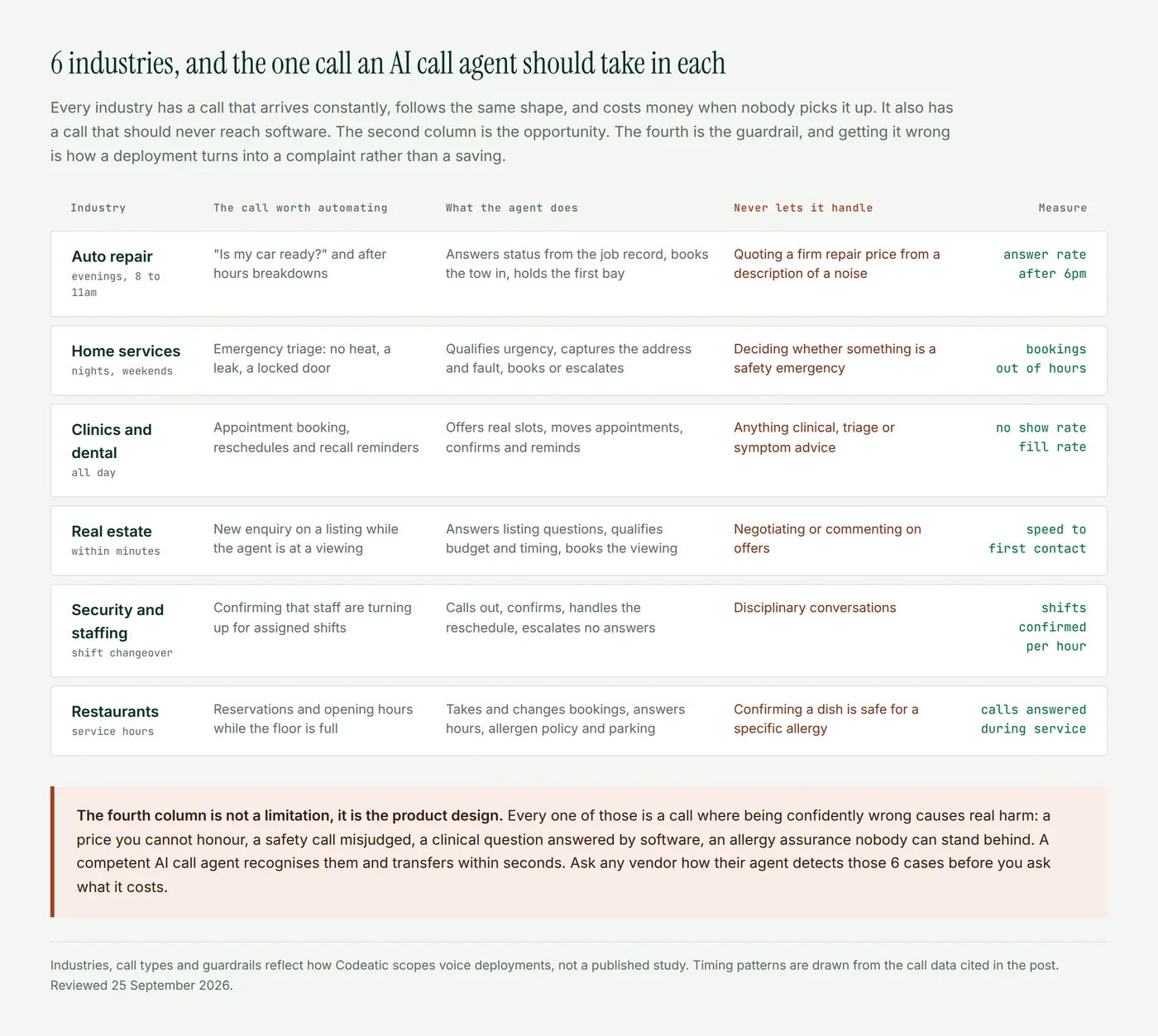
The pattern across all 6 is the same. The winning call is high volume, follows a predictable shape, and arrives when the people who would normally answer are busy or absent. The losing call is the one where being confidently wrong causes harm, and that is why the fourth column exists.
Adoption is uneven by sector for exactly this reason. Industry compilations for 2026 put telecom at 95% AI adoption in customer support workflows and banking and finance at 92%, while healthcare and government trail at 18% and 14%, held back by regulatory complexity rather than by the technology. Where healthcare does deploy, it is on scheduling and administration rather than anything clinical, which is the same boundary the table above draws.
How does an AI call agent work?
5 components in a chain, and the whole chain has to finish before the caller hears anything back.
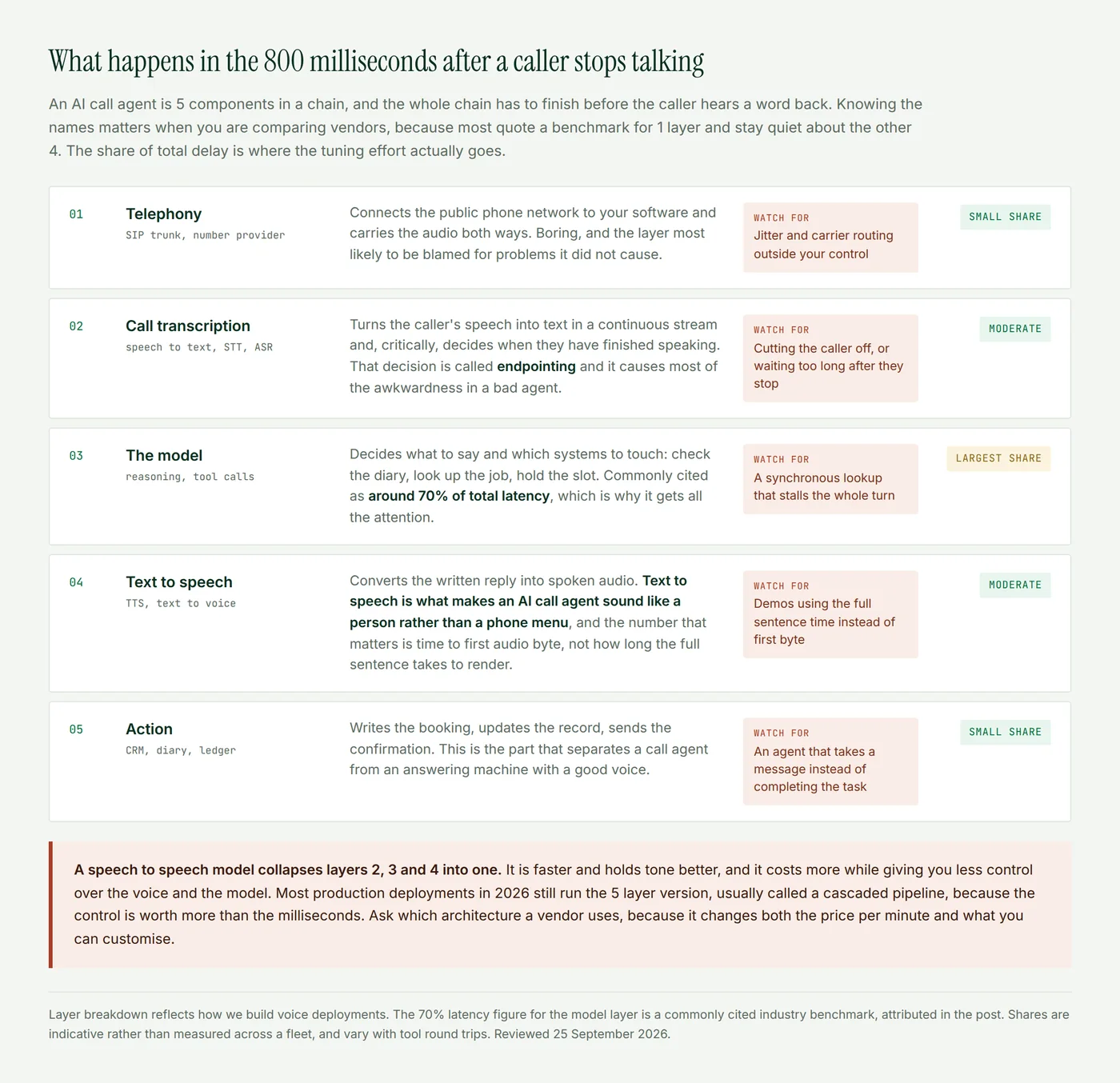
Latency is the product. The gap between speakers in ordinary human conversation is roughly 200 to 300 milliseconds, and under 800 milliseconds reads as a thoughtful pause rather than a delay. Past 1,500 the caller can tell, and starts talking over the agent. Every layer in that chain spends part of the budget.
What is text to speech, and why it decides the experience
Text to speech, usually shortened to TTS and sometimes called text to voice, is the technology that converts written text into spoken audio. In an AI call agent it is the final layer: the model decides what to say in words, and TTS turns those words into the voice the caller actually hears.
It is worth understanding because it is the layer callers judge you on. Two agents can run identical logic and feel completely different depending on the voice, the pacing and how naturally it handles numbers, addresses and names. A TTS engine that reads a postcode as a single long number, or stumbles over a surname, undoes a lot of careful engineering elsewhere.
The number to ask a vendor about is time to first audio byte: how long before the caller hears the first sound, not how long the whole sentence takes to generate. A demo that quotes full sentence generation time is quoting the flattering number. If you want to test how a voice sounds before committing, most TTS providers offer a browser demo where you can type a sentence and hear it read back, and typing your own business name, an address and a price is a far better test than the marketing sample.
One architectural note. A speech to speech model collapses transcription, reasoning and text to speech into a single step. It is faster and carries tone better, and it costs more per minute while giving you less control over which voice and which model you use. Most production deployments in 2026 still use the separated version.
What call transcription gives you after the call
Call transcription is the layer that turns the caller's speech into text in real time, and it does 2 jobs. During the call it feeds the model. After the call it leaves you a written record of every conversation your business had.
That record is quietly one of the biggest benefits and it rarely appears in a sales pitch. With transcripts you can see what callers actually ask for, in their own words, which is a better source of product and marketing insight than any survey. You can spot where the agent is failing before a customer complains. And when somebody disputes what was agreed, the transcript settles it.
Two practical points. Recording and transcription consent rules vary by state and province across the US and Canada, so check before you switch it on. And a transcript is only useful if somebody reads it, so put 20 minutes a week in the calendar for the first month.
Where adoption actually stands in the US and Canada
Worth grounding, because the marketing suggests universal adoption and the data does not. Statistics Canada put Canadian business AI use at 19.2% in the second quarter of 2026. Within that, information and cultural industries lead at 42.3%, finance and insurance at 40.4%, and professional, scientific and technical services at 32.4%, with Canadian finance running more than 6 percentage points ahead of its US equivalent.
Spending tells the other half of the story. Gartner's September 2026 forecast puts worldwide AI spending at $2.67 trillion in 2026, with $29.2 billion of that on AI agents and assistants. And the gap between buying and using remains wide: industry data suggests only 25% of call centers have fully integrated AI automation into daily workflows, and roughly 40% of enterprise AI agent pilots are expected to be scrapped by 2027.
For a small business the read is straightforward. Most of your competitors have not done this properly yet, and the ones who fail will fail on scope rather than technology.
From our work. We built an AI call agent for mechanic shops that answers inbound calls and books appointments entirely by voice, running one deployment across several shops and routing by the number the caller dialled. Early on it had a response lag of 1.5 seconds, which on a live call is long enough that people talk over it. We brought it to 0.5 seconds, and almost none of that came from the model. It came from voice activity detection thresholds and the round trip to the booking system.
We also had to switch off preemptive generation, the trick of speaking a filler phrase while the real answer computes, because it was dropping the booking call afterwards and leaving the line silent. On a phone call, silence is worse than slowness.
The deployment with measured results is in a different industry. At Ziltrix, a security workforce platform, an AI call agent took shift confirmation from 8 staff to 1, moved coverage from 12 hours to 24/7, raised capacity from 100 calls a day to more than 5,000, and recovered $42,000 a year in salary. It went live in 4 weeks.
How to start
- Pull last month's call log and split it by hour. Count what came in outside staffed hours and what rang out during them. This is the entire business case and it takes 20 minutes.
- Pick 1 call type from the table above. The highest volume, most predictable one. Not everything.
- Write down what it must never handle before you write down what it should.
- Set the disclosure line and the transfer trigger. Both go in before launch, not after the first complaint.
- Run it beside a person for 2 weeks and read the transcripts daily.
Where Codeatic fits in
We build AI call agents for service businesses across the US, Canada and the UK, starting with inbound because that is where the gap is measurable. Our pieces on voice agents for auto repair shops and what a voice agent fixes in customer service go deeper on 2 of the industries above.
If you want to know whether your call volume justifies one, run the free AI audit or get in touch, and we will tell you honestly if the answer is no.
When an AI call agent is the wrong answer
When the calls arrive during business hours and somebody genuinely answers all of them. When the conversation is the product, as in consultative or advisory work where a human voice is the differentiator. And when the underlying problem is what happens after the answer rather than the answer itself, because a faster route to a poor experience is not an improvement.
The short version
An AI call agent answers the phone, talks like a person, and finishes the job in your systems. Every industry has one call worth handing over: status and breakdowns in auto repair, emergency triage in home services, booking in clinics, first contact in real estate, shift confirmation in staffing, reservations in restaurants. Each also has a call it must never take. Behind the conversation sit 5 layers, telephony, call transcription, the model, text to speech and the action, and the whole chain needs to finish in under 800 milliseconds. Start with 1 call type, set the guardrails before launch, and read the transcripts.
How these figures were arrived at
The industry table, the call types and the guardrails describe how we scope voice deployments and are not a published study. The 5 layer breakdown reflects how we build them; latency shares are indicative rather than measured across a fleet, and the 70% figure for the model layer is a commonly cited industry benchmark. Adoption and spending statistics are attributed inline with the publishing organization and date; several come from industry compilations rather than primary research, which is why they are presented as directional. Our own latency figures are from a demo still under test, measured from the end of caller speech to the first audio the caller hears. The Ziltrix outcomes are published on our case study page and measured against the manual process the client recorded before the build.
Reviewed 25 September 2026 by Usama Tariq, Co-Founder and CTO. If you find an error in this post, email info@codeatic.com and we will publish a correction on the page rather than editing it quietly.
Frequently asked questions
What is an AI call agent?
Software that answers or places phone calls, holds a normal spoken conversation, and completes the task: booking the appointment, updating the record, confirming the shift. It is also called an AI phone agent or a voice AI agent, and unlike a phone menu the caller simply talks.
Which industries use AI call agents most?
Telecom, banking and finance lead on adoption, while healthcare and government trail because of regulatory complexity. Among smaller businesses the clearest fits are auto repair, home services, clinics and dental practices, real estate, staffing and restaurants, all of which have one high volume call that arrives when nobody can answer.
What is text to speech?
Text to speech, or TTS, sometimes called text to voice, converts written text into spoken audio. In an AI call agent it is the final layer: the model decides the words and TTS produces the voice the caller hears. The metric that matters is time to first audio byte, not how long the whole sentence takes to generate.
What is the difference between text to speech and speech to text?
They run in opposite directions. Speech to text, also called call transcription, turns the caller's voice into text the system can work with. Text to speech turns the reply back into audio. An AI call agent uses both, one at each end of the conversation.
Does an AI call agent record and transcribe calls?
Transcription is part of how it works, so you get a written record of every call as a by product. That record is useful for spotting failures and for settling disputes, but recording and transcription consent rules vary by state and province across the US and Canada, so check the rules for where you operate.
How fast does an AI voice call need to be?
Under 800 milliseconds from the end of the caller's sentence to the first audio back reads as a natural pause. Human conversation sits at roughly 200 to 300 milliseconds. Past 1,500 the caller notices and starts talking over the agent.
Will callers know they are talking to an AI phone agent?
Often not immediately, which is exactly why disclosure matters. Say it in the first sentence, and if a caller asks directly whether they are speaking to a person, the agent must answer honestly. In several jurisdictions this is a legal requirement.
What should an AI call agent never handle?
Anything where being confidently wrong causes harm: quoting a firm price from a description, judging whether something is a safety emergency, answering clinical questions, confirming a dish is safe for an allergy, or handling a complaint from an already frustrated caller. All of those should transfer within seconds.
Abdul Wahab, Co-Founder and CEO, Codeatic
Abdul has spent 5 years building software, across web stacks and mobile in React Native, Flutter and native Android, before moving into product, architecture and AI work. He holds an MS in Computer Science from PUCIT and leads Codeatic, an AI automation agency working with SMBs and startups across the US, Canada, the UK and Saudi Arabia. Connect on LinkedIn.
Technically reviewed by Usama Tariq, Co-Founder and CTO, Codeatic. Usama is an AI and computer vision engineer who builds production systems from unstructured video, image and speech data. He built the REVOX engine at Veedback, developed LLM and computer vision systems at Coeus Solutions GmbH, and led AI model development at OMNO AI. He is an OpenCV OAK-D finalist and a contributor to Workhub, and holds a BS in Computer Science from COMSATS University Islamabad. Connect on LinkedIn.