How a Voice Agent Improves Small Business Service
A voice agent fixes the 3 service failures small business customers notice most: nobody answering after hours, the engaged tone when everyone calls at once, and time on hold. It also makes 2 things worse. This covers both, and the 6 numbers that prove your service improved rather than just got faster.
On this page
A voice agent improves small business customer service by removing the 3 failures customers notice most: nobody answering after hours, the engaged tone when several people call at once, and time on hold. It answers every call on the first ring, handles 10 at once as easily as 1, and gives the same answer every time.
It also makes 2 things worse if you point it at them, and no vendor page will tell you which. This covers both, plus the 6 numbers that prove your service actually improved rather than just got faster.
On this page
- The service gap a small business is actually in
- What does a voice agent fix?
- Where does it make service worse?
- The improvement nobody expects
- How do you prove service improved?
- The 5 settings that decide how it feels
- What to do this week
- How these figures were arrived at
- Frequently asked questions
The service gap a small business is actually in
Customer expectations moved and small business phone coverage did not. Compiled 2026 benchmark data drawing on Zendesk and HubSpot reports finds that 88% of customers expect faster responses than they did a year ago, while only 37% of companies meet response time expectations at all.
On the phone specifically the standards are old and well established: answer 80% of calls within 20 seconds, with a target average speed of answer under 28 seconds. Industry compilations of Five9 and Call Centre Helper data note that 34% of callers hang up after 2 minutes on hold. Voicemail is not the safety net people assume either. Figures published by Hiya and compiled in a 2026 SMB review indicate that more than 80% of callers who reach voicemail hang up without leaving a message.
And the clock no longer matters. In 2026 survey data, 64% of customers expect the same response time regardless of the hour, with 56% still expecting a same day response on a holiday. A business that answers well between 9 and 5 is meeting a standard customers stopped applying.
What does a voice agent fix, and what does it not?
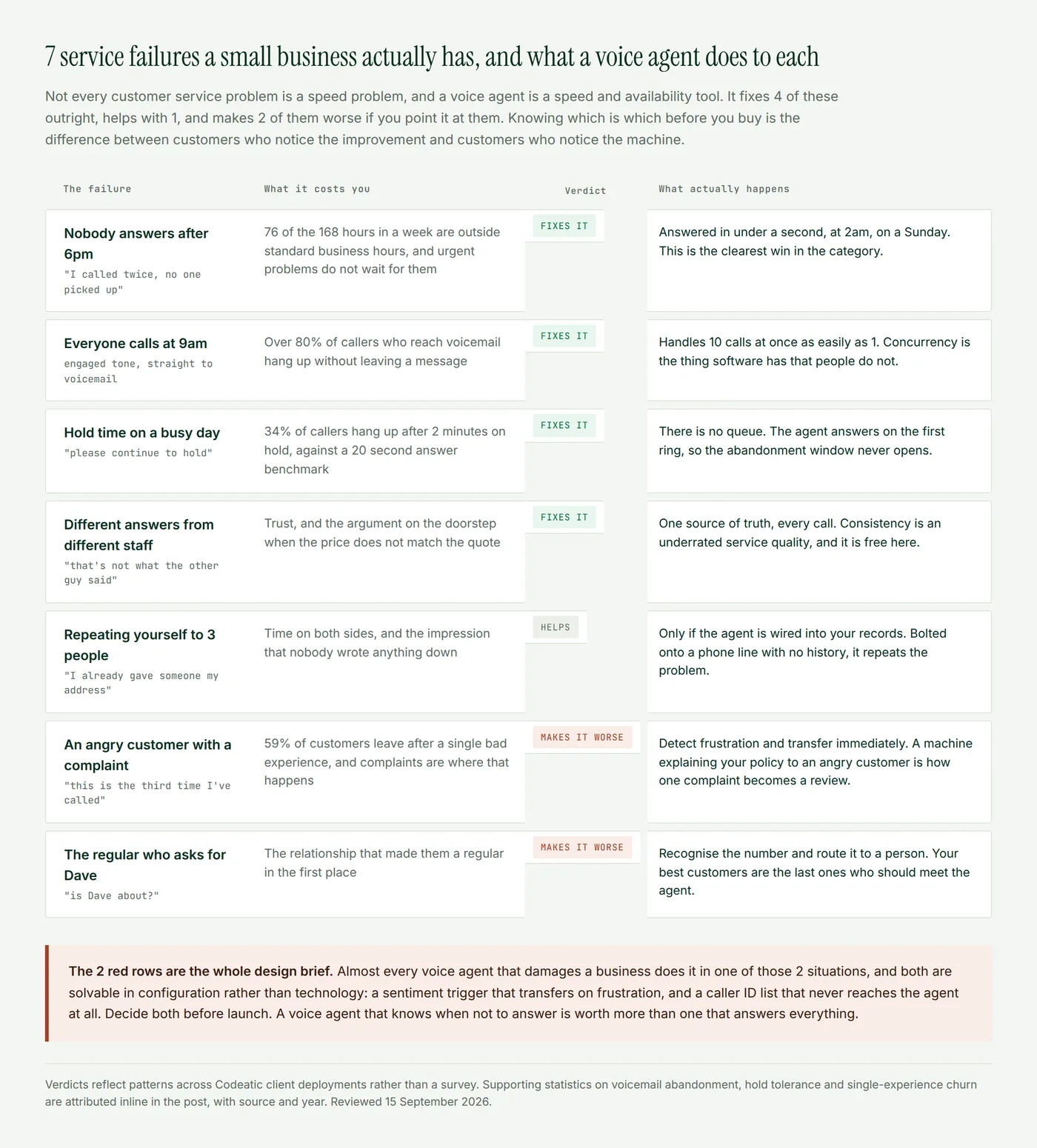
Read the verdict column rather than the row count. The wins are real and they are narrow: availability, concurrency, speed and consistency. Those are the qualities of software. A voice agent is not a better listener than your team and it is not more empathetic, and any pitch that implies otherwise is selling you something that will embarrass you in front of a customer.
Where does it make service worse?
Two situations, and both are configuration decisions rather than technology limits.
The angry caller. Complaints are exactly where relationships are lost: PwC research, widely cited in 2026 service compilations, puts the share of customers who abandon a brand after a single poor experience at 59%. A machine calmly explaining your policy to somebody already frustrated converts a complaint into a public review. The fix is a sentiment trigger that transfers on frustration, early, before the agent has tried twice to help.
The regular who asks for a person by name. Your long standing customers stayed because of a relationship, and routing that relationship through software is how you find out how fragile it was. The fix is a caller ID list that bypasses the agent entirely. It takes 10 minutes to set up and protects the revenue you can least afford to test.
Both fixes are unglamorous and neither appears in a demo. Ask about them anyway.
The improvement nobody expects
Owners buy a voice agent for availability and are usually most surprised by consistency. Every caller hears the same opening hours, the same price band, the same list of what you need before a visit, phrased the same way. In a business where 3 people answer the phone between other jobs, that alone removes a category of complaint: the one that starts with somebody else told me something different.
It is also the cheapest quality improvement available, because it requires no additional technology. It is a side effect of there being one script instead of 3 memories.
How do you prove your customer service improved?
Write these down before you deploy anything, because afterwards you can only compare against what you recorded.
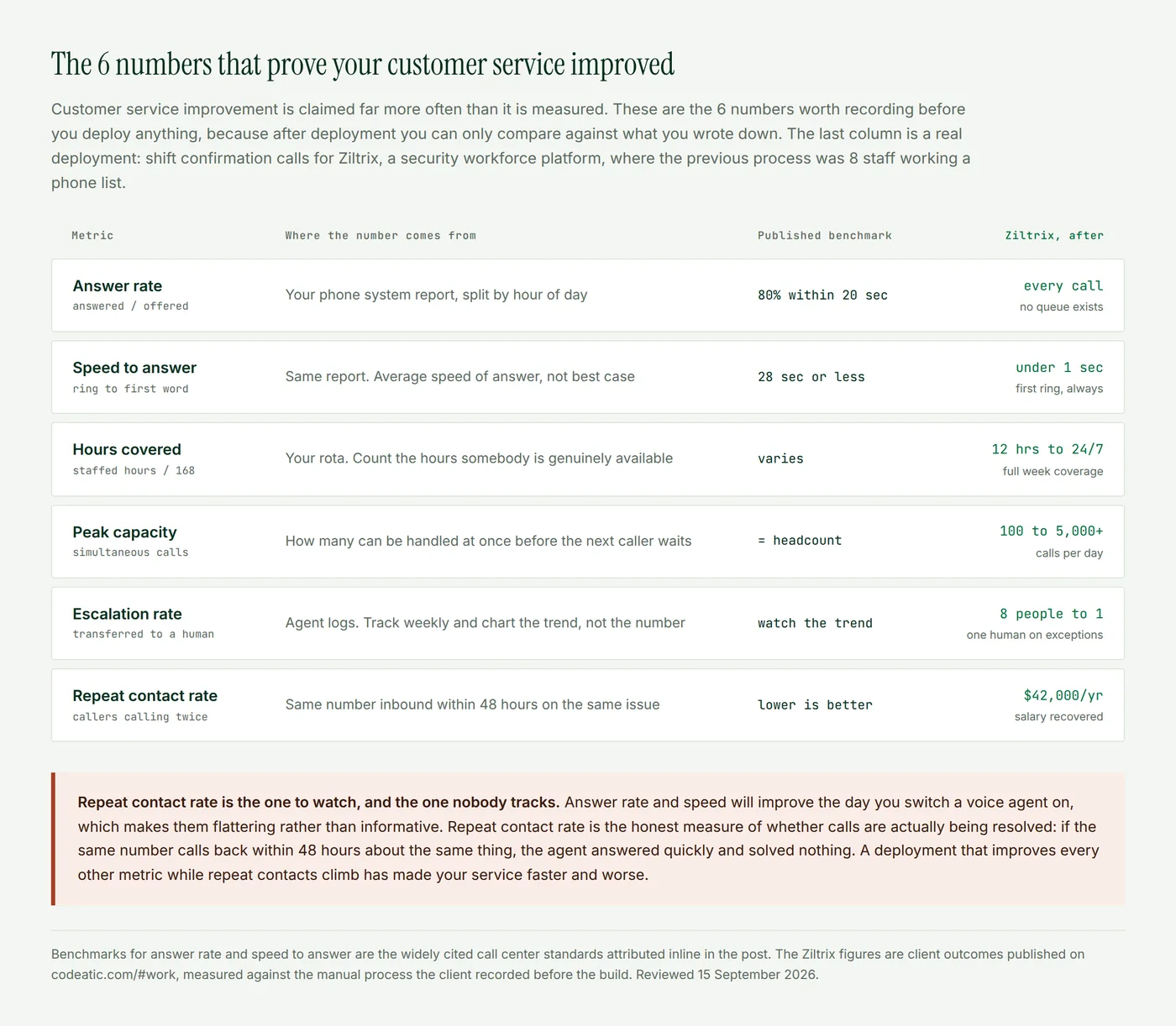
From our work. The Ziltrix numbers in that table are a security workforce platform where confirming shifts was 8 staff working a phone list across a 12 hour window. The voice agent took that to 1 person handling exceptions, moved coverage to 24/7, raised daily call capacity from 100 to more than 5,000, recovered $42,000 a year in salary spent on dialling, and went live in 4 weeks.
What is worth noticing is which number moved first. Answer rate and speed to answer improved on day 1, automatically, because that is what the technology does. The measure that took real work was whether calls were actually resolved, and that came from wiring the agent into the roster rather than from anything about the model. On our automotive receptionist the same pattern showed up as latency: tuning the response from 1.5 seconds to 0.5 seconds was mostly work on the systems around the model, not the model.
The 5 settings that decide how it feels to a customer
- Disclosure in the first sentence. Say it is an AI assistant before anything else. Callers mind being deceived far more than they mind a machine, and in several places it is legally required.
- A transfer trigger on frustration. Detect it and hand over early rather than after 2 failed attempts to help.
- A bypass list. Known numbers, key accounts and anybody who has complained recently go straight to a person.
- A hard scope. Bookings, hours, status, simple questions. Anything else transfers. An agent that attempts everything fails visibly.
- A named human behind it. Somebody who reads the transcripts weekly for the first month and can switch the whole thing off.
Those settings matter more to the customer experience than which vendor you pick. Two businesses running the same platform can deliver completely different service depending on how these 5 are set.
What to do this week
Pull last month's call log and split it by hour. Count what came in outside your staffed hours, what hit voicemail, and how many callers phoned twice in 48 hours. That third number is the important one and almost nobody has it. Then listen to 10 recorded calls and mark which ones a script could have handled. If most of them could, you have a clear case. If most needed judgment, you need better phone coverage rather than a voice agent, and you should spend the money there instead.
Where Codeatic fits in
We build voice agents for service businesses, starting with inbound because that is where the service gap is measurable. Our guide to how voice agents work covers the technology, latency and compliance side, and our published client work has the detail behind the Ziltrix figures.
The AI Opportunity Audit maps where the calls are actually going and what recovering them is worth, and there is a free self serve version if you would rather run the numbers yourself first.
When a voice agent is the wrong answer
When your call volume is low enough that somebody genuinely answers every call, because then you are solving a problem you do not have. When the conversation is the product, as in consultative or high value advisory work. And when the underlying service problem is not speed but quality, since answering faster is not an improvement if the answer was the thing customers were unhappy with.
The short version
A voice agent improves small business customer service on 4 specific dimensions: availability outside staffed hours, concurrency when everyone calls at once, speed to answer, and consistency of what customers are told. It damages service in 2 situations, angry callers and long standing regulars, and both are fixed with a transfer trigger and a bypass list. Measure answer rate, speed to answer, hours covered, peak capacity, escalation rate and repeat contact rate before you deploy. Repeat contact rate is the one that tells you the truth.
How these figures were arrived at
The verdicts in the first figure reflect patterns across our client deployments, not a survey, and the right answer shifts with how relationship driven your business is. Client outcomes are published on our case study page and measured against the manual process each client recorded beforehand. The automotive latency figure comes from a demo still under test, measured from the end of caller speech to the first audio the caller hears. External statistics on response expectations, hold tolerance, voicemail abandonment and churn are attributed inline with the publishing organization and the year; several are vendor compiled benchmark round ups rather than primary research, which we have noted where it applies.
Reviewed 15 September 2026 by Usama Tariq, Co-Founder and CTO. If you find an error in this post, email info@codeatic.com and we will publish a correction on the page rather than editing it quietly.
Frequently asked questions
How can a voice agent improve customer service for a small business?
By answering every call instantly, at any hour, and handling several callers at once. Those 3 things remove the failures customers notice most: no answer after hours, an engaged tone at peak times, and time spent on hold. It also gives every caller the same answer, which removes the complaint that starts with somebody else told me something different.
Will customers be annoyed to reach an AI?
Far less than they are annoyed by voicemail, provided you disclose it immediately and transfer quickly when they want a person. The resentment comes from being trapped or deceived, not from the technology itself.
What should a voice agent never handle?
Complaints from an already frustrated caller, and calls from long standing customers who expect a person. Route both to a human automatically, using a sentiment trigger and a caller ID bypass list.
How do I measure whether customer service actually improved?
Record 6 numbers before deploying: answer rate, speed to answer, hours covered, peak simultaneous capacity, escalation rate and repeat contact rate. The last one matters most, because a rising repeat contact rate means calls are being answered quickly and resolved badly.
Does a voice agent replace my receptionist?
In most small businesses it changes what that person does rather than removing them. The routine confirmations and hours questions stop reaching them, and they handle exceptions and the conversations that need judgment. In one deployment we ran, a team of 8 doing confirmation calls became 1 person working exceptions.
How fast should it answer?
On the first ring, with a spoken response under a second. The phone industry benchmark for humans is answering 80% of calls within 20 seconds, so any competent voice agent clears that standard trivially. What matters more is the pause before it speaks during the conversation.
Can it handle several calls at the same time?
Yes, and this is one of the largest practical differences from staffing. Concurrency is effectively unlimited, so the caller who arrives while 3 others are talking is answered normally rather than queued.
What do I need before I set one up?
Your current call data split by hour, a decision on what the agent is allowed to do, a transfer path to a named person, a bypass list of customers who should never reach it, and a disclosure line. The technology decision is the smallest of those.
Abdul Wahab, Co-Founder and CEO, Codeatic
Abdul has spent 5 years building software, across web stacks and mobile in React Native, Flutter and native Android, before moving into product, architecture and AI work. He holds an MS in Computer Science from PUCIT and leads Codeatic, an AI automation agency working with SMBs and startups across the US, Canada, the UK and Saudi Arabia. Connect on LinkedIn.
Technically reviewed by Usama Tariq, Co-Founder and CTO, Codeatic. Usama is an AI and computer vision engineer who builds production systems from unstructured video, image and speech data. He built the REVOX engine at Veedback, developed LLM and computer vision systems at Coeus Solutions GmbH, and led AI model development at OMNO AI. He is an OpenCV OAK-D finalist and a contributor to Workhub, and holds a BS in Computer Science from COMSATS University Islamabad. Connect on LinkedIn.