AI Agents Compared: Dots, Muse, Grok Bot and Claude
Grok Bot, Muse, dots and Claude all landed between August and September 2026. What each agent actually does, where it runs, what it costs, how people are using them, and the one thing every article about these launches misses: none of them is built for the work your business does for customers.
On this page
Between 11 August and 29 September 2026, xAI, Meta and OpenAI each launched an always-on AI agent with its own cloud computer, and Anthropic folded its equivalent into the main Claude app in the same window. Grok Bot, Muse, dots and Claude. Four products, three of them under 2 months old.
They look almost identical in the launch videos and they are built for different jobs. This covers what each one actually does, what it costs, and the question nobody's launch post answers: what any of it changes for a business that is not a technology company.
On this page
- What are these AI agents, exactly?
- Grok Bot, Muse, dots and Claude compared
- What each one is actually for
- How are people using them?
- What does this change for a business?
- What none of them will do
- Which should you try first?
- How these figures were arrived at
- Frequently asked questions
What are these AI agents, exactly?
The shared idea across all 4 is the same: an agent that keeps working after you close the window. Each runs on its own cloud computer with a browser, signs into apps using your accounts, and carries context between sessions rather than starting fresh every time.
That is the difference between these and the chatbots that preceded them. A chatbot answers while you wait. These AI agents are given a goal and left to it, with an approval gate on the actions that matter.
Forbes described OpenAI's entry as a new class of persistent AI agents that continue working after chat sessions end, which is a fair description of the whole category rather than just one product.
Grok Bot, Muse, dots and Claude compared
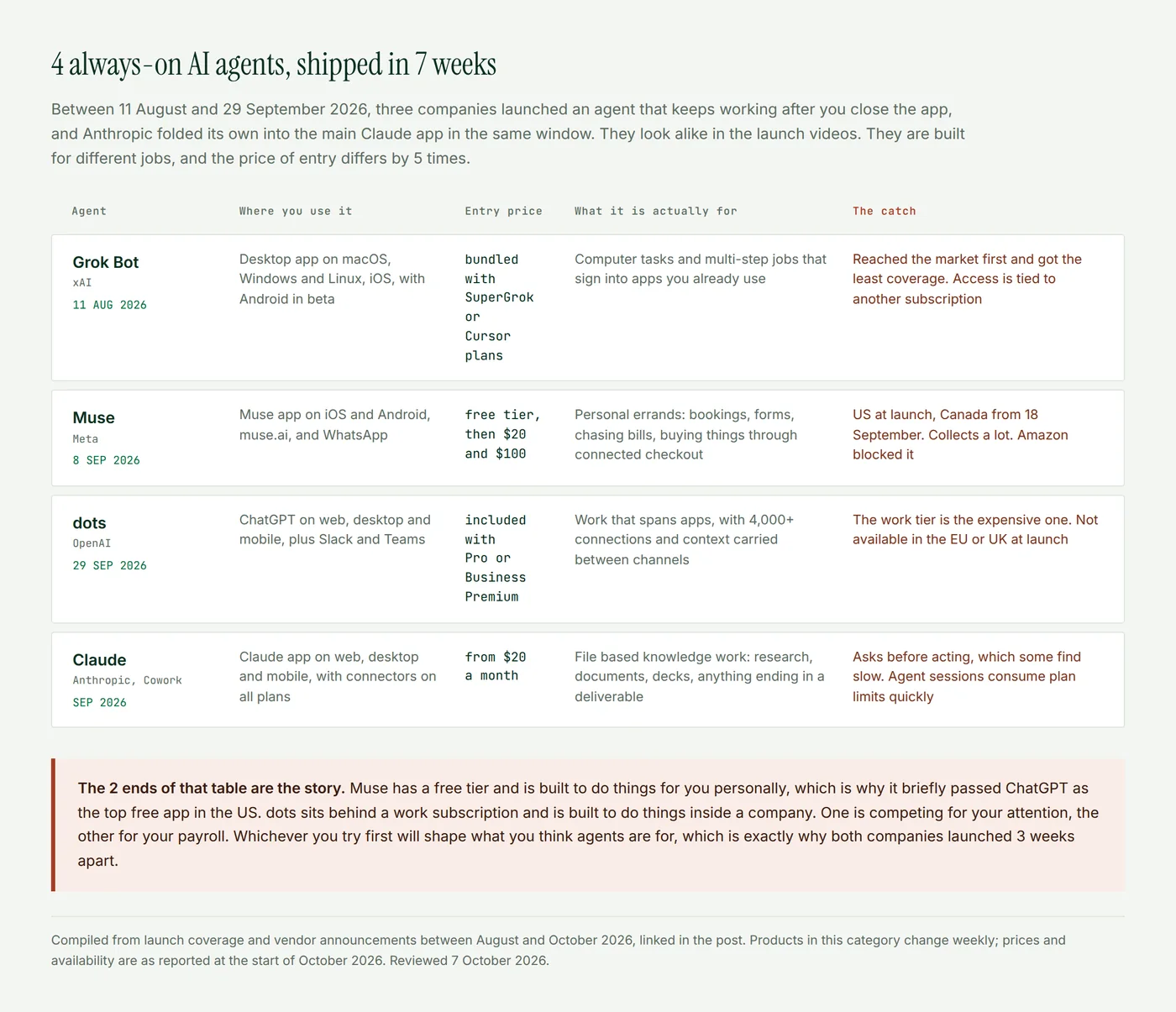
Two naming corrections, because the coverage has been sloppy. xAI's product is Grok Bot, not Grok Boards. Meta's is Muse, a Meta app rather than a Facebook one. And Anthropic's is not a new app at all: Cowork folded into the main Claude app in September.
What each one is actually for
Grok Bot arrived first, in beta on 11 August, and got the least attention of the 4. It runs as a desktop app across macOS, Windows and Linux plus iOS, and access comes bundled with SuperGrok or Cursor subscriptions rather than sold on its own. If you already pay for either, you may have an agent you have not opened.
Muse launched on 8 September and is the one that broke through to the public. MacRumors, covering OpenAI's response, described Muse plainly as the popular Meta agent that dots was built to compete with. It runs in its own app, on muse.ai and through WhatsApp, launched in the US with Canada following on 18 September, and has a free tier with paid plans at $20 and $100. It is aimed squarely at personal errands: bookings, forms, chasing a bill, buying something.
dots arrived at OpenAI's DevDay on 29 September, running on GPT-6 Astra. Each dot gets its own cloud computer with a browser, connects to more than 4,000 apps, and you reach it through ChatGPT, Slack or Teams, with context carried between those channels. One dot is included with Pro and Business Premium, and it was not available in the EU or UK at launch.
Claude took the opposite approach to a launch. Anthropic put the capability inside the product people already used rather than shipping a separate app with a mascot, which The New Stack summed up as its answer to dots and Muse already being inside Claude. It starts at $20 a month, asks before acting by default, and is built around work that ends in a document.
How are people using them?
The honest answer in October 2026 is that adoption is running ahead of habit. Muse reached the top of the US App Store and reportedly passed 2.8 million users in its first weeks, with analysis suggesting more than 95% of them also use Facebook, which says as much about distribution as about the product.
What people actually do with them splits cleanly. Personal agents get used for errands: travel, forms, bills, shopping. Work agents get used for research, drafts, decks and reports. One comparison of these products for marketers landed on the practical version of that split, recommending Claude for work that ends in a deliverable and Muse only for low risk tasks with approvals on.
Worth noting what has already gone wrong, because this is a young category. Coverage has reported that Amazon blocked Muse, that OpenAI's own safety material says dots can still make mistakes and consequential work should be reviewed, and that an independent comparison found dots unavailable in the EU and UK and Muse collecting a lot of data. None of that makes them bad products. It makes them new ones.
What does this change for a business?
Less than the coverage implies, and more than the sceptics think.
What genuinely changes is the hours you personally lose to your own admin. If you are an owner or a manager, a personal agent can take a real bite out of research, drafting, scheduling and chasing. At $20 a month that is an easy decision and you should make it this week.
What does not change is the work your business does for customers. And that is the distinction almost every article about these launches misses.
What none of them will do
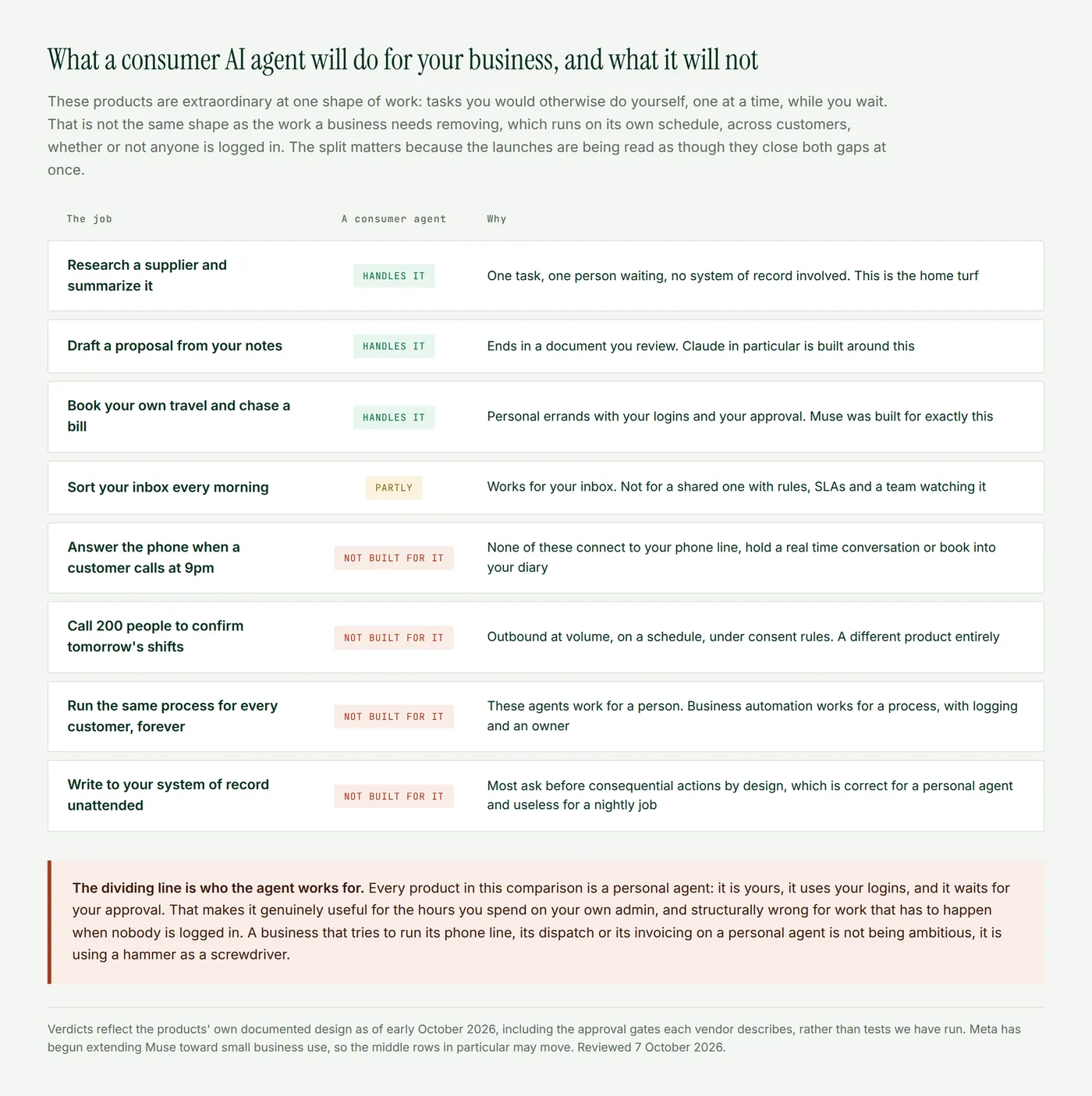
Every product in this comparison is a personal agent. It is yours, it uses your logins, and by design it asks before consequential actions. Those 3 properties make it useful for your own day and structurally wrong for work that has to happen when nobody is logged in.
Your phone ringing at 9pm is not your admin. Confirming tomorrow's shifts with 40 staff is not your admin. Neither is invoicing every completed job, or answering the same status question 75 times a week. That work runs on its own schedule, touches your customers, needs logging and needs an owner. It is a different category of system, and no amount of capability in a personal agent turns it into one.
From our work. The difference is easiest to see in a real deployment. At Ziltrix, a security workforce platform, 8 staff spent their days ringing guards to confirm shifts. The agent we built took that to 1 person handling exceptions, moved coverage from 12 hours to 24/7, raised capacity from 100 calls a day to more than 5,000, and recovered $42,000 a year in salary. It went live in 4 weeks.
No personal agent does that, and not because it lacks intelligence. It is not connected to a phone line, it does not run on a schedule across hundreds of people, and it is built to pause and ask you first, which is exactly the wrong behavior for a job running at 3am. At Ph3onix, the same point in a different shape: a full working day every week counting shelf stock became minutes, worth about $68,000 a year, because the system was built around their process rather than around a person.
We are genuinely enthusiastic about these launches. They are how most people will first understand what an agent is, which makes the conversation with a business owner considerably shorter than it was a year ago.
Which should you try first?
- Check what you already pay for. If you have a Cursor or SuperGrok subscription, Grok Bot is already included. If you have ChatGPT Pro or Business Premium, you have a dot.
- For personal errands, Muse. Free tier, built for exactly that, and the lowest friction way to understand what these things feel like.
- For work that ends in a document, Claude. From $20, asks before acting, built around deliverables rather than checkout.
- For work spread across business apps, dots. The 4,000 connections and the Slack and Teams presence are the real differentiators, and the price reflects it.
- Give it one low risk task with approvals on. Not your invoicing. Something where being wrong costs you 10 minutes.
- Then ask the separate question. Which work in your business happens whether or not you are at your desk. That list is not a job for any of these 4.
Where Codeatic fits in
We build the second kind: agents that work for a process rather than for a person. Voice agents that answer your phone line, workflow automation that runs on a schedule, systems that write to your records and log what they did.
If you want to know which of those is worth building in your business, the free AI audit reads your public footprint and returns scored findings in a couple of minutes. Our guides to AI agents and voice agents cover the business versions in depth, and AI call agents by industry covers the one most service businesses start with. Or just get in touch.
When to ignore all of this
When you have not yet counted what your own repetitive work costs, because a subscription is not a strategy. When the task you want handled touches customers directly, since a personal agent is the wrong tool. And when you are in the EU or UK and the product you read about is not available to you, which currently applies to dots.
The short version
Four always-on AI agents arrived in 7 weeks. Grok Bot from xAI on 11 August, bundled with Cursor and SuperGrok. Muse from Meta on 8 September, free tier, built for personal errands, US and Canada. dots from OpenAI on 29 September, on GPT-6 Astra, built for work across 4,000 apps, behind a work subscription. Claude in the same window, from $20, built for documents and research. All 4 are personal agents that use your logins and ask before acting, which makes them excellent for your own admin and unsuitable for work that runs on a schedule across your customers. Try one this week. Then make a separate list for the work that happens when you are asleep.
How these figures were arrived at
Launch dates, pricing, platforms and availability are compiled from launch coverage and vendor announcements published between August and October 2026, attributed inline. This category is moving weekly and several of these products changed availability during the period covered, so treat every figure as correct at the start of October 2026 and check before relying on it. The verdicts in the second figure describe the products' own documented design, including the approval gates each vendor publishes, rather than tests we ran. Client outcomes are published on our case study page and measured against the manual process each client recorded before the build.
Reviewed 7 October 2026 by Usama Tariq, Co-Founder and CTO. If you find an error in this post, email info@codeatic.com and we will publish a correction on the page rather than editing it quietly.
Frequently asked questions
What are the new AI agents from OpenAI, Meta and xAI?
OpenAI launched dots on 29 September 2026, running on GPT-6 Astra with its own cloud computer and more than 4,000 app connections. Meta launched Muse on 8 September, a personal agent with a free tier aimed at errands like bookings and bills. xAI launched Grok Bot in beta on 11 August, bundled with SuperGrok and Cursor plans. Anthropic folded the same capability into the main Claude app in September.
What is the difference between dots and Muse?
dots is built for work, reaches you in ChatGPT, Slack and Teams, connects to over 4,000 apps and sits behind a work subscription. Muse is built for personal errands, runs in its own app and WhatsApp, and has a free tier. They launched 3 weeks apart and are aimed at different budgets and different jobs.
Which AI agent is free?
Muse has a free tier with paid plans at $20 and $100 a month. Grok Bot comes bundled with existing SuperGrok or Cursor subscriptions rather than sold separately. dots is included with ChatGPT Pro and Business Premium. Claude starts at $20 a month.
Can these AI agents answer my business phone?
No. None of them connects to a phone line, holds a real time spoken conversation with a customer or books into your diary unattended. That is a voice agent, which is a different product built for a process rather than for a person.
Are AI agents safe to let loose on my accounts?
They are built with approval gates for exactly that reason, and the vendors say so themselves. OpenAI's own safety material notes dots can still make mistakes and that consequential work should be reviewed. Start with a task where being wrong costs you 10 minutes rather than money.
Which AI agent is best for a small business owner?
For your own admin, whichever you already pay for, then Muse for errands or Claude for work that ends in a document. For work your business does for customers, none of them, because they are personal agents and that work needs a system built around the process.
Are these AI agents available in the UK and EU?
Not all. dots was not available in the EU or UK at launch, and Muse started in the US before reaching Canada on 18 September. Availability in this category is changing quickly, so check before committing.
What is the difference between a personal AI agent and a business one?
Who it works for. A personal agent uses your logins, works on your tasks and asks your permission. A business agent runs on a schedule, serves your customers, writes to your systems and logs what it did, with an owner accountable for it. The second kind is built, not subscribed to.
Abdul Wahab, Co-Founder and CEO, Codeatic
Abdul has spent 5 years building software, across web stacks and mobile in React Native, Flutter and native Android, before moving into product, architecture and AI work. He holds an MS in Computer Science from PUCIT and leads Codeatic, an AI automation agency working with SMBs and startups across the US, Canada and the UK. Connect on LinkedIn.
Technically reviewed by Usama Tariq, Co-Founder and CTO, Codeatic. Usama is an AI and computer vision engineer who builds production systems from unstructured video, image and speech data. He built the REVOX engine at Veedback, developed LLM and computer vision systems at Coeus Solutions GmbH, and led AI model development at OMNO AI. He is an OpenCV OAK-D finalist and a contributor to Workhub, and holds a BS in Computer Science from COMSATS University Islamabad. Connect on LinkedIn.