AI for Cleaning Companies: What to Automate First
Most cleaning companies will use AI in the office, not on the floor. The five jobs to automate first, what to keep human, what it costs, and a real build where shift confirmation calls went from 8 people to 1.
On this page
AI for cleaning companies is mostly office work, not robots. It answers calls and web leads, follows up on quotes, confirms cleaners' shifts, and sends clients proof the job was done. Start with the task your team repeats every day by hand, because that is where AI pays back fastest.
This guide is for owners and managers of commercial cleaning and janitorial companies in the US and Canada. It covers how cleaning companies are using AI in 2026, what to automate first, what to keep human, what it costs, and how to start without buying another app.
What Codeatic does: AI automation for security and cleaning companies. We find the work your team still does by hand, then build the automations and AI agents that do it. Start with our free automation audit, which takes 1 to 3 minutes.
Written by Abdul Wahab, Co-Founder and CEO of Codeatic. Technical review by Usama Tariq, Co-Founder and CTO. Reviewed 24 November 2026.
On this page
- How cleaning companies use AI
- Why now
- What to automate first
- What this looks like when it is built
- What to keep human
- What it costs
- Software or automation?
- How to start
- Frequently asked questions
How are cleaning companies using AI in 2026?
Mostly for office work: answering leads, writing and following up on quotes, scheduling, and client updates. Very few use it to clean.
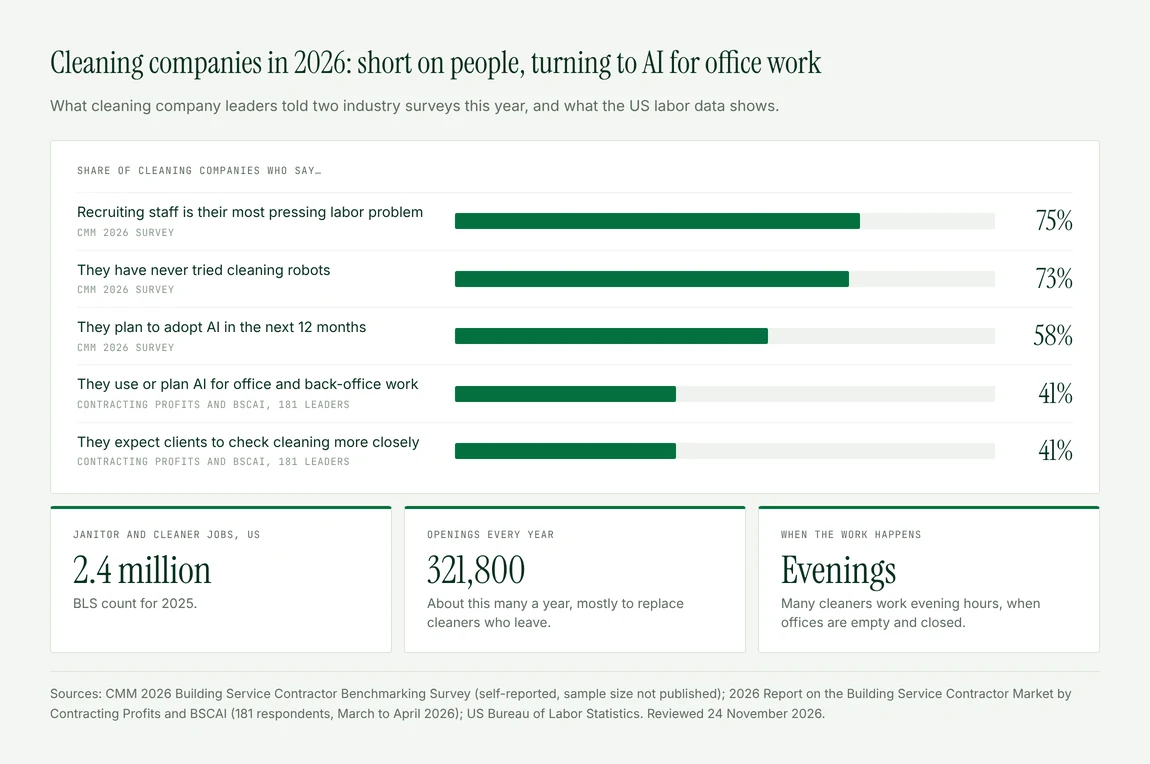
Two industry surveys from 2026 point the same way. In the 2026 Report on the Building Service Contractor Market, by Contracting Profits and BSCAI, 41% of 181 cleaning company leaders said they use AI, or plan to, for office, marketing and back-office work. In the same study, 38% expect clients to ask for more automation and technology in their contracts, as BSCAI's summary of the 2026 trends notes. In CMM's 2026 survey of building service contractors, 58% said they plan to adopt AI in the next 12 months, more than any other technology on the list. In the same CMM survey, 73% had never tried autonomous cleaning equipment.
So the AI most cleaning companies will use first sits in the office. It handles the calls, emails, texts and paperwork that keep the cleaning running.
Why are cleaning companies turning to AI now?
Because finding and keeping cleaners is harder than ever, and the office work grows with every new account.
In the CMM survey, 75% of cleaning companies named recruiting qualified staff as their most pressing labor problem. Paying enough to stay competitive came second, at 56%, and keeping existing staff came third, at 44%. The US Bureau of Labor Statistics counts about 2.4 million janitor and building cleaner jobs, with about 321,800 openings a year. BLS says most of those openings come from replacing workers who leave.
The hours add to the strain. As BLS puts it:
"Because office buildings are often cleaned while they are empty, many cleaners work evening hours."
So a cleaner calls off at 7 p.m., or a client calls about a missed restroom at 6 a.m., when the office is closed. Someone still has to answer, and an AI agent can answer at any hour.
What should a cleaning company automate first?
Start with work that happens every day, follows clear rules, and costs you when it is late: new leads, quote follow-ups, shift confirmations, client reports and supply counts.
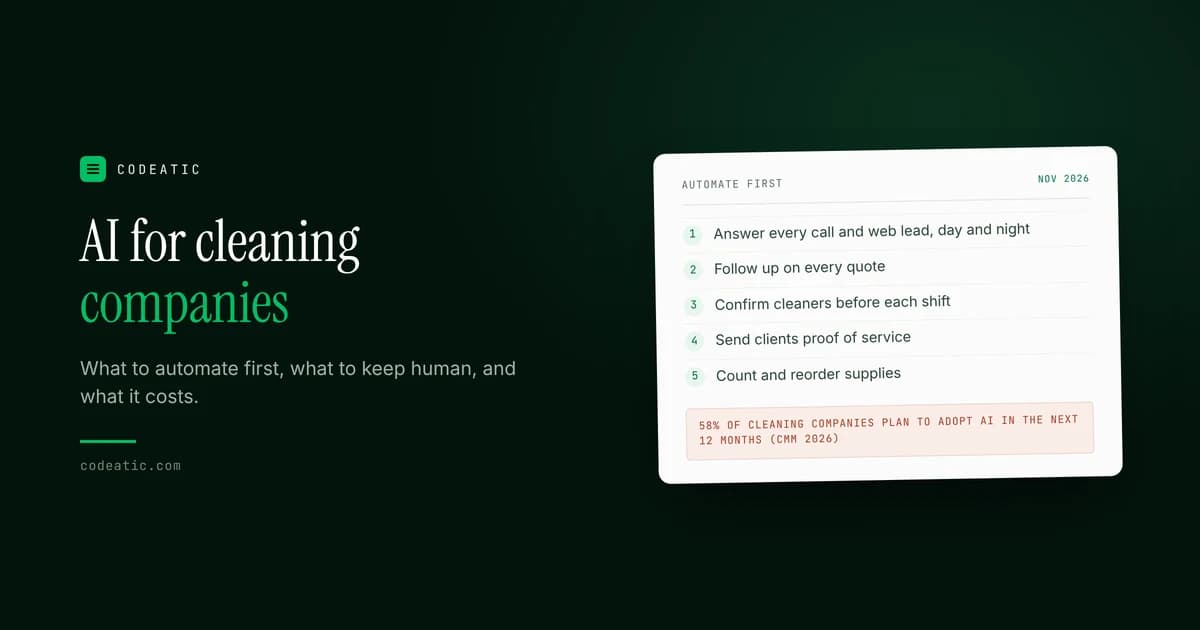
- Answer every call and web lead, day and night. An AI receptionist answers the phone, asks for the building type, size and how often it needs cleaning, and books a walkthrough. Web forms get a reply in minutes, not the next morning. This matters because, in the CMM survey, cleaning companies said they win 71% of their new accounts by replacing another cleaning company. A building manager who is unhappy with their cleaner wants an answer fast.
- Follow up on every quote. A quote that goes quiet is not always a no. Automation sends a short follow-up by email or text on a set schedule, stops the moment the prospect replies, and tells you who opened the quote.
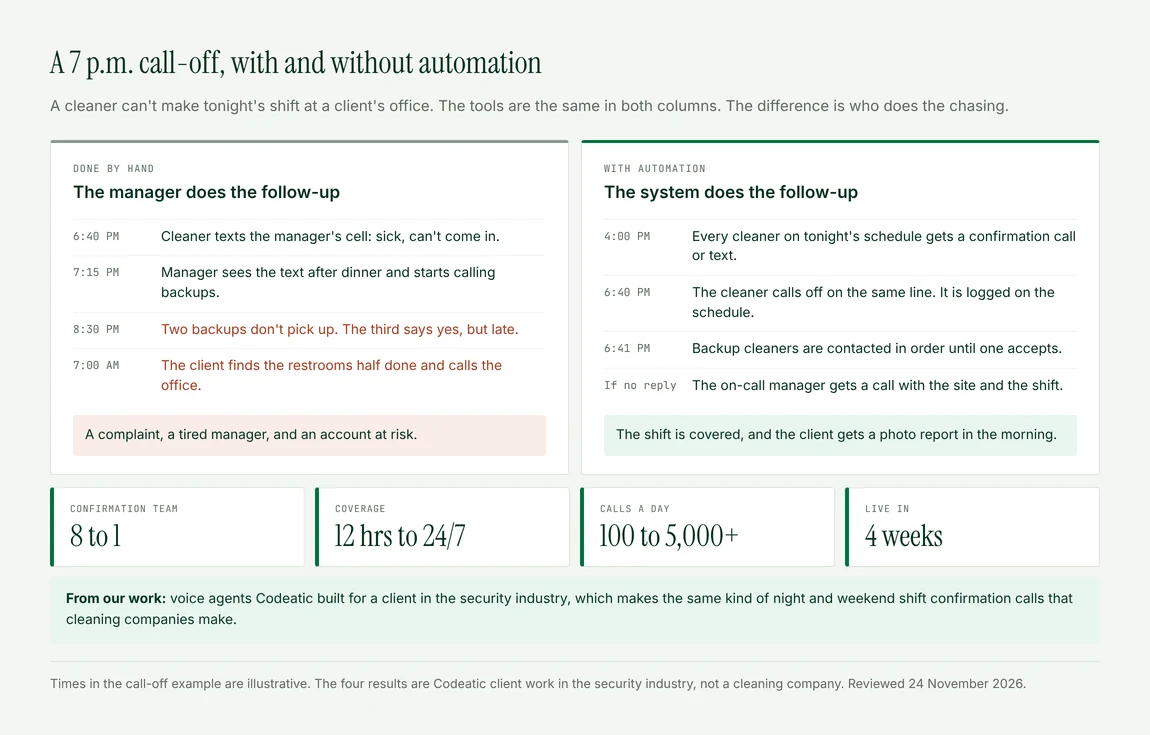
- Confirm cleaners before each shift. An AI voice agent or text calls each cleaner before their shift and asks them to confirm. Anyone who doesn't confirm, or calls off, triggers a message to backup cleaners in order, then to the on-call manager.
- Send clients proof of service. Cleaners take photos and tick a checklist on their phone. Automation turns that into a short report the client gets each week, without anyone typing it up. In the BSCAI market study, 41% expect clients to check cleaning more closely.
- Count and reorder supplies. A photo of a supply closet can be counted by AI and compared with what each site should have, so reorders go out before a site runs low.
You don't need all five. Pick the one that costs you the most each week and start there.
What does this look like when it is built?
From our work: we built voice agents for a client in the security industry that took shift confirmation calls from 8 people to 1, and it was live in 4 weeks.
That client had the same problem many cleaning companies have. People work nights and weekends across many sites, and someone has to make sure each person shows up. Their team called every worker to confirm shifts, and called back when nobody picked up. We built voice agents that make those calls, handle the back and forth, and pass anything unusual to a person.
- The team making the calls went from 8 people to 1.
- Coverage went from 12 hours a day to 24/7.
- Capacity went from about 100 calls a day to more than 5,000.
- About $42,000 a year in salary went back to work that needed people.
This client is not a cleaning company. We share it because shift confirmation works the same way for a night cleaning crew as it does for a night security post. The supply count idea comes from our work too. For Ph3onix, a retail client, we replaced a weekly stock count done by hand on a clipboard with a count from a single phone photo. A job that took a full day each week now takes minutes.
What should a cleaning company not automate?
Keep people on anything that needs judgment, trust or a hard conversation: pricing a new building, handling an upset client, safety problems and staff decisions.
- Pricing a new bid. AI can draft a proposal from your walkthrough notes. A person should still set the price, because every building is different.
- Complaints from unhappy clients. Let automation log the complaint and alert you right away. Then call the client yourself.
- Safety and injuries. A chemical spill or an injury on site goes straight to a manager.
- Hiring, discipline and firing. AI can screen applications and book interviews. People decide.
One more limit. AI calls to customers and prospects have rules. In February 2024 the Federal Communications Commission ruled that AI-generated voices count as "artificial" under the Telephone Consumer Protection Act, so the consent rules for prerecorded calls apply. Check with a lawyer before you use AI to call people who haven't agreed to it. This guide is not legal advice.
How much does AI automation cost a cleaning company?
It depends on what you automate. A simple quote follow-up can cost little to run, while a custom AI phone agent costs more. Compare the price with what the manual work costs you now.
A quick way to check is to count the hours. If someone on your team spends 10 hours a week chasing quotes and confirming shifts, and that time costs you $20 an hour, that is $10,400 a year. Any automation that costs less than that, and frees those hours, is worth a look.
Codeatic's own prices are published:
- The free automation audit costs nothing and takes 1 to 3 minutes.
- The AI Opportunity Audit is a fixed $999 and takes 7 to 10 days.
- An AI receptionist starts from $249 a month and depends on what we automate.
- Custom builds usually take 4 to 8 weeks and are priced after the audit, once we know what is worth building. You own 100% of the code.
Do you need janitorial software or custom automation?
Often both. Janitorial software holds your schedules, sites and inspections. Automation connects that software to your phone, email and texts, and does the chasing it can't.
If you already use janitorial software, keep it. Ask whether other tools can connect to it, or whether you can at least export your data. If they can, the work around it can be automated. If they can't, everything outside it stays manual. For the bigger picture, see our guide to workflow automation for service businesses.
How do you start using AI in a cleaning business?
Write down what your team does by hand each week, pick one task, run it next to a person for 2 weeks, then measure what changed.
- List the manual work. Calls, texts, quotes, reports, reorders. Note roughly how many hours each one takes.
- Pick one task. Choose one that happens often, follows clear rules, and costs you when it is late.
- Run it side by side. Let the automation do the work while a person checks it.
- Measure it. Hours saved, replies sent, shifts confirmed. Then decide what to automate next.
How Codeatic helps cleaning companies
Codeatic builds AI automation for security and cleaning companies. We don't sell you another app. We look at how your team runs leads, quotes and shifts today, then automate the calls, follow-ups and reports around the tools you already use.
- Free automation audit. Give it your company name or website. In 1 to 3 minutes it scores how ready you are for AI out of 100 and lists the work still done by hand. No card and no account. Run it here.
- AI Opportunity Audit. A free 30-minute call first. If an audit is the right next step, it is a fixed $999 and takes 7 to 10 days. You get a ranked plan you can approve, shelve or hand to any developer. See what it covers.
- Build. We build what the plan says is worth it, usually in 4 to 8 weeks.
To see how shift confirmations work for a night workforce, read our guide to security guard scheduling. Or talk to us about your cleaning business.
The short version
- Cleaning companies use AI mostly for office work: leads, quotes, scheduling and client updates.
- 58% plan to adopt AI in the next 12 months, and 75% say recruiting is their biggest labor problem.
- Automate first: lead replies, quote follow-ups, shift confirmations, client reports and supply counts.
- Keep people on pricing, complaints, safety and staff decisions.
- Start with one task, run it beside a person, and measure it.
How these figures were arrived at
Survey figures are from the 2026 Report on the Building Service Contractor Market by Contracting Profits and BSCAI (181 respondents, surveyed 9 March to 6 April 2026, margin of error 7.2 points) and CMM's 2026 Building Service Contractor Benchmarking Survey, which is self-reported and does not publish its sample size. Job figures and the quote are from the US Bureau of Labor Statistics. The FCC ruling is from the Federal Communications Commission. The $10,400 example is simple arithmetic to show the method, not a measured figure.
The voice agent and Ph3onix results are Codeatic's own client work. The questions in this guide come from what Google, Google autocomplete and AI assistants showed for this topic in November 2026. If you find an error, tell us and we will correct it and note the correction.
Frequently asked questions
How is AI being used in the cleaning industry?
Mostly in the office. Cleaning companies use AI to answer calls and leads, write and follow up on quotes, schedule and confirm cleaners, and send clients reports. Cleaning robots are still rare: in CMM's 2026 survey, 73% of cleaning companies had never tried them.
How can I use AI for my cleaning business?
Pick one task your team does by hand every day, such as replying to new leads or confirming shifts, and automate that first. Run it beside a person for 2 weeks, measure the hours saved, then move on to the next task.
What should a cleaning company automate first?
The work that happens daily, follows clear rules and costs you when it is late. Good first picks are replying to new leads, following up on quotes, confirming cleaners before each shift, and sending clients proof of service.
Can an AI receptionist answer calls for a cleaning company?
Yes. An AI receptionist can answer every call day and night, ask about the building and how often it needs cleaning, book a walkthrough, and pass urgent calls to you. Codeatic's AI receptionist starts from $249 a month.
How do I follow up on cleaning quotes automatically?
Connect your quotes to an email or text sequence that sends a short follow-up on set days after the quote goes out. It should stop as soon as the prospect replies and alert you when someone opens or answers the quote.
Will AI replace cleaning companies?
No. AI can't clean a building, and robots are still rare in the industry. What AI replaces is office work: calls, follow-ups, reports and scheduling. That frees managers to spend more time with clients and cleaners.
How much does AI automation cost for a cleaning business?
It depends on what you automate. Compare it with what the manual work costs now: 10 hours a week at $20 an hour is $10,400 a year. Codeatic's AI Opportunity Audit is a fixed $999, and its free automation audit costs nothing.
Do I need janitorial software or an AI automation agency?
Often both. Janitorial software stores schedules, sites and inspections. An automation partner connects it to your phone, email and texts, and automates the follow-ups and reports the software leaves to your team.