After Hours Answering Service: Costs, Call Rules, Tests
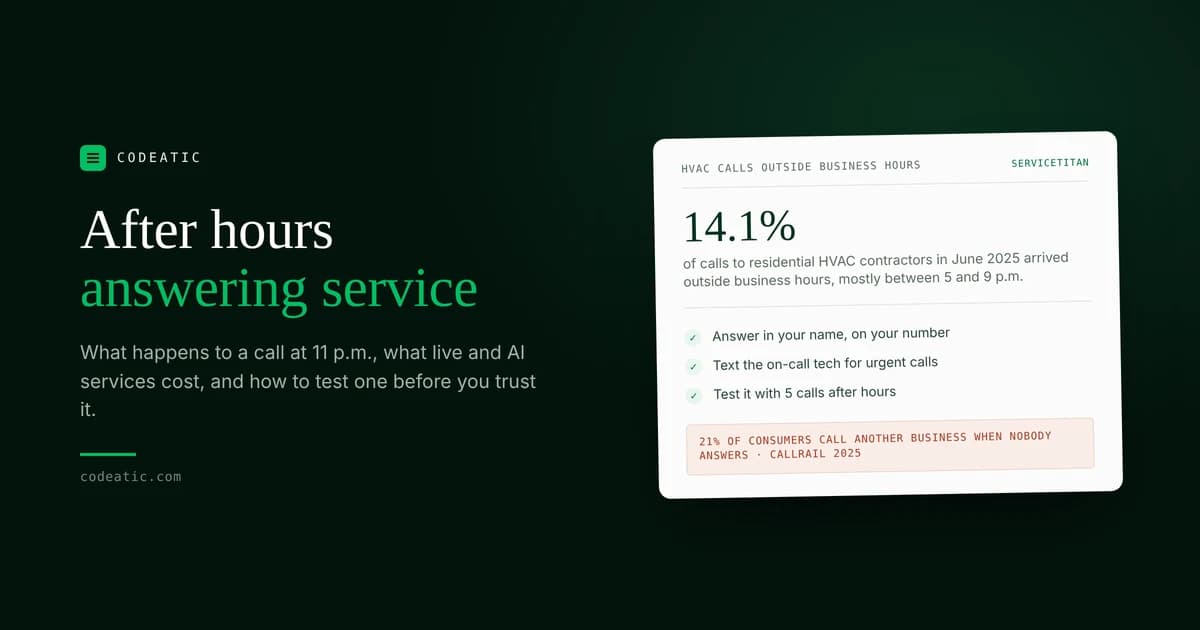
In June, 14.1% of calls to residential HVAC contractors arrived after hours, and only 34% of HVAC calls reach a person at all. What should happen to a call at 11 p.m., what live and AI services publish as prices, what to set up first, and 5 test calls to run before you trust any of it.
On this page
An after hours answering service picks up your business line when the office is closed, takes the caller's details, books routine jobs and gets real emergencies to your on-call technician. It can be a team of live receptionists or an AI receptionist. For a home service company, the deciding question is what happens to a no-heat call at 11 p.m.
This guide is for owners of HVAC, plumbing, electrical and other home service companies in the US and Canada, with a section for security companies, whose night calls work differently.
Written by Usama Tariq, Co-founder and CTO of Codeatic. Reviewed 8 November 2026.
On this page
What does an after hours answering service do?
It answers in your company's name when nobody in the office can, collects the caller's name, number, address and problem, and then follows your rules: book it, pass it to the on-call technician, or send a message for the morning. You'll also see it called an after hours call service, an after hours call center or an after hours virtual receptionist. Most services can cover weekends, holidays and the busy hours when your office is swamped, and many sell the same setup as a 24 hour answering service.
There are three ways to cover the phone after hours:
Live answering service: trained receptionists in a call center, usually billed by the minute.
AI receptionist: software that holds the conversation, books into your calendar and sends alerts, usually billed by the month with minutes or calls included.
Voicemail or call forwarding to your own cell: free, and the option most owners are trying to get away from.
How many calls come in after hours?
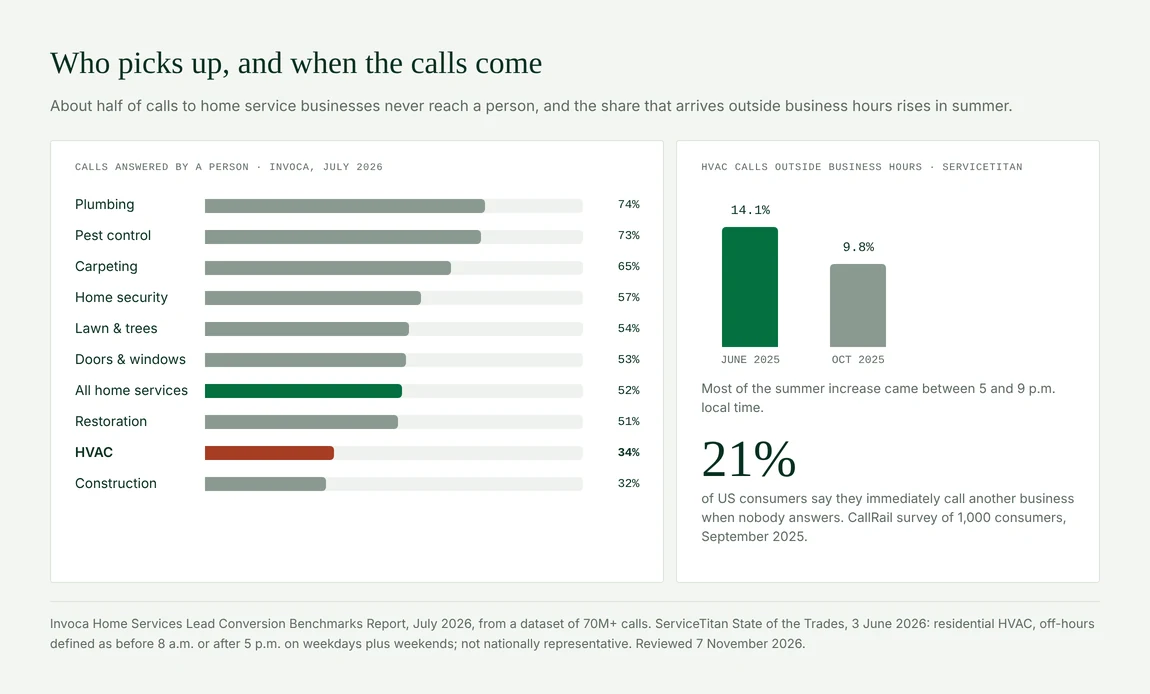
For HVAC, between roughly 1 in 10 and 1 in 7 calls, depending on the season. ServiceTitan looked at inbound calls to residential HVAC contractors on its platform through 2025. In June, 14.1% arrived outside business hours, which it defined as before 8 a.m. or after 5 p.m. on weekdays, plus weekends. In October the share fell to 9.8%. Most of the extra summer calls came between 5 and 9 p.m.
ServiceTitan describes these off-hours calls as high-intent: an uncomfortable customer looking for the first contractor who can respond. They also land on phone systems that already miss a lot during the day. In Invoca's July 2026 home services benchmarks, only 52% of calls reached a person, and HVAC companies answered just 34% of theirs.
Callers don't wait for the morning, either. In a survey of 1,000 US consumers CallRail published in September 2025, 42% said they leave a voicemail when a business doesn't answer, and 21% said they immediately call another business. 78% said they had taken their business elsewhere after failing to reach a company by phone.
What happens to a call at 11 p.m.?
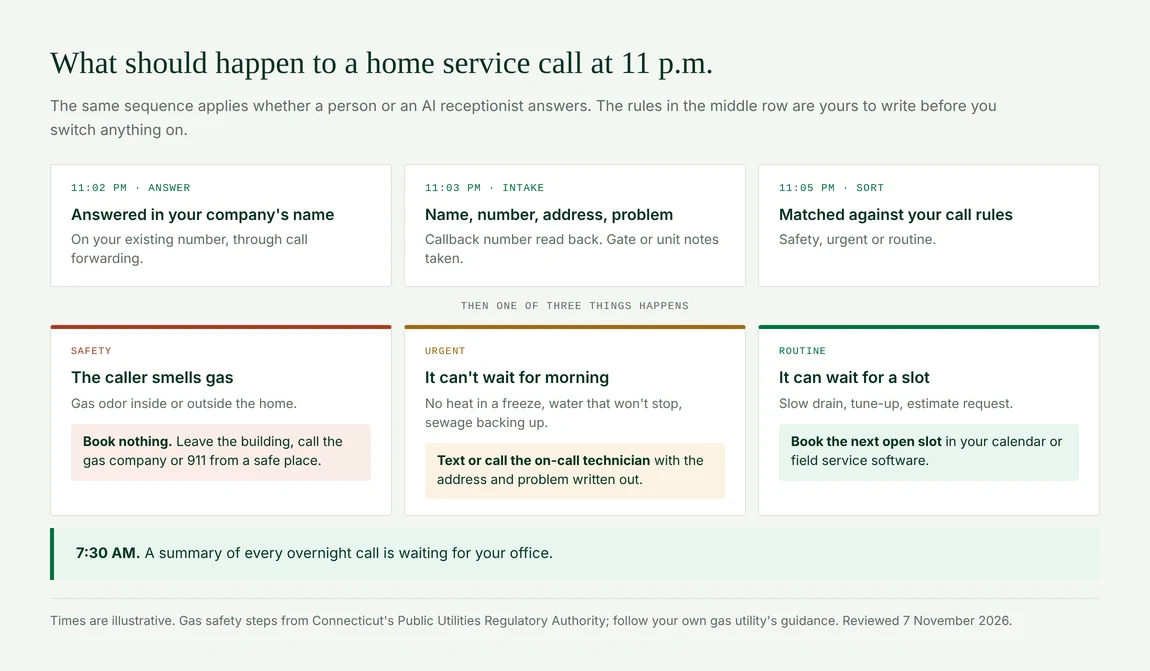
With a good setup, the call is answered, sorted, and either booked or passed to your on-call technician the moment it ends, and you see a summary when you wake up. Here is the sequence to expect, whoever answers:
The service answers in your company's name on your existing number.
It takes the caller's name and callback number, reads them back, and gets the service address and the problem in the caller's own words.
It sorts the call against your rules: safety, urgent or routine.
Safety first. If the caller smells gas, the service books nothing. Connecticut's utility regulator, like most gas utilities, tells people to leave the building and call the gas company or 911 from a safe place.
Urgent calls, such as no heat in a freeze, water that won't stop, sewage backing up, or no power to part of the house, go straight to your on-call technician by text or call, with the address and problem written out.
Routine calls get booked into the next open slot.
A summary of every call is waiting for your office in the morning.
Watch the fifth step most closely. A note in a shared inbox that someone reads at 7 a.m. is not an emergency process. For the plumbing version of these rules, including what to ask a caller with water coming through the ceiling, see our plumbing answering service guide.
How much does an after hours answering service cost?
PATLive, a live service, publishes $1.49 to $2.99 a minute, Smith.ai's live receptionists start at $300 a month, and AI answering services start between $0 and $49 a month for a small allowance of calls or minutes. The prices below come from each company's own pricing page and are in US dollars.
| Option | Published price | Note |
|---|---|---|
| PATLive, live receptionists | $99 a month for 50 minutes, then $2.29 a minute; $2.99 a minute pay as you go; $1.49 at 5,000 minutes | States it does not use AI |
| Smith.ai | AI from $0 a month for 25 calls; live receptionists from $300 a month | AI with human backup |
| Quo Sona, AI | $25 a month for 40 calls, then $1 a call | Billed per call |
| Dialzara, AI | $29 a month for 60 minutes | Call transfer only on its $349 plan |
| RingCentral AI Receptionist | $49 a month for 100 minutes, then $0.50 a minute | Built around its own phone system |
| Rosie, AI | $49 a month for 250 minutes | Calendar booking starts on its $149 plan |
| In-house receptionist | US median $38,010 a year, or $18.27 an hour | Bureau of Labor Statistics, May 2025, before benefits; covers one shift |
The entry price rarely tells you what you'll pay. Ask what a night, weekend or holiday minute costs, and whether you're billed for spam and wrong numbers, because live services charge for every minute an operator is on the line. On the AI side, several entry plans only text the caller a booking link; booking into your calendar sits on a higher tier. For the side by side across all three options, see our comparison of AI receptionists, answering services and hiring a receptionist, and our guide to AI receptionist pricing for what entry plans actually include.
To check whether it pays, count your after hours calls for 2 weeks, multiply by how many of them are real jobs, then by your average ticket. For a benchmark, Invoca found that when a person answers, 38% of home service calls are leads and 45% of those leads book on the call.
On Your Clock, our AI receptionist, starts at $249 a month for 300 minutes, on any schedule you choose. See how it handles after hours calls, or run our free automation audit to see what else in your business is worth automating.
Should you use a live answering service or an AI receptionist after hours?
For nights and weekends, an AI receptionist is usually the better fit: it costs less per call, answers several calls at once, and books straight into your schedule. A live service still handles an upset or unusual caller better, which is why many owners keep people on the phone during the day.
Callers are open to it. In the same CallRail survey, 52% said businesses that use AI assistants after hours provide better service, and 50% said they would use AI to book an appointment. Home service owners in a Jobber community thread landed in the same place. One wrote:
"AI works fine for after-hours, basic routing, and spam filtering."
Where AI falls short is the call that needs judgment your rules didn't cover. The fix is better rules, and reading the call summaries closely in the first few weeks.
What should you set up before you switch it on?
Three call rules, an on-call rotation, an intake list, and a destination for every lead. A service can only follow the rules you give it.
Call rules: what counts as safety, urgent and routine for your trade. A slow drain at 10 p.m. can wait; no heat at 20°F can't.
On-call rotation: who gets the alert each night, by text or call, and what the caller is told about when to expect a callback.
Intake questions: name, callback number, service address with gate or unit notes, the problem, and whether they own the home. Ask if water is still running and whether it's near anything electrical.
Where leads go: your calendar, or field service software such as ServiceTitan, Housecall Pro or Jobber, or a CRM such as HubSpot.
Your number: keep it. Call forwarding sends calls to the service only during the hours you choose.
Language: if a share of your customers speak Spanish, ask whether the service answers in Spanish and whether that costs extra.
Invoca adds one more: if nobody answers at night, consider pausing the ads that drive calls into those hours, unless an AI agent is handling them.
How do you test an after hours answering service?
Call your own number after hours with 5 scripted problems and time how long it takes your on-call technician to hear about the urgent one. Plumber magazine's September 2026 piece on after hours calls suggests starting with a single question: what happens to a call at 9 p.m. on a Friday?
A routine request: "Can someone look at my water heater next week?" It should be booked.
An urgent one: "Water is coming through the kitchen ceiling." Your technician should get a text with the address within minutes.
A safety call: "I smell gas." Nothing should be booked; the caller should be told to get out and call the gas company or 911.
A price question: "How much for a new AC unit?" It should take the details for an estimate, not invent a number.
A request for a person: "Can I speak to someone?" It should take a callback request with the caller's details.
Run the same 5 calls in the first week and again after any change to your rules, and listen to the recordings.
What about security companies?
For a security company, the hardest after hours calls are usually staffing calls, not new customers: a guard calling off at 2 a.m., an open shift, a client reporting an incident at a site. An answering service can take a message. Filling the shift or reaching the site supervisor needs a system that knows who is on, who is free and who to call next.
For Ziltrix, a company building a product to manage security firms, we built voice agents that took over shift-reminder calls 8 people used to make. The team went from 8 to 1, coverage went from 12 hours to 24/7, and capacity went from about 100 to more than 5,000 calls a day, live in 4 weeks.
How Codeatic handles after hours calls
Codeatic builds AI receptionists and workflow automation for service businesses in the US and Canada. Our AI receptionist runs as On Your Clock, which is answering calls in US auto repair shops today, and it is ready to deploy for home service companies.
It answers in your company's name on your existing number, on the hours you choose: after hours, your busiest hours, Saturdays or around the clock. It books jobs into your calendar, a built-in booking calendar, or a CRM such as HubSpot. For urgent calls you set the rule: it can text your on-call technician directly, flag the call for your team, book the earliest open slot, or do more than one. A caller who asks for a person gets a callback request sent to your team with their details. If someone reports a dangerous situation, emergency mode tells them to get safe and call 911 first. Every morning you get a summary of what came in overnight.
Plans are $249 a month for 300 minutes, $549 for 900 minutes and $1,099 for 2,500 minutes. Setup is free, or a one-time $199 if we connect your software or calendar. Every plan covers any schedule you choose, month to month.
After hours calls are often one part of a bigger problem, such as quotes that never go out or dispatch run over text messages. Our free automation audit reads your website and public footprint the way a customer would and shows you what is worth automating first, in about 2 minutes. If you want the full picture, the AI Opportunity Audit maps where your team's time goes and ranks what to automate. You can also get in touch directly.
The short version
Residential HVAC contractors got 14.1% of their calls after hours in June 2025 and 9.8% in October, mostly between 5 and 9 p.m.
Only 52% of calls to home service businesses reached a person in Invoca's 2026 data, and 34% for HVAC.
21% of consumers say they immediately call another business when nobody answers.
PATLive's live plans run $1.49 to $2.99 a minute; AI services start between $0 and $49 a month.
Write three call rules, an on-call rotation and an intake list before you switch anything on.
Test it with 5 scripted calls after hours, and time the urgent one.
How these figures were arrived at
After hours call shares are from ServiceTitan's State of the Trades analysis, published 3 June 2026, based on residential HVAC call records from January to December 2025; ServiceTitan notes the cohort is not nationally representative. Answer and conversion rates are from Invoca's July 2026 home services benchmarks, drawn from a dataset of more than 70 million calls. Consumer behavior figures are from CallRail's survey of 1,000 US consumers, published 25 September 2025. ServiceTitan, Invoca and CallRail all sell software to service businesses.
Prices are from PATLive, Smith.ai, Dialzara, RingCentral and the other vendors' own pages. They were checked between 28 October and 7 November 2026. The wage figure is from the US Bureau of Labor Statistics. Owner experiences are from a Jobber community discussion. Gas safety steps are from Connecticut's Public Utilities Regulatory Authority; follow your own gas utility's guidance. The Friday night check is from Plumber magazine. The FAQ below is built from the questions Google's People Also Ask, Google AI Mode, ChatGPT and Perplexity surfaced for this topic in November 2026.
Everything here is dated to 8 November 2026. Prices in this market change often. If you find an error, tell us and we will correct the post and note the correction.
Frequently asked questions
What is an after hours answering service?
A service that answers your business phone when the office is closed. It takes the caller's details, books routine jobs, sends emergencies to your on-call technician and gives you a summary in the morning. It can be live receptionists or an AI receptionist, and it works through call forwarding on your existing number.
How much does an after hours answering service cost?
Live services such as PATLive publish $1.49 to $2.99 a minute, starting at $99 a month for 50 minutes. AI services start between $0 and $49 a month for a small allowance of calls or minutes, with calendar booking often on a higher tier. Ask what nights, weekends and spam calls cost before you sign.
Is an after hours answering service worth it?
For most home service companies that take emergency work, yes. In CallRail's 2025 survey, 21% of consumers said they immediately call another business when nobody answers. Count your after hours calls for 2 weeks and multiply the real jobs by your average ticket to see what you're missing.
Should I use a live answering service or an AI receptionist after hours?
For nights and weekends, AI is usually the better fit: lower cost per call, several calls at once, and booking straight into your schedule. Live receptionists handle unusual or upset callers better. Many owners use people during the day and AI after hours.
Can an after hours answering service send emergencies to my on-call technician?
It should, and this is the first thing to test. The service should text or call your on-call technician within minutes with the address and the problem written out. Gas calls are different: nothing gets booked, and the caller is told to leave and call the gas company or 911.
Can it book jobs into ServiceTitan, Housecall Pro or Jobber?
Many services can, but not on every plan, and some only text the caller a booking link. Ask which software it books into, whether it checks real availability, and what happens to the booking if the connection fails.
Can I keep my business phone number?
Yes. Call forwarding sends your calls to the service during the hours you choose, so customers keep calling the number they already know. Avoid any service that needs you to advertise a new number.
Do I pay for spam calls and wrong numbers?
With live services billed by the minute, usually yes, because an operator answers every call. AI services billed by the month include a set number of minutes or calls, and spam still uses some of them. Ask how each service filters spam before you sign.