Plumbing Answering Service: Costs, Call Rules, What to Ask
Burst pipes and overflowing toilets were the two most common home emergencies in 2026. Which calls can't wait, what to ask every caller, what live and AI answering services publish as prices, and how to make sure your on-call plumber hears about an emergency within a minute.
On this page
A plumbing answering service picks up the calls your team can't, sorts the emergencies from the routine jobs, books what it can and gets the urgent ones to your on-call plumber fast. You can buy one staffed by people or run by AI, and the right choice depends less on price than on what happens to a burst pipe call at 11 at night.
This guide is for plumbing company owners in the US and Canada.
Written by Abdul Wahab, Co-Founder and CEO of Codeatic. Technical review by Usama Tariq, Co-Founder and CTO. Reviewed 3 November 2026.
On this page
- What a plumbing answering service does
- Which calls can't wait
- What it should ask callers
- What it costs
- Live service or AI receptionist
- Getting emergencies to your on-call plumber
- What goes wrong
- What to ask before you sign
- Frequently asked questions
What does a plumbing answering service do?
It answers your business line in your company's name when nobody in the office can, takes the caller's details, books or passes on the job, and decides how urgent it is. Most plumbing companies use one for nights and weekends, for overflow when the office is slammed, or for both.
The calls are worth answering. In call data CallRail published in January 2025, home service businesses missed 14% of their calls, and CallRail found up to 85% of callers who reach no one don't call back. Invoca's July 2026 benchmarks found that only 52% of inbound calls to home service businesses reached a person.
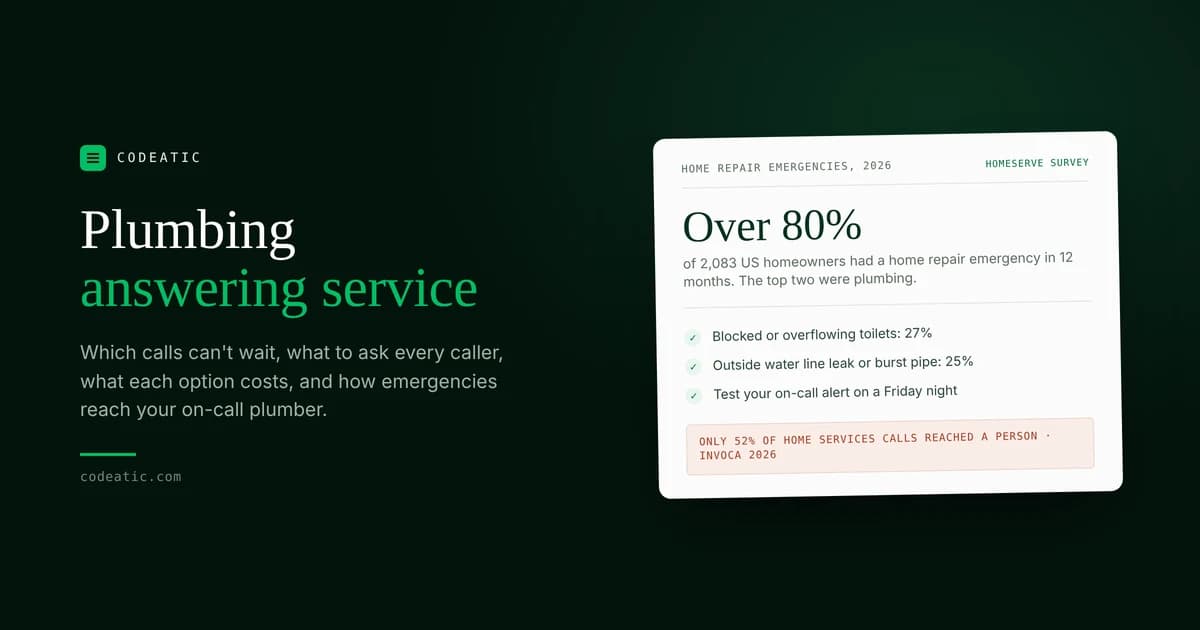
Plumbing gets more than its share of urgent ones. In HomeServe's 2026 survey of 2,083 US homeowners, more than 80% had at least one home repair emergency in the past 12 months, and the two most common were both plumbing: blocked or overflowing toilets at 27%, and an outside water line leak or burst pipe at 25%.
Which plumbing calls can't wait for a callback?
Anything involving gas, water that won't stop, sewage, or a home with no water at all. Those need action on the call. A dripping faucet, a water heater quote or a remodel enquiry can be booked for the next open slot.
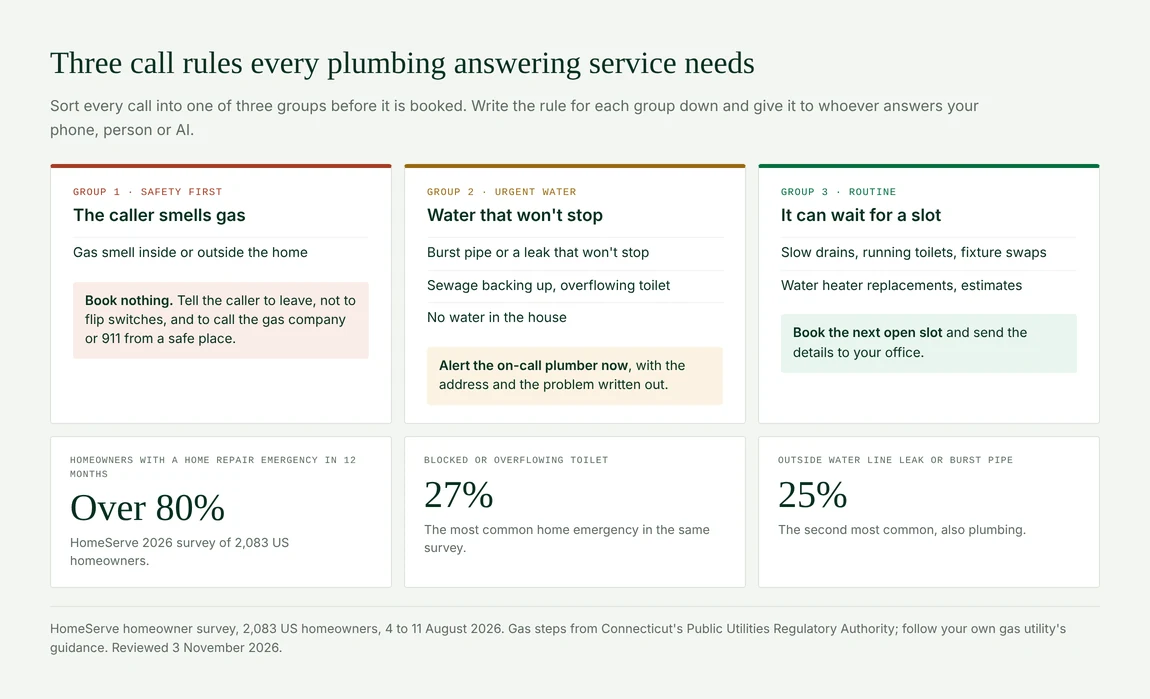
Sort every call into one of three groups and give each a rule:
- Safety first: the caller smells gas. The service should not book anything. Connecticut's utility regulator, like most gas utilities, tells people to leave the building and call the gas company or 911 from a safe place, and not to flip switches on the way out.
- Urgent water: a burst pipe, a leak that won't stop, sewage backing up, an overflowing toilet, or no water in the house. These go to your on-call plumber right away.
- Routine: slow drains, running toilets, fixture swaps, water heater replacements, estimates. Book the visit and send the details to your office.
Write these rules down before you hire anyone. A service can only follow the rules you give it.
What should a plumbing answering service ask callers?
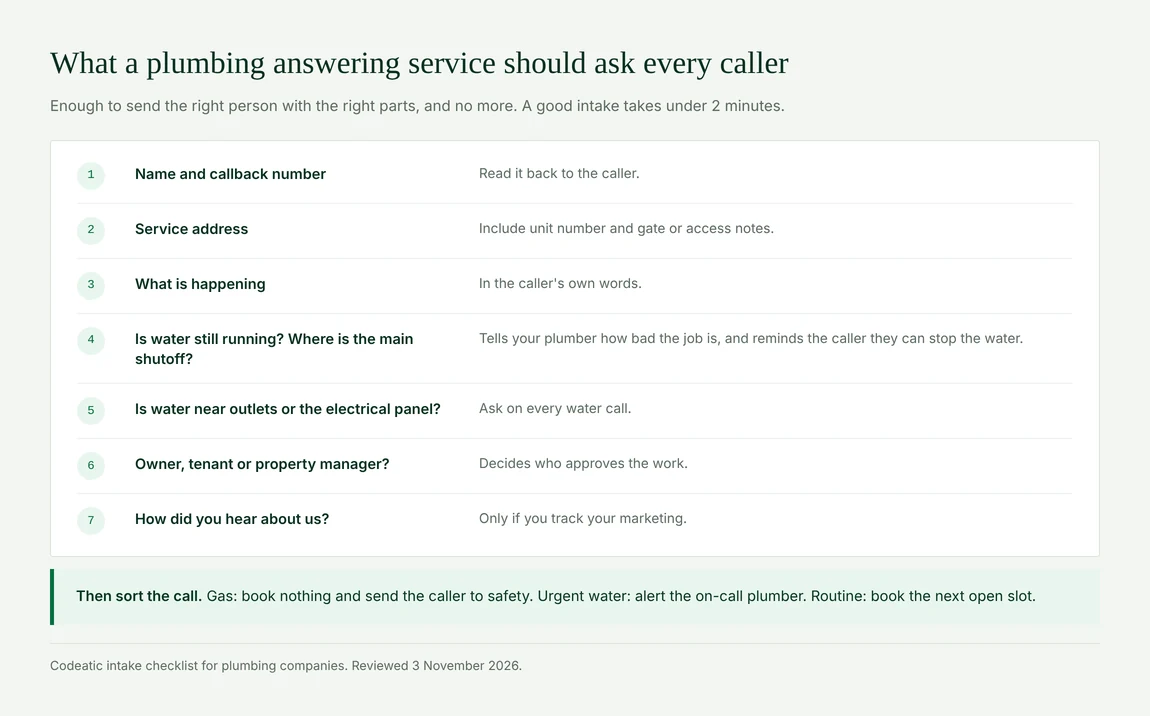
Enough to send the right person with the right parts, and no more. A good intake takes under 2 minutes and covers:
- Name and a callback number, read back to the caller.
- Service address, including unit number and gate or access notes.
- What is happening, in the caller's own words.
- Whether water is still running, and whether they know where the main shutoff is.
- Whether any water is near electrical outlets or the electrical panel.
- Whether they are the owner, a tenant or a property manager, since that decides who approves the work.
- How they heard about you, if you track your marketing.
The shutoff question does two jobs. It tells your plumber how bad the job is before they leave, and it reminds a panicking caller that they can stop the water themselves.
How much does a plumbing answering service cost?
A live service such as PATLive publishes plans from $1.49 to $2.99 a minute, while AI answering services start at $25 to $79 a month. Prices below were taken from each company's own pricing page.
| Option | Published price | Note |
|---|---|---|
| PATLive, live receptionists | $99 a month for 50 minutes, then $2.29 a minute; $2.99 a minute pay as you go; $1.49 at 5,000 minutes | States it does not use AI |
| Quo Sona, AI | $25 a month for 40 calls, then $1 a call | Billed per call |
| Dialzara, AI | $29 a month for 60 minutes | Call transfer only on its $349 plan |
| RingCentral AI Receptionist | $49 a month for 100 minutes, then $0.50 a minute | Built around its own phone system |
| Rosie, AI | $49 a month for 250 minutes | Calendar booking starts on its $149 plan |
| In-house receptionist | US median $38,010 a year, or $18.27 an hour | Bureau of Labor Statistics, May 2025, before benefits; one shift only |
Check what the entry plan actually does. Several AI products only text the caller a booking link on their cheapest tier, and live services bill every minute an operator spends on the call, including the ones that turn out to be a wrong number or a sales pitch. For the full side by side, see our comparison of AI receptionists, answering services and hiring a receptionist.
Should a plumber use a live answering service or an AI receptionist?
A live service handles upset and unusual callers better. An AI receptionist costs far less per call, answers several calls at once, and books straight into your schedule. Many owners end up using both.
That is the pattern in a Jobber community thread where home service owners compared their setups. Most keep a person answering during business hours and use AI for nights, weekends and overflow. One owner put it plainly: "AI works fine for after-hours, basic routing, and spam filtering." Another said that in home services, friction equals lost sales, which is why the daytime phone stayed with a person.
A rough rule: if most of your missed calls come after hours, start with AI there. If you miss calls during the day because the office is overloaded, an overflow setup that answers only during your busiest hours is worth testing.
How should emergency calls reach the on-call plumber after hours?
The service should alert the on-call plumber directly, by text or a call, within a minute of hanging up, with the address and the problem already written out. A note in a shared inbox that someone reads at 7 in the morning is not an emergency process.
Set three things before go-live: who is on call each night, how they get alerted, and what the caller is told about when to expect a callback. Then test it yourself on a Friday night. Plumber magazine's September 2026 piece on after-hours calls suggested a simple check: ask what happens to a call at 9 p.m. on a Friday, and if the answer is voicemail, look again.
Call your own number after hours, say there is water coming through the kitchen ceiling, and time how long it takes your on-call plumber to hear about it.
What goes wrong with plumbing answering services?
Wrong bookings, details that don't reach your software, and urgent calls treated like routine ones. The same Jobber thread lists the failures owners hit:
- Bookings and records that didn't match existing customers, so the office had to clean them up.
- Older customers confused by an AI on the line. One tree service owner switched theirs off and went back to voicemail with transcripts.
- Weak handling of urgent calls, the main reason several owners keep a person on the phone during the day.
Live services have their own version: operators who read a script and take a message instead of booking, and per-minute bills that climb with spam calls. Whichever you choose, run a trial on your own line before committing, and listen to the recordings from the first week.
What should you ask a plumbing answering service before you sign?
- Does it book into my schedule, or only take messages?
- How does it alert my on-call plumber, and how fast?
- What does it tell a caller who smells gas?
- Can I set different rules for business hours, nights and weekends?
- Does it keep my existing business number?
- What does a spam call or a wrong number cost me?
- Where do call recordings and summaries go, and who can read them?
- Can I try it on my own line before paying?
How Codeatic sets it up for plumbing companies
Codeatic builds AI receptionists and workflow automation for service businesses in the US and Canada. Our AI receptionist is already answering calls in US auto repair shops and is ready to deploy for plumbing companies.
It answers in your company's name on your existing number, during whatever hours you choose: after hours, your busiest hours, Saturdays or around the clock. It books jobs into your calendar, a built-in booking calendar, or a CRM such as HubSpot. For urgent calls you set the rule: it can text your on-call plumber directly, flag the call for your team, book the earliest open slot, or do more than one of those. A caller who asks for a person gets a callback request sent to your team with their details. If someone reports a dangerous situation, emergency mode tells them to get safe and call 911 first. Every morning you get a summary of what came in overnight.
From our work: we shipped voice agents for Ziltrix, a security company client, to take over shift-reminder calls that 8 people used to make. The team went from 8 to 1, coverage went from 12 hours to 24/7, and it was live in 4 weeks.
If you want to hear it handle a burst pipe call for your company, get in touch and we will set up a demo on your own scenarios. For a broader look at what else in your business could run on its own, try the free automation audit, which takes about 2 minutes. Our guide to AI receptionist pricing covers what the wider market charges.
The short version
- Home service businesses miss calls often: 14% in CallRail's data, and only 52% of calls reached a person in Invoca's 2026 benchmarks.
- The two most common home emergencies in 2026 were plumbing: overflowing toilets at 27% and burst pipes or water line leaks at 25%.
- Set three call rules before hiring anyone: gas, urgent water, routine.
- PATLive's live plans run $1.49 to $2.99 a minute; AI services start at $25 to $79 a month.
- Many owners keep a person on the phone by day and use AI after hours.
- Test the on-call alert yourself on a Friday night before you trust it.
How these figures were arrived at
Emergency figures are from HomeServe's 2026 homeowner survey, 2,083 US homeowners surveyed 4 to 11 August 2026. Missed call figures are from CallRail's January 2025 report on 1.1 million conversations and Invoca's July 2026 home services benchmarks; both companies sell call tracking. Prices are from PATLive, Quo and the other vendors' own pricing pages, checked between 28 October and 3 November 2026, and the wage figure from the US Bureau of Labor Statistics. Owner experiences are from a Jobber community discussion. Gas safety steps are from Connecticut's Public Utilities Regulatory Authority; follow your own gas utility's guidance. The after-hours check is from Plumber magazine, September 2026, written by the founder of an AI voice company.
Everything here is dated to 3 November 2026. Prices in this market change often. If you find an error, tell us and we will correct the post and note the correction.
Frequently asked questions
What is a plumbing answering service?
A service that answers a plumbing company's phone when the team can't, takes the caller's details, books routine jobs and sends emergencies to the on-call plumber. It can be staffed by people or run by AI, and most companies use it after hours, for overflow, or both.
How much does a plumbing answering service cost?
PATLive, a live service, publishes plans from $1.49 to $2.99 a minute, starting at $99 a month for 50 minutes. AI answering services start at $25 to $79 a month, with booking and call transfer often on higher tiers.
Is there an AI answering service for plumbers?
Yes. AI receptionists answer in the company's name, take the job details, book into the schedule and alert the on-call plumber about emergencies. Check that the plan you're quoted books jobs rather than only texting the caller a link.
Do I need a 24/7 plumbing answering service?
If you take emergency work, yes, or at least an after-hours one. Burst pipes and overflowing toilets were the two most common home emergencies in HomeServe's 2026 survey, and they don't keep business hours.
What should an answering service do when a caller smells gas?
Not book a visit. It should tell the caller to leave the building, avoid light switches, and call the gas company or 911 from a safe place, following the local utility's guidance.
Can an answering service book jobs into my schedule?
Many can, but not on every plan. Some live services only take messages, and some AI services only text the caller a booking link on their entry tier. Ask which one you are getting before you sign.
Will I keep my business phone number?
You should. Call forwarding sends your calls to the service during the hours you choose, so customers keep calling the number they already know. Ask any service whether it works by forwarding or needs a new number.
Should I use a live answering service or an AI receptionist?
Many plumbing companies use both: a person during business hours, when calls are more complex, and AI at night and on weekends. Pick based on when you miss calls, then test it on your own line.